
Navigating the world of video formats can feel overwhelming, especially when faced with acronyms like AVI and WMV. Both were developed by Microsoft, yet they serve vastly different purposes. Choosing the wrong one can lead to playback issues, unnecessarily large files, or a loss of quality. Understanding the core differences between AVI vs WMV is crucial for anyone from students and office workers to professional content creators. This guide will demystify these two formats, helping you make an informed decision for your specific video needs.
In this article, you will learn:
- What AVI and WMV files are and their origins.
- A quick side-by-side comparison of their key features.
- A detailed breakdown of how they stack up in terms of file size, quality, and compatibility.
- The best use cases for both AVI and WMV formats.
- How to easily convert between formats using a simple, step-by-step guide.
In this article
Part 1. What is AVI? What is WMV?
Before diving into a direct comparison, it's important to understand what each format is on its own. Both have a long history and were designed with different goals in mind.
What is an AVI File?
AVI stands for Audio Video Interleave. Developed by Microsoft way back in 1992, it's one of the oldest and most established video container formats. Think of a container format like a box: it doesn't dictate what's inside, but it holds everything together. An AVI file can contain both video and audio data, using a wide variety of codecs (compression/decompression algorithms) to encode that data.
Because it can use codecs that apply very little or no compression, AVI is renowned for its high, often lossless, quality. This makes it a favorite for archiving and professional editing. However, this quality comes at a cost: AVI files are notoriously large, which can make them difficult to store and share.
What is a WMV File?
WMV, which stands for Windows Media Video, is another format developed by Microsoft. Unlike AVI, which is a container, WMV is primarily a video compression format. It was created specifically for web streaming and video playback on Windows-based systems.
The main goal of WMV is to achieve a good balance between video quality and file size. It uses advanced, lossy compression techniques to significantly reduce the amount of data needed to store a video. This results in much smaller files compared to AVI, making WMV an excellent choice for sharing videos online, sending them via email, or saving storage space on your hard drive.
Part 2. Quick Comparison Table
For a quick overview, here is a side-by-side comparison of the most important attributes of AVI and WMV.
| Feature | AVI (Audio Video Interleave) | WMV (Windows Media Video) |
| Developer | Microsoft | Microsoft |
| Compression | Low to none (depends on codec) | High (lossy) |
| File Size | Large to very large | Small to medium |
| Quality | Very high to lossless | Good to very good |
| Compatibility | Broad, but may require specific codecs | Best on Windows, limited on other OS |
| Primary Use | High-quality editing and archiving | Web streaming and file sharing |
Part 3. AVI vs WMV: Which One Is Better?
The question of which format is "better" depends entirely on what you want to achieve. Let's break down the comparison across three critical factors: file size, quality, and compatibility.
File Size and Compression Efficiency
This is where the most significant difference between the two formats lies. WMV was built for efficiency. It uses powerful compression algorithms to drastically shrink video file sizes. For a video of the same length and resolution, a WMV file will be a fraction of the size of a typical AVI file. This makes WMV the undisputed champion for any scenario where file size is a major concern, such as streaming over a slow internet connection or attaching a video to an email.
AVI, on the other hand, prioritizes quality over size. When using uncompressed or lossless codecs, AVI files retain all the original video data. This results in massive files that can quickly fill up a hard drive. While you can use more aggressive compression codecs within an AVI container, the format itself is not inherently optimized for small file sizes in the way WMV is.
Video and Audio Quality
When it comes to pure, unadulterated quality, AVI has the upper hand. Because it can house video data with minimal or even zero compression, it is capable of producing a mathematically perfect, lossless copy of the source footage. This is why professionals often use AVI for "master copies" of their edited projects. Every pixel is preserved, which is essential for further editing, color grading, or special effects work.
WMV uses lossy compression, which means it strategically discards some video data to reduce the file size. While modern WMV codecs are very intelligent about this process and can produce excellent visual quality for the file size, it is not lossless. For the average viewer watching on a laptop or phone, the difference might be unnoticeable. However, for a trained eye or in a professional workflow, the pristine quality of a lossless AVI is superior.
Platform Compatibility
Both formats were created by Microsoft, but their compatibility profiles differ. AVI, due to its age and widespread use, enjoys broad support across many media players on both Windows and macOS. However, there's a significant catch: playback depends on the specific codec used to create the file. If your system doesn't have the right codec installed, the AVI file won't play, or you might only get audio with a black screen.
WMV is native to the Windows ecosystem. It plays flawlessly on any Windows PC using Windows Media Player right out of the box. However, its compatibility on other platforms is limited. On macOS and Linux, you'll need to install third-party software, such as the VLC media player, to watch WMV files. This lack of native cross-platform support can be a major hurdle if you're sharing content with a diverse audience.
The Verdict: Which Format Wins?
There is no single winner; the best format is the one that fits your task.
- For Archiving and Editing: AVI is the winner. Its ability to store video with minimal to no quality loss makes it the ideal choice for preserving master copies and for use in demanding, multi-stage editing workflows where maintaining maximum quality is paramount.
- For Streaming and Sharing: WMV is the clear choice. Its excellent compression results in small, manageable file sizes that are perfect for uploading to the web, sending via email, or saving space on your device, especially within a Windows environment.
Part 4. Use Cases for AVI and B
To make the choice even clearer, let's look at some practical, real-world scenarios where you would choose one format over the other.
Common Use Cases for AVI
- Storing Master Copies: After finishing a major video project, editors often export a master file in a lossless AVI format. This file serves as the ultimate high-quality archive of their work.
- Professional Editing Workflows: When a video needs to pass through multiple stages of editing, effects, and color correction, using a lossless AVI ensures that no quality is degraded between steps.
- High-Quality Short Clips: For short video clips used in presentations or as source material where file size is not a constraint, AVI can provide the best possible visual fidelity.
Common Use Cases for WMV
- Embedding Videos on Websites: WMV's small file size makes it suitable for embedding directly into a webpage, allowing for faster loading times for visitors.
- Sending Videos as Email Attachments: Many email services have strict limits on attachment size. Converting a video to WMV can often shrink it enough to be sent directly.
- Streaming Content Over Limited Bandwidth: For streaming video in situations where internet speed is a concern, the efficiency of WMV helps ensure smoother playback with less buffering.
- Saving Storage Space: If you have a large library of videos on your Windows PC or tablet, storing them in the WMV format can save a significant amount of disk space compared to formats like AVI.
Part 5. Step-by-Step Guide to Convert AVI to WMV Using UniConverter
What if you have a high-quality AVI master file but need to share it online? This is a perfect scenario for converting your file. A reliable video converter is essential to bridge the gap between AVI's quality and WMV's efficiency. Wondershare UniConverter is a powerful yet user-friendly tool that makes this process fast and simple, ensuring your converted video looks great.
How to Convert AVI to WMV in 4 Simple Steps
Follow these steps to turn your large AVI file into a web-friendly WMV.
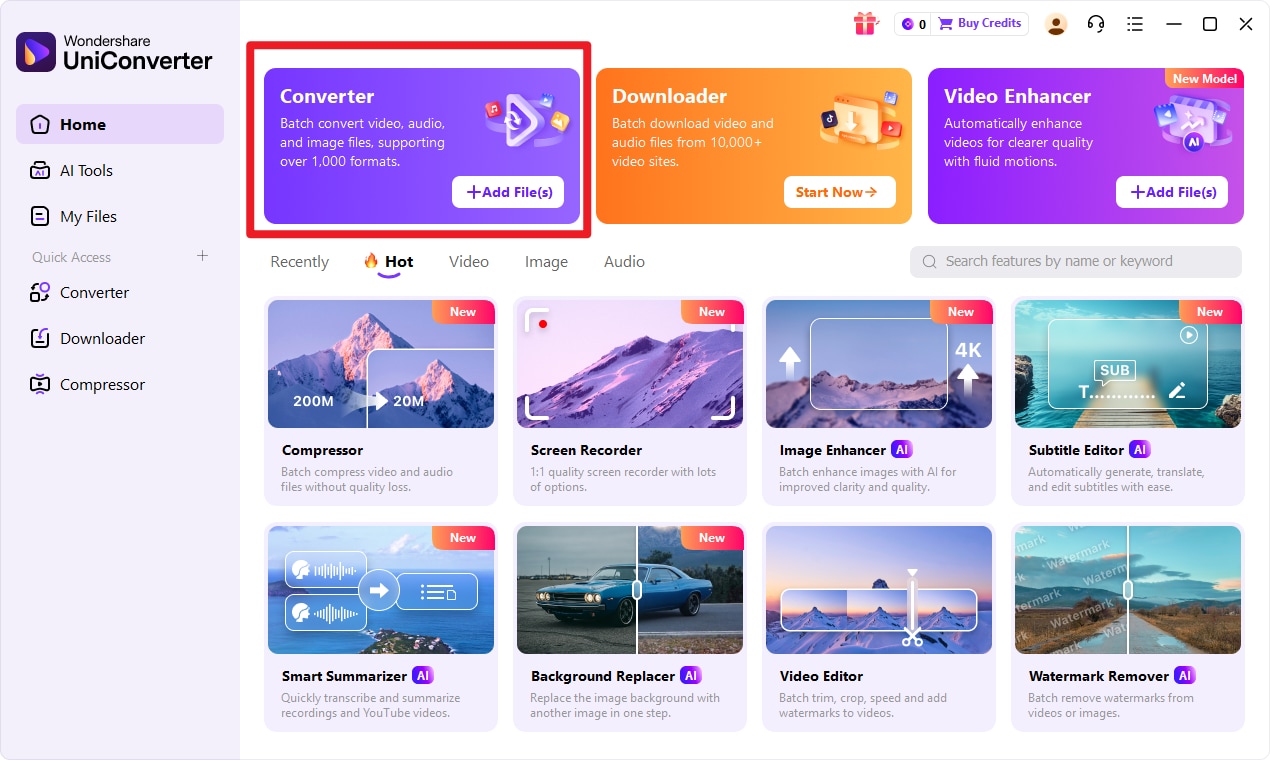
Step 1: Launch Wondershare UniConverter
Launch Wondershare UniConverter on your computer. In the main interface, ensure you are on the Converter tab from the left-hand menu.
Step 2: Add Files to UniConverter
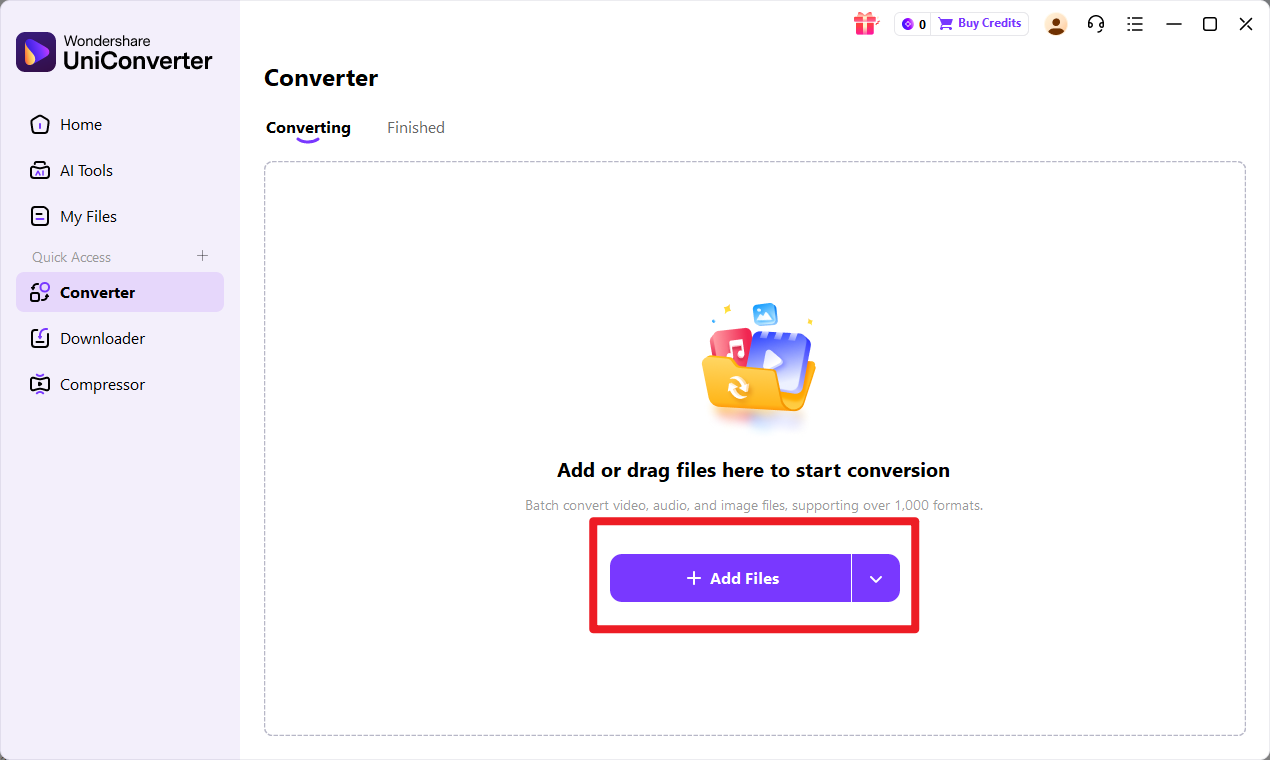
You can either drag and drop your AVI file directly into the program window or click the Add Files button to browse your computer and import it.
Step 3: Choose Output Format
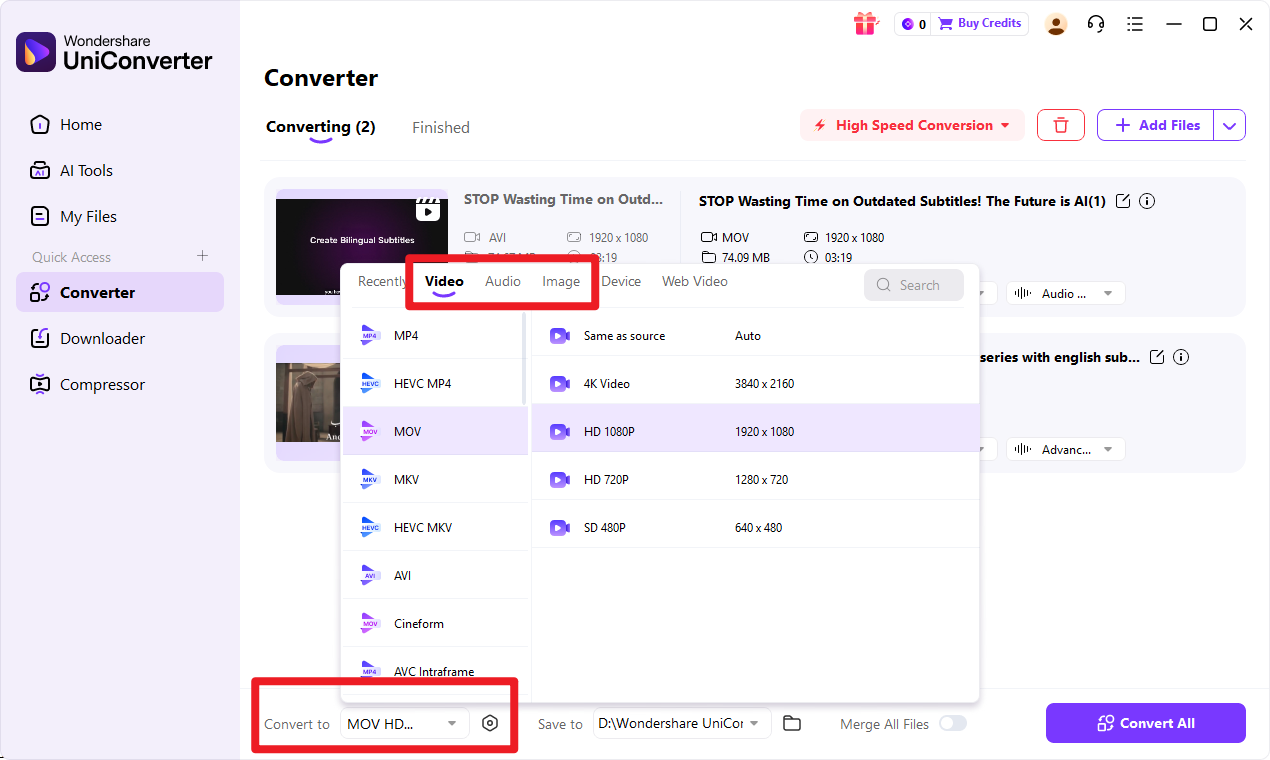
Click on the Output Format menu located at the bottom of the window. A new dialog box will appear. Go to the Video tab, select WMV from the list of formats on the left, and then choose your desired output resolution from the options on the right (e.g., "Same as source" to maintain the original resolution).
Step 4: Start the Conversion
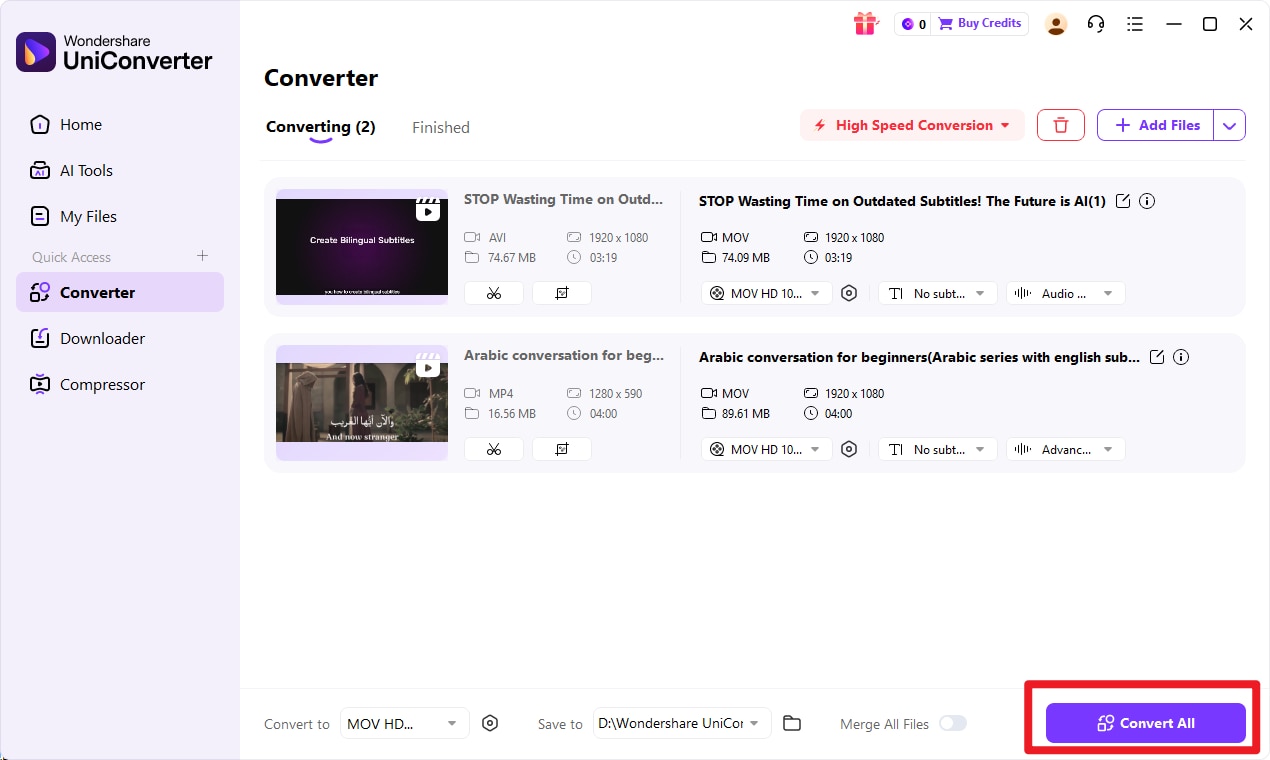
Before starting, you can specify where to save your new file. Use the File Location field at the bottom of the main screen to select a destination folder on your computer. Once you're ready, click the Convert button next to your file. If you've added multiple files to convert at once, you can click the Start All button in the bottom-right corner.
UniConverter will process your file at high speed. Once the conversion is complete, you can find your new WMV file in two ways: either by navigating to the output folder you selected in the previous step or by clicking on the Finished tab at the top of the UniConverter window to see a list of all your completed conversions.

Go Beyond Simple Video Conversion
FAQs
-
1. Is WMV always smaller than AVI?
Yes, for a video of the same length and resolution, a WMV file will almost always be significantly smaller than an AVI file. This is because WMV was designed with modern, efficient compression methods, whereas AVI often uses older codecs that result in much larger files to preserve quality. -
2. Will I lose quality when converting AVI to WMV?
Since WMV is a lossy format, some data is technically lost during the conversion from a lossless AVI. However, with a high-quality program like UniConverter, you can control the output settings (like bitrate and resolution) to minimize this loss. For most viewing purposes, such as on a website or social media, the difference in quality is negligible to the human eye. -
3. Can I play a WMV file on my Mac?
Natively, macOS does not support WMV files. If you try to open one with QuickTime Player, it won't work. To play them, you need to either install a third-party media player that supports the format (like VLC) or use a converter like UniConverter to change the WMV file into a Mac-compatible format like MP4 or MOV. -
4. Is AVI or WMV better for YouTube?
Neither format is considered ideal for YouTube today. While YouTube accepts both, AVI files are generally too large for efficient uploading, and WMV is not as universally compatible as other formats. The recommended format for YouTube is MP4 with an H.264 video codec and AAC audio codec. You can easily create this optimal file by converting your AVI or WMV video using UniConverter.
Conclusion
Choosing between AVI vs WMV is a practical decision that depends entirely on your specific goal. AVI stands as the champion for quality and professional editing, making it the go-to format for archiving master files and complex post-production work. In contrast, WMV excels in efficiency, offering impressively small file sizes that are perfect for web streaming, emailing, and general use on Windows devices. Neither format is universally superior, but understanding their distinct strengths and weaknesses empowers you to pick the right tool for the job. For those inevitable moments when you need to switch between them or convert to a more universal format, a versatile tool like Wondershare UniConverter provides a seamless, high-quality, and straightforward solution.
