
Navigating the world of video formats can often feel like deciphering a complex code. You might have a video file that plays perfectly on your TV but refuses to open on your laptop, or you might be wondering which format offers the best balance of quality and file size. Two formats that frequently cause this kind of confusion are AVI and TS. While both are containers for video and audio data, they were designed for vastly different purposes, leading to significant differences in compatibility, performance, and use cases. Understanding the core distinctions in the AVI vs TS debate is crucial for anyone who works with digital video, from content creators to casual users archiving their favorite TV shows.
This guide will provide a comprehensive breakdown of AVI and TS formats. We will demystify their technical aspects, compare them across key metrics like quality and compatibility, and help you determine which one is the right choice for your specific needs. We'll also show you how to effortlessly convert between them, ensuring your media is always ready for any device or platform.
In this article:
Part 1. What is AVI? What is TS?
Before we dive into a head-to-head comparison, it's essential to understand what each format is and what it was designed to do. Both are container formats, meaning they are like digital boxes that can hold various types of video and audio data, which are compressed using different codecs.
What is an AVI File?
AVI stands for Audio Video Interleave. Introduced by Microsoft in 1992 as part of its Video for Windows technology, AVI is one of the oldest and most established video container formats. Its primary function is to "interleave" audio and video data together into a single file for synchronous playback. Think of it as a versatile digital wrapper that can contain video compressed with a wide variety of codecs, such as DivX, XviD, and MJPEG.
For decades, AVI was the de facto standard for standard-definition video on Windows-based computers. Its long history has given it remarkable compatibility with a vast range of media players, older editing software, and legacy devices. While it has been surpassed by more modern formats in terms of features and efficiency, its simplicity and widespread recognition keep it relevant for certain applications.
What is a TS File?
TS stands for Transport Stream, or more formally, MPEG Transport Stream. As the name suggests, this format was specifically designed for "transport"—that is, for transmission of audio, video, and data over potentially unreliable networks. It is the standard format used in digital broadcasting systems like DVB (Digital Video Broadcasting), ATSC (Advanced Television Systems Committee), and IPTV (Internet Protocol Television). You'll also find TS files on Blu-ray discs.
The key feature of a TS file is its robustness. It breaks the media stream into small, fixed-size packets. Each packet contains synchronization and error-correction information, which allows a decoder to handle data loss or corruption without losing the entire stream. This makes it exceptionally well-suited for live broadcasting and streaming, where a stable, uninterrupted viewing experience is paramount.
Part 2. Quick Comparison Table
To get a quick overview of the key differences between AVI and TS, here is a side-by-side comparison table.
| Feature | AVI (Audio Video Interleave) | TS (MPEG Transport Stream) |
| Full Name | Audio Video Interleave | MPEG Transport Stream |
| Primary Use | General-purpose video storage and playback | Digital broadcasting, streaming, and Blu-ray authoring |
| Compatibility | Very high on PCs and legacy devices; less on modern mobile | High on modern TVs, set-top boxes, and broadcast-related software |
| Streaming | Not optimized for streaming; requires full download | Designed specifically for streaming with robust error correction |
| Error Resilience | Low; file corruption can make the entire file unplayable | High; packet-based structure allows for recovery from data loss |
| Codec Support | Good support for older codecs (DivX, XviD), limited for new ones | Excellent support for modern codecs like H.264/AVC and H.265/HEVC |
Part 3. AVI vs TS: Which One Is Better?
There is no single "better" format; the right choice depends entirely on your goal. Let's break down their performance in four critical areas: compatibility, quality, file size, and usability for streaming and editing.
Compatibility and Playback
When it comes to playing a video file, compatibility is king. Here, the age and purpose of each format play a significant role.
- AVI: Thanks to its long history, AVI boasts incredible legacy support. It is almost universally playable on Windows PCs, and most desktop media players can handle it without any extra codecs. Many older DVD players and media devices also list AVI as a supported format. However, its support on modern mobile devices and macOS can be spotty without a third-party player like VLC.
- TS: As the standard for digital television, TS files are natively supported by virtually all modern smart TVs, set-top boxes, and Blu-ray players. If you've recorded a show from your TV's digital tuner, it will be in a TS container. On computers, modern media players handle TS files well, but some older or more basic players might struggle.
Verdict: For broad compatibility across older hardware and Windows PCs, AVI has a slight edge. For content destined for modern TVs and broadcast systems, TS is the native and superior choice.
Quality and Compression
A common misconception is that the container format itself dictates the video quality. In reality, the quality is determined by the codec used to compress the video and the bitrate at which it's encoded. The container's role is to hold this data.
- TS: This format was designed in an era of high-definition video. It is perfectly suited to carry video streams compressed with modern, highly efficient codecs like H.264 (AVC) and H.265 (HEVC). These codecs are the standard for HD, Full HD, and 4K content, delivering exceptional quality at manageable bitrates.
- AVI: While AVI can technically hold video compressed with newer codecs, it wasn't designed for them. It lacks native support for features like B-frames, which are crucial for the efficiency of modern codecs. As a result, AVI is more commonly associated with older codecs like DivX and XviD, which are less efficient for high-definition content.
Verdict: For high-definition video, TS is the better choice as it is optimized for the modern codecs that deliver the best quality.
File Size
Like quality, file size is not a direct property of the container but a result of the codec and bitrate. A higher bitrate generally means better quality but a larger file, and vice versa.
- An unprocessed TS stream recorded directly from a broadcast can be very large because it often contains multiple audio tracks, subtitles, and other data, and may be encoded at a high bitrate.
- However, if you take the same source video and encode it, a TS file using an efficient H.264 codec will typically be smaller than an AVI file of similar visual quality that uses an older DivX codec. The modern compression technology supported by TS allows for better quality in a smaller package.
Verdict: Assuming modern codecs are used, TS has the potential to offer a better quality-to-size ratio. If you have large, raw TS files, you can significantly reduce their size without a noticeable quality drop by re-encoding them with a tool like Wondershare UniConverter.
Streaming and Editing
The structural differences between AVI and TS have a massive impact on their suitability for streaming and editing.
- Streaming: TS is the undisputed champion here. Its packet-based structure and error-correction mechanisms are precisely what's needed for streaming over networks like the internet or a broadcast signal. If a few packets are lost during transmission, the player can quickly resynchronize and continue playback with minimal disruption. AVI, on the other hand, is not designed for streaming. It typically needs to be downloaded completely before playback can begin, as its index is often located at the end of the file.
- Editing: Both formats can be imported into video editing software. However, AVI's simpler structure often makes it easier for consumer-level editors to handle. The complex, multi-stream nature of TS files can sometimes cause issues with audio sync or performance in non-professional editing programs. For this reason, it's a common workflow for editors to convert TS files to a more edit-friendly format before starting a project.
Verdict: TS is the only viable option for reliable streaming. For editing, AVI can be simpler to work with, but converting TS files for editing is a straightforward solution.
Part 4. Use Cases for AVI and TS
Based on the comparison above, here are the practical scenarios where you would choose one format over the other.
When to Use AVI
- Legacy Device Playback: If you need to create a video that will play on a very old DVD player, a digital photo frame, or an outdated media device, AVI is often a safe bet.
- Simple Video Projects: When working with older or basic video editing software that has strong native AVI support, keeping your files in this format can simplify the workflow.
- Archiving Standard-Definition Content: For storing older, standard-definition videos where modern features aren't necessary, AVI serves as a simple and widely recognized container.
When to Use TS
- Recording Digital TV: This is the primary use case. Any content recorded from an over-the-air broadcast, cable, or satellite TV will be in a TS format.
- Streaming Over a Network: If you are setting up a local media server or streaming video over any network where packet loss is a possibility, TS provides the necessary resilience for a smooth experience.
- Authoring Blu-ray Discs: The Blu-ray Disc standard (BDMV) uses the MPEG-2 Transport Stream for its video content.
- Preserving Original Quality: When you want to keep the pristine, original stream from a source like a high-end camcorder or a digital broadcast feed with all its accompanying data (multiple audio tracks, subtitles, etc.), you should keep it as a TS file.
Part 5. Step-by-Step Guide to Convert AVI to TS Using UniConverter
Whether you need to convert a bulky TS recording into a more compatible format or turn an old AVI file into a streamable TS file, a reliable video converter is an indispensable tool. Wondershare UniConverter is a comprehensive video toolbox that excels at this task. It supports over 1,000 formats, including AVI and TS, and uses GPU acceleration to deliver blazing-fast conversions without compromising quality.
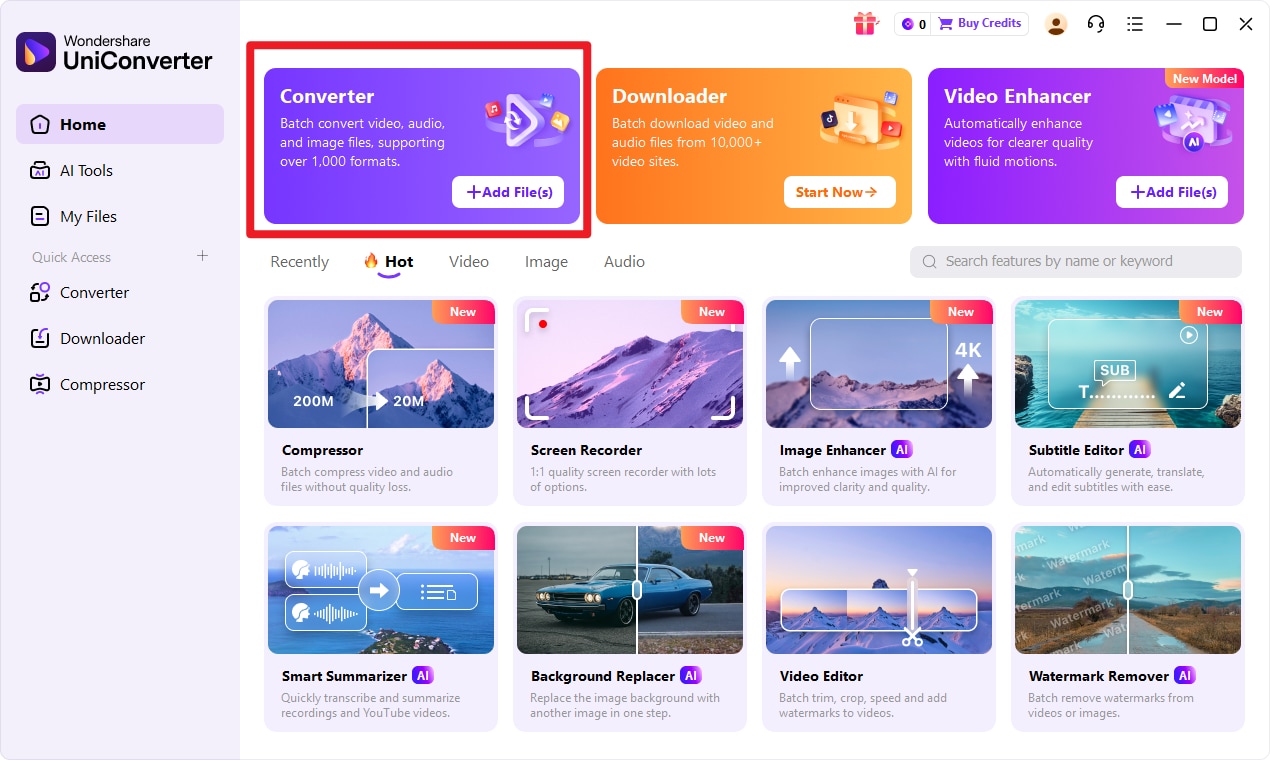
Step 1. Choose Converter in UniConverter
Launch Wondershare UniConverter on your computer. From the home screen, navigate to the left-side menu and select the Converter tool.
Step 2. Add Files to UniConverter
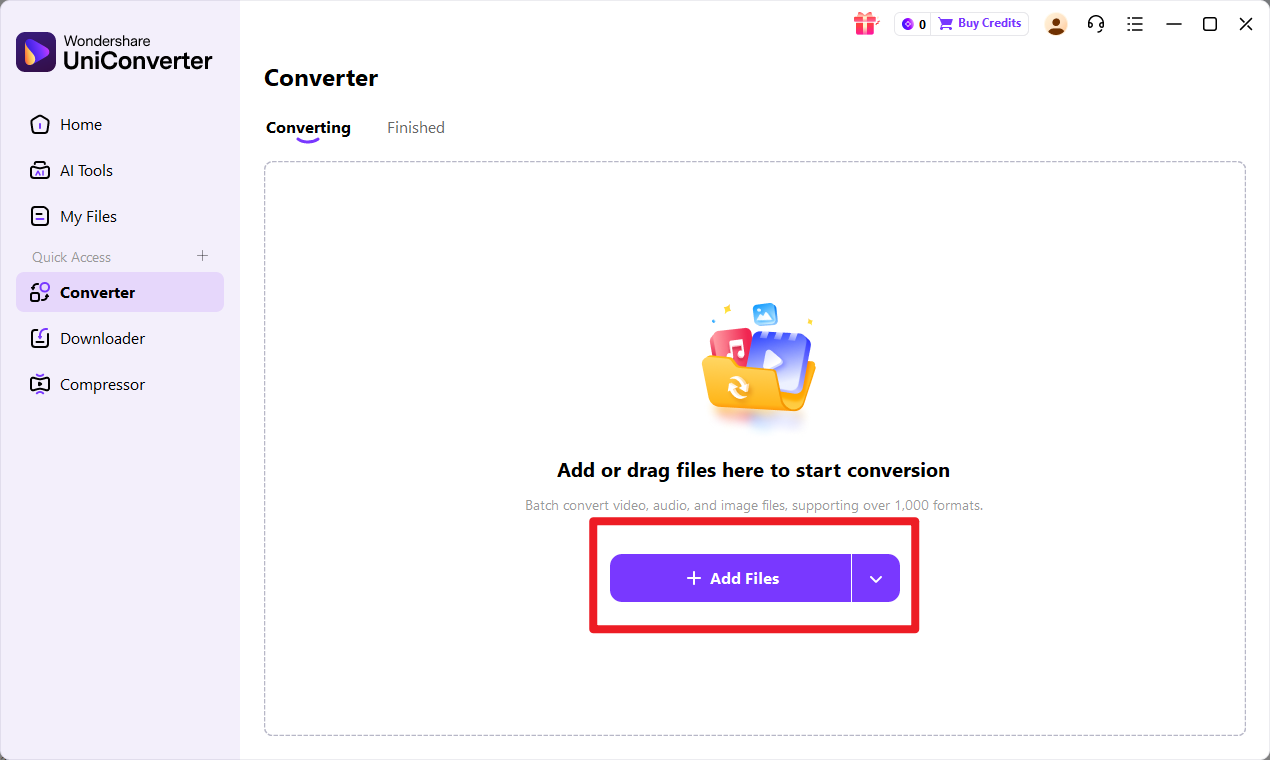
In the Converter window, you can either click the Add Files button to browse for your input format files or simply drag and drop them directly onto the interface. UniConverter supports batch conversion, so feel free to add multiple files at once.
Step 3. Choose Output Format
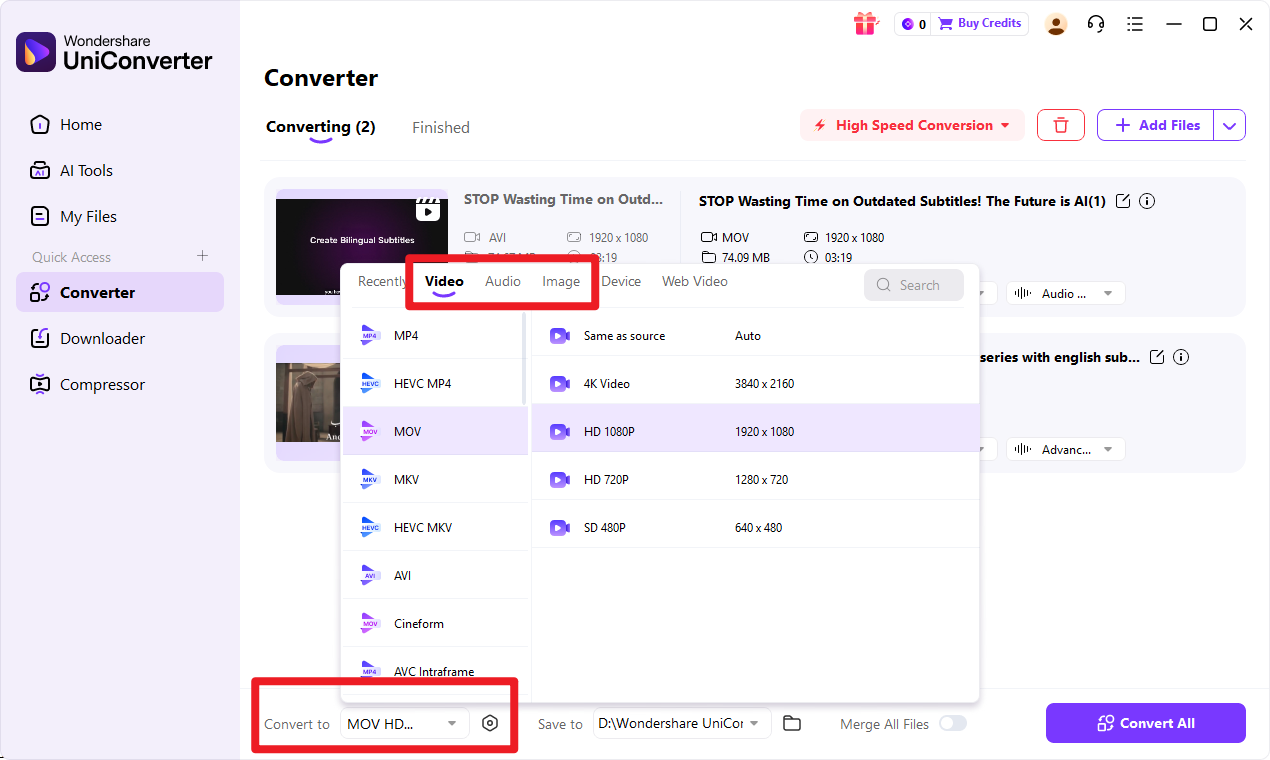
At the bottom of the window, click on the Output Format menu. A new window will appear. Select the Video tab, and from the list on the left, choose your desired target format. On the right, you can select the specific resolution or choose "Same as source" to maintain the original quality.
Step 4. Start the Conversion
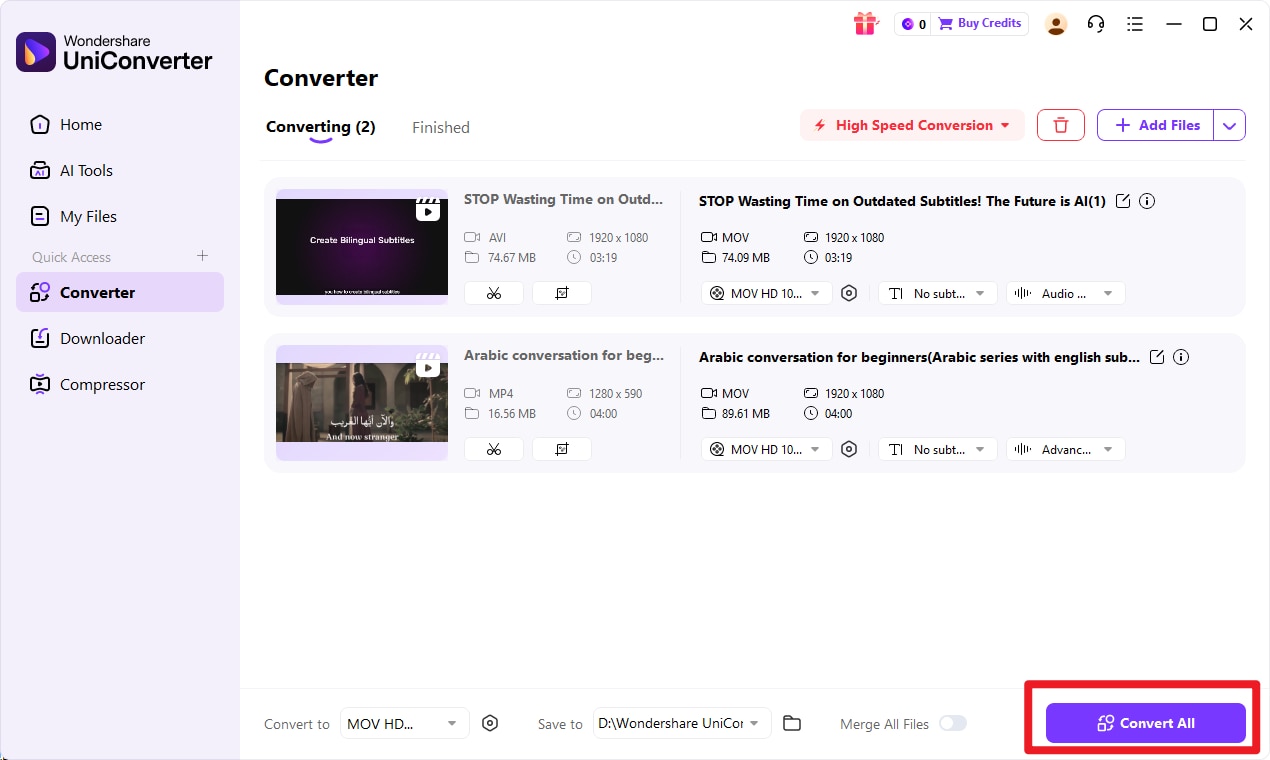
Before starting, you can specify where to save the converted files by using the File Location field at the bottom. Once you are ready, click the Start All button to begin the conversion process. Your files will be converted to the target format quickly and saved to your chosen folder.

Your Complete Video Conversion and Editing Toolbox
Conclusion
Choosing between AVI and TS is a matter of matching the format to the mission. AVI stands as a testament to legacy compatibility, a reliable choice for playback on older systems and for simple editing workflows. In contrast, TS is the modern workhorse of digital broadcasting and streaming, offering superior error resilience, support for multiple data streams, and optimization for the efficient, high-definition codecs that power today's media landscape. Ultimately, there is no universally "better" format—only the format that is best suited for your specific task.
For true media freedom and to eliminate any compatibility headaches, the best solution is to have a powerful conversion tool at your disposal. With Wondershare UniConverter, you can seamlessly bridge the gap between AVI, TS, and a thousand other formats. This ensures your videos are always in the perfect format for any device, platform, or project, giving you ultimate control over your digital media.
FAQs
-
1. Is AVI or TS better for quality?
The quality of a video is not determined by the container (AVI or TS) but by the codec (e.g., H.264, DivX) and the bitrate used during compression. However, TS has better support for modern and efficient codecs like H.264 and H.265, which are standard for HD and 4K content. Therefore, for high-definition video, TS is generally the more capable container for achieving the best quality. -
2. Can I play TS files on my computer?
Yes, absolutely. Most modern media players can play TS files without any issues. Popular software like VLC Media Player, PotPlayer, and the latest versions of Windows Media Player and QuickTime (with appropriate components) all have built-in support for the TS format. -
3. Why would I need to convert a TS file?
There are several common reasons to convert a TS file. You might want to convert it to a more universally compatible format like MP4 for playback on a smartphone or tablet. You may also need to convert it to make it easier to edit in certain video editing programs, or you might want to compress it to a smaller file size for easier sharing or archiving. -
4. What is the best tool to convert AVI to TS or vice versa?
For reliable and high-quality conversions between AVI, TS, and other formats, a dedicated video converter like Wondershare UniConverter is the best choice. It offers a user-friendly interface, supports a vast library of formats and codecs, enables batch processing to convert multiple files at once, and utilizes hardware acceleration to ensure the process is as fast as possible.
