
Navigating the world of video formats can feel overwhelming. You have a video file, but you're not sure if it's in the best format for your needs. Two of the most common yet frequently confused formats are AVI and MPG. You might wonder which one offers better quality, which takes up less space, or which is more compatible with your devices. This guide is here to clear up the confusion surrounding the AVI vs MPG debate.
Understanding the core differences between these two formats is crucial whether you're a content creator, a video hobbyist, or simply someone trying to manage their digital media library. Your choice can impact everything from storage space and playback smoothness to editing flexibility. By the end of this article, you'll have a clear understanding of each format's strengths and weaknesses, empowering you to choose the right one for any task.
In this article:
Part 1. What is AVI? What is MPG?
Before we can compare AVI and MPG, it's essential to understand what each format is, how it works, and where it came from. Both have played significant roles in the history of digital video, and their foundational designs influence their modern-day applications.
What is an AVI File?
AVI stands for Audio Video Interleave. Introduced by Microsoft back in 1992 as part of its Video for Windows technology, AVI is one of the oldest and most well-known video container formats. A "container" format is like a digital box that can hold various types of data—in this case, both audio and video streams—synchronized to play together.
One of AVI's defining characteristics is its versatility with codecs. A codec (short for coder-decoder) is a piece of software that compresses and decompresses digital video. AVI files can use a vast range of codecs, from uncompressed (which stores every single frame of data) to highly compressed ones. This flexibility is both a strength and a weakness. On one hand, it allows for extremely high, even lossless, video quality, making it a favorite for professional archiving and editing. On the other hand, using less compression results in very large file sizes. Furthermore, if a device doesn't have the specific codec used to create the AVI file, it won't be able to play it, leading to the infamous "codec error."
What is an MPG File?
MPG (also seen as .mpeg) is a file format developed by the Moving Picture Experts Group, the organization responsible for setting standards for audio and video compression. Unlike AVI, which is a container that can use many different compression types, MPG files are intrinsically linked to the MPEG-1 and MPEG-2 compression standards.
These standards use a form of "lossy" compression. This means that to achieve smaller file sizes, the algorithm intelligently removes some video and audio data that is considered least perceptible to the human eye and ear. The result is a file that is significantly smaller than a comparable AVI file while still maintaining good visual quality. This efficiency made MPG the format of choice for early online video distribution and, most famously, as the standard format for video on DVDs (using the MPEG-2 standard). Its balance of quality and size makes it highly suitable for streaming, sharing, and storing large video libraries without consuming excessive disk space.
Part 2. Quick Comparison Table
To get a quick overview of the key distinctions between AVI and MPG, here is a side-by-side comparison table.
| Feature | AVI | MPG |
| Full Name | Audio Video Interleave | Moving Picture Experts Group |
| Compression | Can be uncompressed or use various lossy/lossless codecs | Uses lossy MPEG-1 or MPEG-2 compression |
| File Size | Generally larger | Generally smaller |
| Quality | Can be very high or even lossless | Good, but some quality is lost due to compression |
| Compatibility | Excellent on Windows systems, may require codecs on other platforms | Very high across most devices and platforms |
Part 3. AVI vs B: Which One Is Better?
The question of which format is "better" doesn't have a single answer. It depends entirely on your priorities. Let's break down the comparison based on the three most important factors: quality, file size, and compatibility.
Quality Comparison
When it comes to raw quality, AVI has the potential to be superior. Because the AVI container can hold uncompressed video or use lossless codecs (like Lagarith or HuffYUV), it can create a perfect, bit-for-bit replica of the original video source. This makes it the undisputed champion for archival purposes, where preserving the master copy in its purest form is the goal.
MPG, by its very nature, uses lossy compression. This process is designed to be incredibly efficient, but it inevitably involves discarding some video information. For the average viewer, the difference between a high-bitrate MPG file and a lossless AVI file might be negligible on a standard screen. However, for professionals who need to perform color grading, apply effects, or re-encode the video multiple times, the slight quality loss in MPG can become more noticeable. In short, AVI can offer better quality, but MPG offers very good quality for a fraction of the file size.
File Size Comparison
This is where MPG has a clear and significant advantage. The MPEG-1 and MPEG-2 compression algorithms were specifically designed to reduce file sizes for practical distribution and storage. An MPG file can be many times smaller than an AVI file of the same video content, especially if the AVI is uncompressed or uses a lossless codec.
For example, a minute of uncompressed standard-definition video in an AVI container could easily exceed a gigabyte in size. The same minute of video encoded as an MPG file might only be 15-20 megabytes. This drastic difference makes MPG the far more practical choice for streaming over the internet, sending via email, or storing a large collection of movies on a hard drive. AVI's large file sizes can quickly become a major issue for storage and transfer.
Compatibility and Playback
Both formats enjoy widespread support, but with some important caveats. MPG generally has a slight edge in universal, out-of-the-box compatibility. Because it's based on a strict international standard, most hardware and software media players—from computers and smart TVs to DVD players and mobile devices—are built to play MPG files without any extra software.
AVI, while a native format for the Windows operating system, can be more problematic on other platforms like macOS or Linux. The issue isn't the AVI container itself, but the codec used within it. If you try to play an AVI file on a Mac that was encoded with a Windows-specific codec (like DivX or XviD in the past), QuickTime Player might not be able to read it without the user first finding and installing the correct codec. This potential for "codec hell" makes MPG a slightly more reliable choice for sharing video with a wide audience, as you can be more confident that everyone will be able to play it.
Part 4. Use Cases for AVI and MPG
Based on their respective strengths and weaknesses, AVI and MPG are suited for very different tasks. Choosing the right format for the job will save you time, storage space, and potential headaches.
When to Use AVI
The primary advantage of AVI is its ability to maintain maximum quality. Therefore, it is the preferred format in scenarios where quality is non-negotiable.
- Archiving: If you have a master copy of a video project—like a wedding video, a short film, or digitized family home movies—storing it as a lossless AVI file ensures no quality is ever lost. This file becomes your digital negative, a pristine source from which you can create compressed copies in other formats for sharing.
- Video Editing: In professional or semi-professional editing workflows, AVI is often used as an intermediate format. The lower compression (or lack thereof) makes it less processor-intensive to scrub through the timeline, perform frame-by-frame edits, and apply effects. Editing a highly compressed file can lead to quality degradation with each new render, a problem that is minimized when working with a high-quality AVI source.
When to Use MPG
MPG's main strength is its efficiency, balancing good quality with small file sizes. This makes it ideal for distribution and general use.
- Web Video: For embedding videos on websites, blogs, or sharing on social media, MPG is an excellent choice. Its smaller file size means faster loading times for viewers and lower bandwidth costs for the website owner. While modern formats like MP4 have become more dominant online, MPG remains a viable and highly compatible option.
- Storage: If you have a large library of movies, TV shows, or other videos, storing them as MPG files is a great way to save hard drive space. You can fit significantly more hours of MPG video onto a drive compared to AVI, without a major sacrifice in viewing quality.
- DVDs: The MPEG-2 compression standard is the backbone of the DVD-Video format. If you need to create a standard DVD that will play in any standalone DVD player, you must encode your video into an MPG file that conforms to the DVD specifications.
Part 5. Step-by-Step Guide to Convert AVI to MPG Using UniConverter
There will be times when you have a file in one format but need it in the other. Perhaps you have a large AVI master file that you want to convert to a smaller MPG for web sharing, or you need to convert various clips to MPG for a DVD project. For these tasks, a reliable video converter is essential. Wondershare UniConverter is a powerful and intuitive tool that makes converting between AVI, MPG, and over 1,000 other formats a simple and fast process, all while maintaining the highest possible quality.
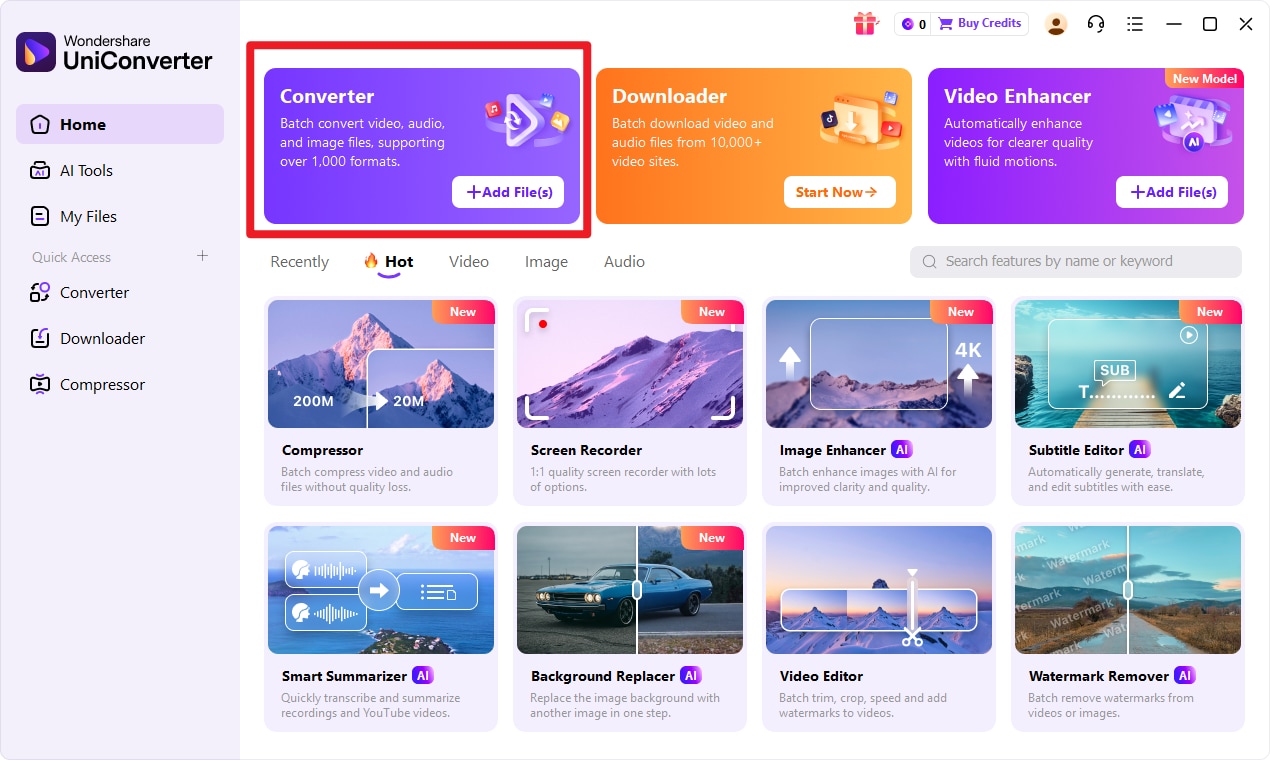
Step 1. Choose Converter in UniConverter
Launch Wondershare UniConverter on your computer. From the main dashboard, navigate to the left-side menu and select the Converter tool to open the video conversion interface.
Step 2. Add Files to UniConverter
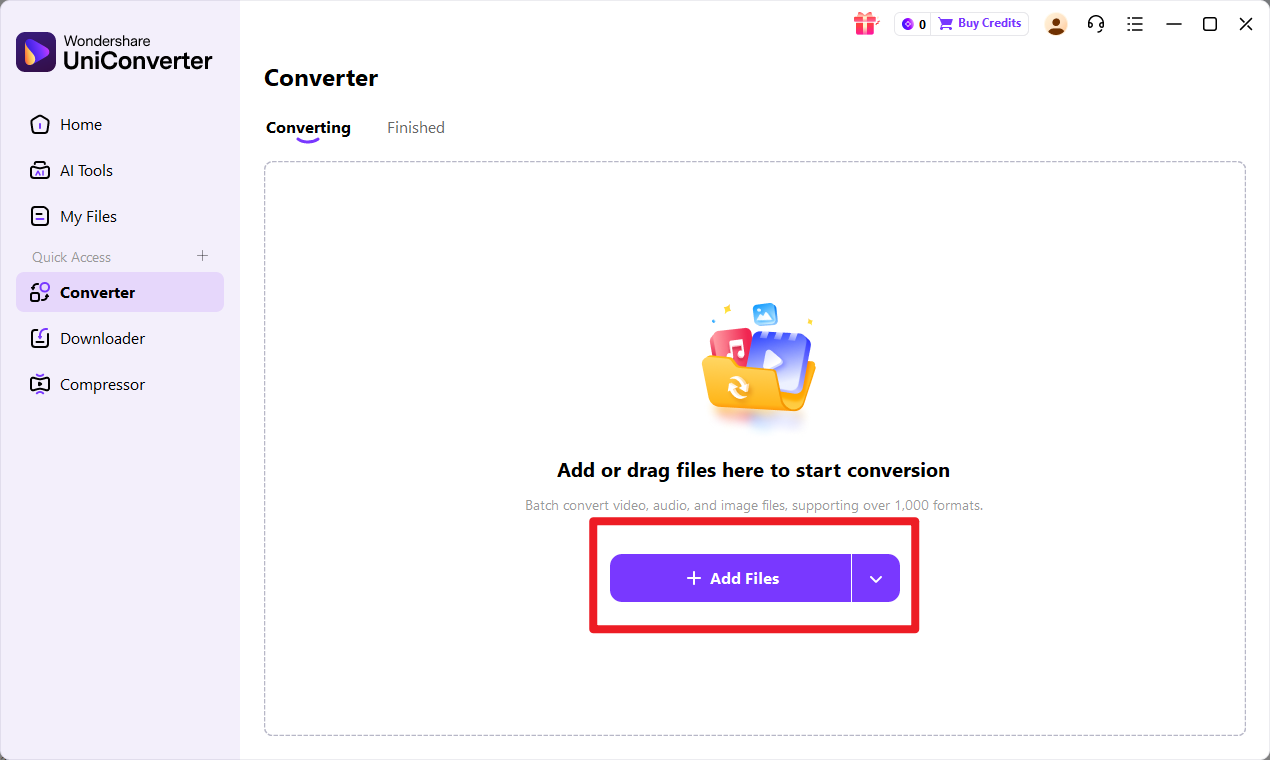
You can now import your input format files. Click the Add Files icon in the center or top-left corner to browse your computer's folders. Alternatively, you can simply drag and drop your video files directly into the UniConverter window. The software supports batch conversion, so feel free to add multiple files at once.
Step 3. Choose Output Format
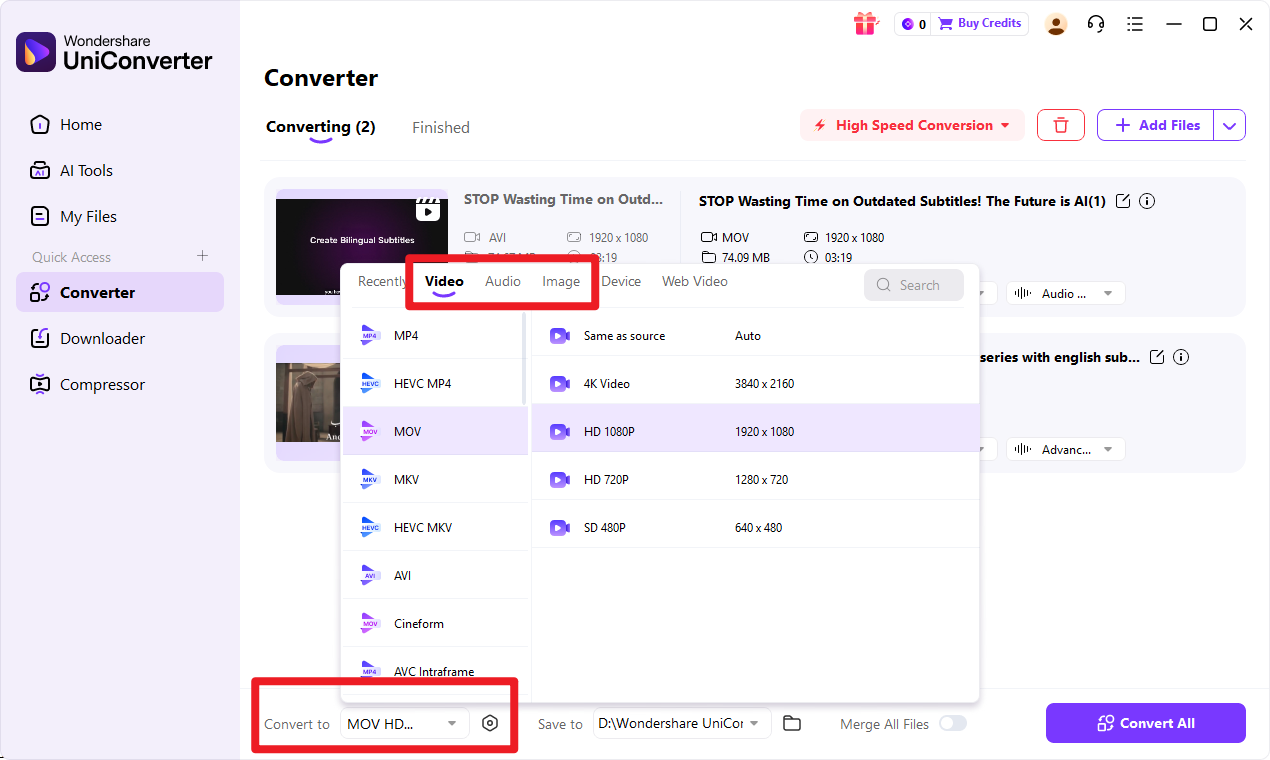
At the bottom of the window, click on the Output Format menu. This will open a new window with a list of supported formats. Click on the Video tab, select your desired target format (e.g., MPG or AVI) from the list on the left, and then choose a specific resolution or quality preset from the right. You can also choose "Same as source" to maintain the original resolution.
Step 4. Start the Conversion
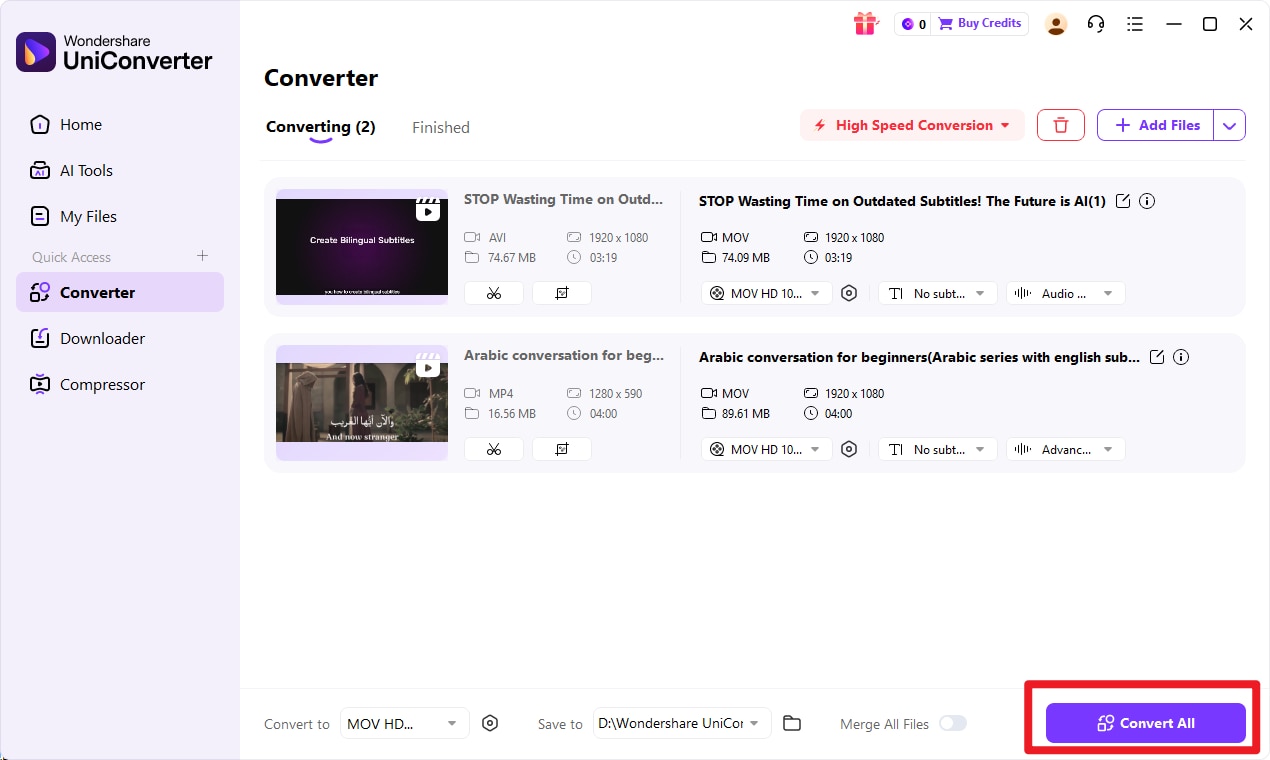
Before starting, you can specify where you want to save the converted files by using the File Location field at the bottom. Once you are ready, click the Convert button for a single file or the Start All button in the bottom-right corner to begin the batch conversion process. UniConverter will quickly convert your files to the target format and save them to your chosen destination.

Your All-in-One Video Processing Toolkit
Conclusion
Ultimately, the choice between AVI and MPG is not about which format is universally superior, but which is best suited for your specific goal. If your priority is preserving the absolute highest quality for professional editing or long-term archiving, and you are not concerned about large file sizes, AVI is an outstanding choice. On the other hand, if you need a format that offers a great balance of good quality and small file sizes for web streaming, sharing, or efficient storage, MPG is the more practical and efficient option.
Understanding these differences empowers you to manage your video files more effectively. And for any situation where you find yourself needing to switch between formats, a versatile tool is indispensable. Wondershare UniConverter provides a fast, reliable, and high-quality solution to seamlessly convert between AVI, MPG, and a vast universe of other media formats, ensuring your videos are always ready for any purpose.
FAQs
-
1. Is AVI higher quality than MPG?
Generally, yes. AVI has the potential for higher quality because it can use lossless compression or be completely uncompressed, which means it retains all of the original video data. MPG files use lossy compression, which always involves discarding some data to reduce file size. However, a high-bitrate MPG can still look excellent and be nearly indistinguishable from the source for casual viewing. -
2. Can I play MPG files on a Mac?
Yes, you can. Modern versions of macOS have native support for MPG files, and they will play directly in the default QuickTime Player. If you are using a very old Mac or encounter a specific MPG file that won't play, a versatile third-party media player like VLC Media Player will handle it without any issues. -
3. Why are AVI files so large?
AVI files are often large because they prioritize quality over file size. They frequently use codecs that apply very light compression, or no compression at all (uncompressed). This method preserves more of the original video information, resulting in pristine quality but also leading to file sizes that can be many times larger than more heavily compressed formats like MPG or MP4. -
4. How do I convert AVI to MPG without losing quality?
While some quality loss is inherent when converting from a potentially lossless format (AVI) to a strictly lossy one (MPG), you can take steps to minimize it. The key is to use a high-quality conversion tool like Wondershare UniConverter and select a high-bitrate setting for your MPG output. A higher bitrate tells the converter to use more data to represent the video, resulting in a larger file but a much closer quality match to the original AVI source.
