
AVI vs MP4: A Complete Comparison and Conversion Guide
Have you ever downloaded a video file only to find it won't play on your device? Or perhaps you've tried to email a video, but the file was just too large? These common frustrations often boil down to the video's format. Two of the most frequently encountered formats are AVI and MP4, and understanding their differences is key to solving these problems. The AVI vs MP4 debate isn't just a technical curiosity; it's a practical issue that affects how we watch, share, and store our digital videos. Choosing the right format can mean the difference between seamless playback and a frustrating error message.
In this article, we will provide a comprehensive breakdown of AVI and MP4, helping you understand their unique characteristics and determine which one is right for your needs. We'll also provide a simple, step-by-step guide to convert your files, ensuring they work perfectly on any device.
In this article
Part 1. What is AVI? What is MP4?
Before we dive into a direct comparison, it's essential to understand what each of these formats is. Both AVI and MP4 are "container formats," which means they are like digital boxes that can hold video, audio, subtitles, and other metadata together in a single file. However, the way they store and compress this data is vastly different.
What is an AVI File? (Audio Video Interleave)
Launched by Microsoft in 1992, AVI (Audio Video Interleave) is one of the oldest and most established video container formats. As its name suggests, it works by interleaving chunks of audio and video data together. For its time, it was a revolutionary format that became the standard for video on Windows-based computers.
One of AVI's defining features is its ability to use a wide variety of codecs for compression, or even no compression at all. This flexibility means AVI files can achieve extremely high, even lossless, quality. However, this comes at a significant cost: file size. Uncompressed or lightly compressed AVI files are notoriously large, making them impractical for streaming, sharing, or storing on devices with limited space. Furthermore, because it's an older format, it lacks support for modern features like embedded subtitles or interactive menus and often runs into compatibility issues on non-Windows devices like Macs, iPhones, and smart TVs without special software.
What is an MP4 File? (MPEG-4 Part 14)
MP4 (MPEG-4 Part 14) is the modern industry standard for digital video, and for good reason. Developed by the Moving Picture Experts Group (MPEG), it was designed from the ground up to be a highly efficient and versatile format for the internet age. It offers an exceptional balance between video quality and file size, making it the go-to format for almost every application today.
The key to MP4's success lies in its use of advanced and highly standardized compression codecs, most notably H.264 (AVC) and its successor, H.265 (HEVC). These codecs can dramatically reduce file size while preserving excellent visual quality, even at high resolutions like 1080p and 4K. This efficiency makes MP4 perfect for online streaming on platforms like YouTube and Netflix, sharing on social media, and playing on virtually any device imaginable—from smartphones and tablets to gaming consoles and smart TVs. Its universal compatibility has cemented its place as the most ubiquitous video format in 2026.
Part 2. Quick Comparison Table
To get a clear, at-a-glance overview of how these two formats stack up, here is a side-by-side comparison of their key attributes.
| Feature | AVI (Audio Video Interleave) | MP4 (MPEG-4 Part 14) |
| File Size | Generally very large, especially when using less aggressive compression. | Highly efficient and significantly smaller for comparable quality. |
| Video & Audio Quality | Can be very high, even lossless. However, quality depends heavily on the codec used. | Excellent quality, widely supporting HD, 4K, and beyond with minimal quality loss. |
| Compression | Uses older, less efficient compression methods (e.g., DivX, XviD) or can be uncompressed. | Uses modern, highly efficient compression standards like H.264 (AVC) and H.265 (HEVC). |
| Compatibility | Limited. Native to Windows but often requires third-party codecs or players on other systems. | Universal. Natively supported by virtually all modern devices, operating systems, and browsers. |
| Common Use Cases | Archiving, professional editing workflows (in specific environments), and legacy systems. | Web streaming, social media sharing, mobile video, online courses, and general video storage. |
Part 3. AVI vs MP4: Which One Is Better?
While the comparison table gives a quick summary, let's delve deeper into the practical implications of these differences. For most users, the choice between AVI and MP4 becomes clear when considering compatibility, file size, and quality in real-world scenarios.
For Compatibility: MP4 is the Clear Winner
In 2026, compatibility is king. We expect our videos to play flawlessly whether we're on a Windows PC, a MacBook, an Android phone, or an iPad. This is where MP4 shines and AVI falters. MP4 is built on a global standard, meaning device and software manufacturers have universally adopted it. When you create or download an MP4 file, you can be confident it will play without any extra steps.
AVI, on the other hand, is a relic of a less interconnected era. Its playback on non-Windows systems is hit-or-miss. A Mac user trying to open an AVI file might be met with a "codec not found" error, as macOS does not natively support many of the older codecs used in AVI files. Similarly, trying to play an AVI on an iPhone or a smart TV is often impossible without first converting it. This need for third-party players or codecs adds a layer of complexity that simply doesn't exist with MP4.
For File Size and Sharing: MP4 Offers Superior Efficiency
If you've ever tried to upload a video to social media or send one via email, you know that file size matters. AVI's tendency to produce massive files makes it a poor choice for sharing. A short, high-quality AVI video can easily run into several gigabytes, exceeding the upload limits of most platforms and making it a nightmare to download on slower connections.
MP4's advanced compression algorithms are a game-changer. An MP4 file can be 5 to 10 times smaller than an AVI file of the same video content while maintaining nearly identical visual quality. This incredible efficiency is why MP4 powers the entire streaming industry. It allows platforms like YouTube and Vimeo to deliver high-definition video quickly and smoothly, even over mobile networks. For personal use, it means you can store more videos on your hard drive and share them with friends and family effortlessly.
For Quality: A Nuanced Comparison
On paper, AVI has a potential advantage in quality because it can store video without any compression, resulting in a "lossless" file that is a perfect replica of the original source. This is valuable in very specific professional contexts, such as video mastering or digital archiving, where preserving every single pixel is the top priority.
However, for 99% of users, this is purely theoretical. Lossless AVI files are impractically enormous and unnecessary for viewing purposes. When both formats use modern, lossy compression, the playing field is leveled. A well-encoded MP4 file using the H.264 codec can deliver stunning high-definition quality that is visually indistinguishable from a much larger compressed AVI file. For watching movies, streaming content, or sharing personal videos, MP4 provides all the quality you need at a fraction of the file size.
The Verdict: Why MP4 is the Best Choice for Most Users
Considering all factors, MP4 is unequivocally the better format for everyday use in 2026. Its combination of universal compatibility, efficient compression, and excellent quality makes it the most practical and versatile choice. Whether you are a student, a content creator, an office professional, or just someone who enjoys watching videos, MP4 simplifies your digital life. It ensures your videos work everywhere, don't consume excessive storage space, and are easy to share. While AVI still has a niche in professional archiving, MP4 is the undisputed champion for the modern user.
Part 4. Use Cases for AVI and MP4
Understanding the ideal scenarios for each format can help you manage your video files more effectively.
When to Use AVI
Despite its drawbacks for general use, AVI still holds value in a few specific situations. Its primary modern application is in professional and archival settings where data integrity is paramount.
- Professional Video Editing: In some Windows-based editing workflows, AVI can be used as an intermediate format for short-term work files, especially when using codecs like DV that were designed for editing. Using an uncompressed or lightly compressed AVI ensures no quality is lost during multiple saves and edits before the final export.
- Archiving Master Copies: For film restoration or long-term digital archives, storing the master source file in a lossless AVI format can be a way to preserve the content in its purest form, before it's compressed for distribution.
When to Use MP4
MP4's versatility makes its list of use cases virtually endless. It is the default format for almost any situation involving the distribution and consumption of video content.
- Online Streaming: Every major video streaming platform, from YouTube and Vimeo to Netflix and Hulu, relies on MP4 (or similar container formats like MKV using the same codecs) to deliver content efficiently to billions of users.
- Social Media: When you upload a video to Instagram, TikTok, Facebook, or X (formerly Twitter), it is almost always processed and delivered as an MP4 file to ensure smooth playback on the platforms' apps and websites.
- Mobile and Device Playback: MP4 is the native video format for iOS and Android. Any video you record on your phone or want to watch on your tablet or smart TV should be in MP4 format for guaranteed compatibility.
- General Storage and Sharing: For your personal library of movies, home videos, or downloaded clips, storing them as MP4s is the most space-efficient and future-proof choice.
Part 5. Step-by-Step Guide to Convert AVI to MP4 Using UniConverter
If you have AVI files that you can't play, share, or store efficiently, the best solution is to convert them to the universally compatible MP4 format.
The Best Way to Convert AVI to MP4 Without Losing Quality
While there are online tools available, they often come with limitations on file size, slower speeds, and potential privacy risks. For a fast, reliable, and high-quality conversion, a dedicated desktop application is essential. Wondershare UniConverter stands out as the top recommended tool for this task. It is a powerful and user-friendly video toolbox that handles large files, batch conversions, and over 1,000 formats with ease, all while preserving the original video quality.
How to Convert AVI to MP4 in 4 Simple Steps
Follow this guide to quickly convert your AVI files to MP4 on your Windows or Mac computer.
Step 1: Add Your AVI File to UniConverter
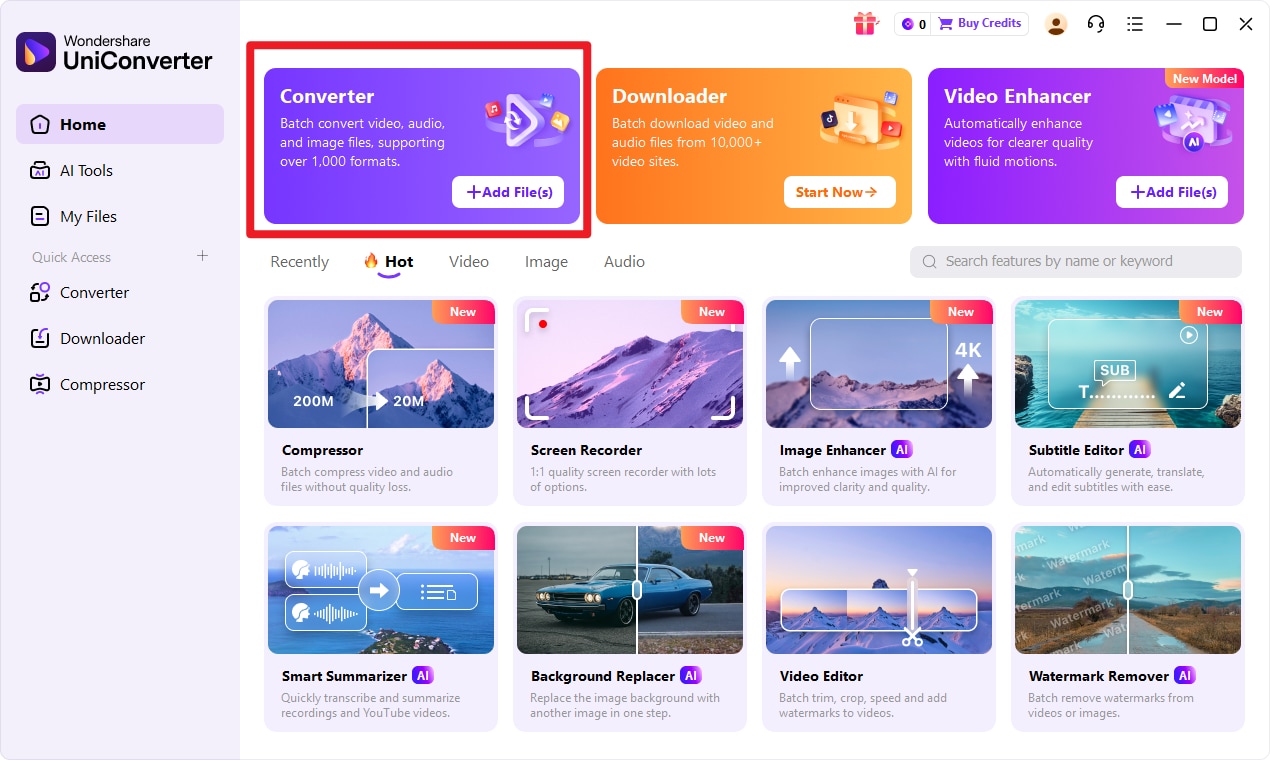
First, download and install Wondershare UniConverter from the official website. Launch the program and ensure you are on the Converter tab in the left-hand menu. You can either drag and drop your AVI file directly into the main window or click the Add Files icon to browse your computer and select the video you want to convert.
Step 2: Choose MP4 as the Output Format
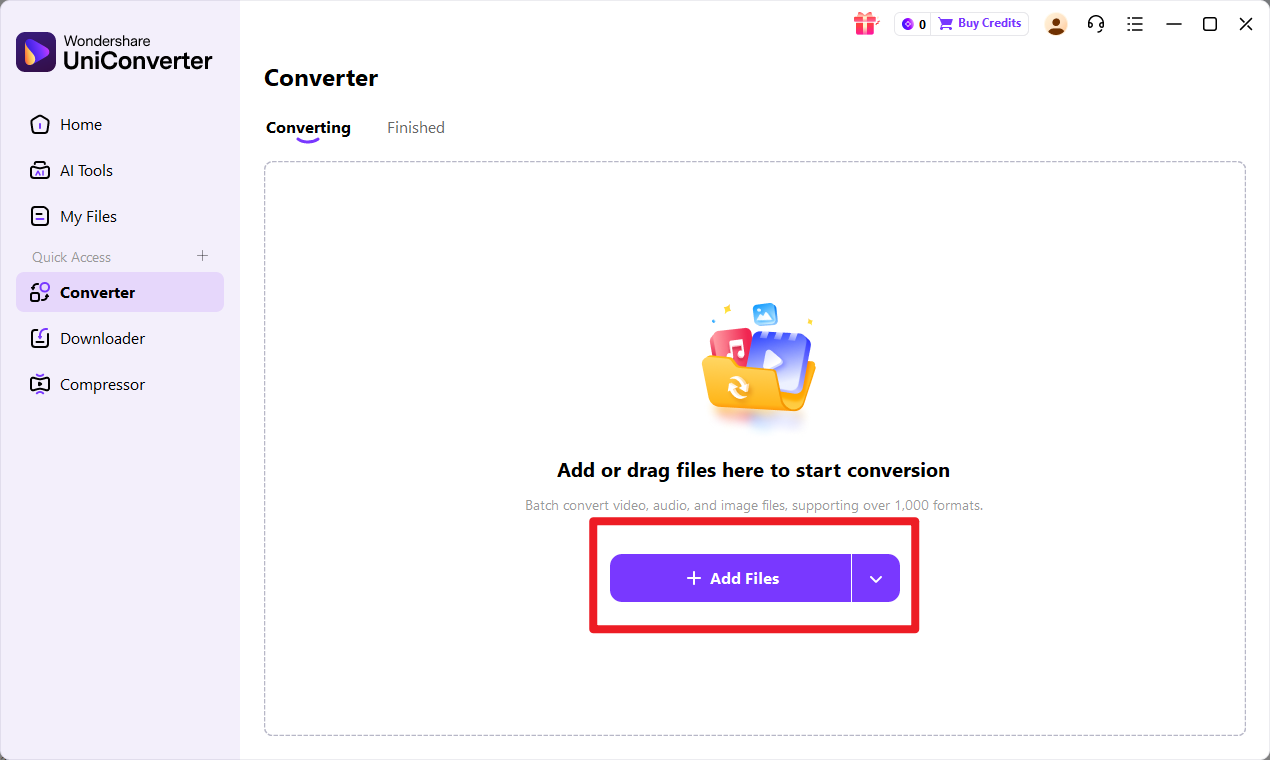
Once your file is loaded, look to the bottom of the application window and click on the Output Format menu. This will open a new window with a list of format options. Select the Video tab, choose MP4 from the list on the left, and then select your desired resolution on the right (e.g., "Same as source" to maintain original quality, or 1080p).
Step 3: Start the Conversion
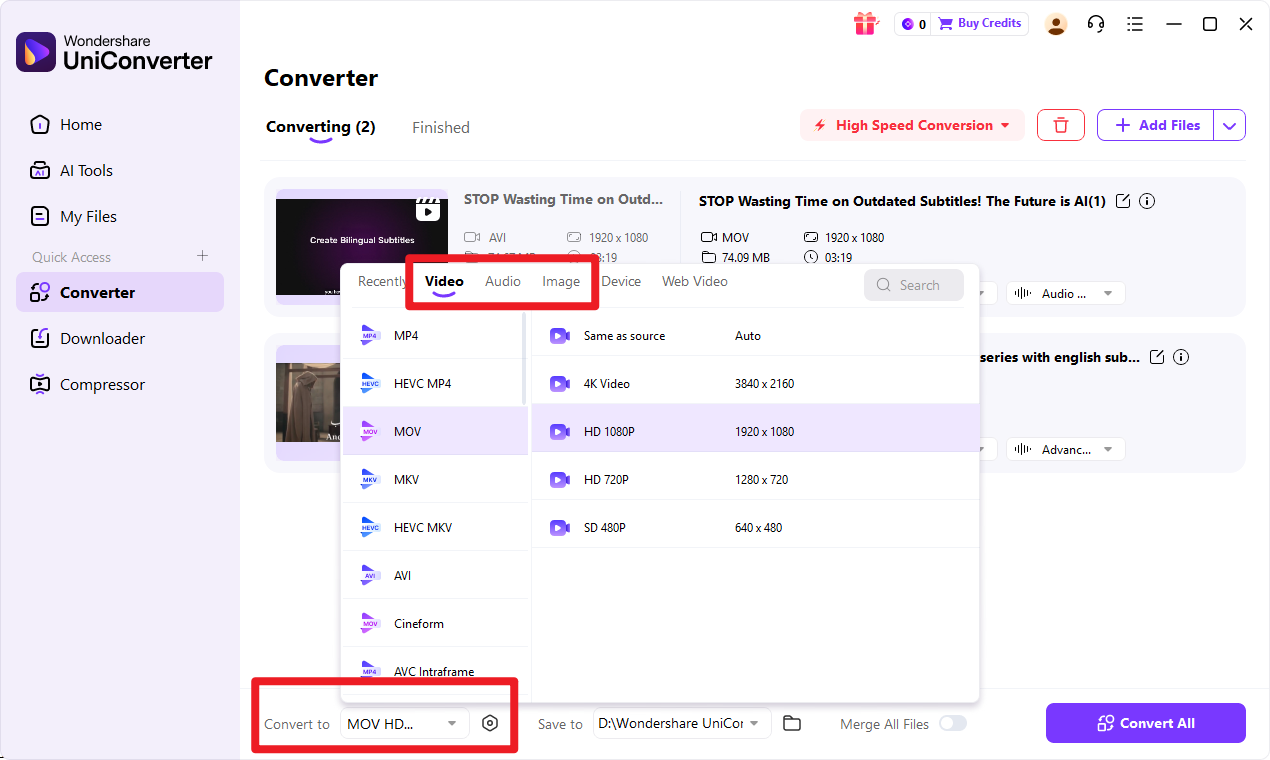
Before starting, you can specify where you want to save the converted file by using the File Location menu at the bottom. Once you are ready, simply click the Convert button next to the file. If you have added multiple files for a batch conversion, click the Start All button in the bottom-right corner to begin the high-speed conversion process.
Step 4: Check Your Converted Files
UniConverter will process your file at remarkable speed. Once the conversion is complete, you can find your new MP4 file by navigating to the Finished tab at the top of the window. From here, you can click the Open icon to immediately locate and play your universally compatible MP4 video.

More Than Just a Video Converter
Conclusion
The AVI vs MP4 comparison reveals a clear winner for the demands of the modern digital world. AVI, while a foundational format known for its potential for high quality, is ultimately held back by its large file sizes and significant compatibility issues. In contrast, MP4 has established itself as the global standard by offering an ideal blend of high-quality video, efficient compression, and universal playback support. For nearly all applications in 2026—from streaming and sharing to storing and editing—MP4 is the more practical, efficient, and reliable choice. If you find yourself with legacy AVI files, don't let them gather digital dust. By using a powerful and dependable tool like Wondershare UniConverter, you can effortlessly convert them to MP4, unlocking their potential to be played and enjoyed anywhere, on any device.
FAQs
-
1. Does converting AVI to MP4 reduce quality?
Any conversion that involves re-compression can technically result in some data loss. However, with a professional tool like Wondershare UniConverter, this loss is negligible. You can select high-quality presets (like "Same as source") that ensure the converted MP4 file is visually identical to the original AVI, so you won't notice any difference in quality. -
2. Can I play AVI files on a Mac?
Natively, macOS has very limited support for the AVI container and the older codecs it often uses. While you could install a third-party media player like VLC, a more permanent and convenient solution is to convert the AVI file to MP4. An MP4 file will play flawlessly in QuickTime Player and all other Mac applications. -
3. Is MP4 always smaller than AVI?
Yes, for video content of the same duration and comparable visual quality, an MP4 file will almost always be significantly smaller than an AVI file. This is because MP4 utilizes far more advanced and efficient compression algorithms (like H.264) than the codecs typically associated with AVI. This size difference can often be dramatic, with MP4 files being many times smaller. -
4. Why should I use UniConverter instead of a free online tool?
While free online converters might seem convenient for a single small file, they come with many drawbacks. Wondershare UniConverter offers superior benefits, including:- Faster Speeds: Desktop software uses your computer's full processing power for much faster conversions.
- No File Size Limits: Online tools often have strict limits on how large a file you can upload.
- Batch Processing: Convert hundreds of files at once, a feature rarely offered by online tools.
- Enhanced Privacy: Your files are processed locally on your computer, not uploaded to a third-party server.
- More Features: UniConverter is a complete video toolbox with features for editing, compressing, recording, and more, all in one place.
