
When working with video files, you've likely encountered a variety of formats, but two of the most common are AVI and MOV. Choosing between them can be confusing, as each has its own history, strengths, and weaknesses. You might have an AVI file that won't play on your Mac or a MOV file that's too large to share easily. Understanding the core differences is the first step to solving these compatibility and performance issues. This guide will break down the AVI vs. MOV debate, helping you determine which format is best for your specific needs, whether it's for editing, storage, or sharing across different platforms in 2026.
In this article, you will learn:
- The definitions and key characteristics of AVI and MOV files.
- A direct side-by-side comparison of the two formats.
- Which format is better for compatibility, file size, and quality.
- Specific use cases for both AVI and MOV.
- How to easily convert AVI to MOV to solve compatibility problems.
Part 1. What is AVI? What is MOV?
Before we dive into a detailed comparison, it's essential to understand what each format is at a fundamental level. Both are "container" formats, meaning they can hold various types of video and audio data, but they were developed by different companies for different purposes.
What is an AVI File?
AVI stands for Audio Video Interleave. It was developed by Microsoft in 1992 as part of its Video for Windows technology. As one of the oldest video formats, it became the de facto standard for video on Windows-based computers for many years.
An AVI file acts as a multimedia container that can bundle audio and video data together, allowing for synchronized playback. It supports a wide range of codecs (compression/decompression algorithms), which means the quality and file size of an AVI file can vary dramatically depending on how it was created.
- Pros:
- Excellent native compatibility on all Windows-based systems.
- Widely recognized by a vast range of software and hardware devices, especially older ones.
- Can achieve very high (even lossless) quality if the right codec is used.
- Cons:
- Often uses older, less efficient compression methods, leading to very large file sizes.
- May require users to install specific codecs to play back files, leading to "codec hell."
- Lacks support for modern features like interactive menus or multiple audio/subtitle tracks in a standard way.
What is a MOV File?
MOV is a multimedia container file format developed by Apple and is native to its QuickTime framework. It was designed to support the creation and playback of high-quality multimedia content on Mac computers. Today, it's a highly versatile format used in professional video production and web streaming.
Like AVI, MOV files can contain multiple tracks of video, audio, text, and effects. However, MOV was built with a more modern architecture, allowing it to support advanced codecs like H.264/AVC and H.265/HEVC. This makes it highly efficient, enabling high-quality video at relatively small file sizes.
- Pros:
- Native to the Apple ecosystem (macOS, iOS, iPadOS), ensuring seamless playback and editing.
- Excellent compression efficiency, providing a great balance between quality and file size.
- The preferred format for professional video editing software like Final Cut Pro and Adobe Premiere Pro.
- Cons:
- While widely supported, it may require installing QuickTime or a compatible media player like VLC on some Windows systems for flawless playback.
- Can sometimes be more complex to work with on non-Apple platforms.
Part 2. Quick Comparison Table
For a quick overview, this table highlights the key differences between the AVI and MOV formats.
| Feature | AVI (Audio Video Interleave) | MOV (Apple QuickTime File Format) |
| Developer | Microsoft | Apple |
| Compatibility | Native to Windows. Widely supported but may require specific codecs on macOS or other platforms. | Native to macOS and iOS. Well-supported on Windows with modern media players (e.g., VLC) or QuickTime. |
| Compression | Generally uses older, less efficient compression methods. File sizes can be very large for good quality. | Supports modern, highly efficient codecs like H.264, HEVC (H.265), and ProRes. |
| Quality | Quality is highly dependent on the codec used. Can be lossless, but this results in enormous files. | Often associated with higher quality due to its use of advanced codecs that preserve detail at lower bitrates. |
| File Size | Tends to be larger than MOV for comparable video quality due to less efficient compression. | Generally smaller than AVI for the same level of quality, thanks to superior compression technology. |
| Common Use | Standard definition video on Windows, legacy video archives, and some specific software workflows. | Professional video editing, web streaming (YouTube, Vimeo), creating content for Apple devices, and general high-quality video storage. |
Part 3. AVI vs MOV: Which One Is Better?
Now that we've covered the basics, let's analyze which format comes out on top in key areas: compatibility, file size, and quality. The "better" format ultimately depends on your specific goal.
Compatibility Across Platforms
Compatibility is often the biggest headache for video creators and viewers. Here's how AVI and MOV stack up.
- AVI: As a Microsoft creation, AVI enjoys universal, out-of-the-box support on Windows. Any Windows PC can play a standard AVI file without issue. However, when you move outside the Windows ecosystem, problems can arise. On a Mac, you might need to install a third-party player like VLC Media Player or a specific codec pack, as native support in QuickTime Player can be hit-or-miss depending on the codecs used within the AVI container.
- MOV: Developed by Apple, MOV is the native format for macOS and iOS. Every Mac, iPhone, and iPad can play MOV files seamlessly. It's also the standard for editing in Final Cut Pro. On Windows, support has improved dramatically over the years. Modern versions of Windows 10 and 11 can play MOV files using the default media player, provided they are encoded with a common codec like H.264. For universal compatibility, players like VLC handle MOV files perfectly on Windows.
Winner: MOV. While AVI is king on Windows, MOV's strong position in the massive Apple ecosystem and its growing cross-platform support make it the more versatile format for sharing and playback in 2026.
File Size and Compression Efficiency
No one wants a video file that's too large to email, upload, or store. This is where compression efficiency becomes critical.
- AVI: AVI is an older format and often relies on older compression technologies like DivX and XviD, or it can be uncompressed entirely. While this can preserve quality, it comes at the cost of massive file sizes. A few minutes of uncompressed AVI video can easily consume several gigabytes of space.
- MOV: The MOV format was designed to be flexible and supports a wide array of modern, highly efficient codecs. The most common is H.264 (or AVC), which is the standard for Blu-ray, web streaming, and most digital video today. It also supports the even more efficient HEVC (H.265), which can deliver the same quality as H.264 at roughly half the file size. This makes MOV far superior for balancing quality and storage space.
Winner: MOV. Its support for advanced codecs like H.264 and HEVC allows it to produce high-quality video in significantly smaller files compared to AVI.
Video Quality and Editing
For content creators and video editors, the format must not only look good but also be easy to work with.
- AVI: While AVI can contain very high-quality or even lossless video, its structure is not ideal for modern editing workflows. The large file sizes can slow down editing software, and the reliance on various codecs can cause import or performance issues in programs like Adobe Premiere Pro or DaVinci Resolve, especially on a Mac.
- MOV: MOV is the industry standard for video editing for a reason. Its structure is optimized for editing, allowing software like Final Cut Pro (which uses MOV exclusively) and Adobe Premiere Pro to access and process video frames quickly and efficiently. Furthermore, it's the container for professional editing codecs like Apple ProRes, which offers a superb combination of high quality and smooth editing performance.
Winner: MOV. Its modern structure, support for professional codecs, and widespread adoption in editing software make it the clear choice for any serious video editing project.
The Verdict: Which Should You Choose?
For the vast majority of modern applications in 2026, MOV is the superior format. Its excellent compression, high-quality output, and strong performance in editing workflows make it the most practical and versatile choice. Whether you're uploading to YouTube, editing a professional project, or sharing a video with friends, MOV provides the best balance of features.
AVI still has its place for legacy content or in specific, closed-loop Windows environments, but for any new projects, MOV is the forward-looking and more efficient option.
Part 4. Use Cases for AVI and MOV
To make the choice even clearer, here are some practical scenarios where you would choose one format over the other.
When to Use AVI
Despite its age, AVI can still be the right choice in certain situations:
- Windows-Centric Projects: If your video will only ever be created, edited, and viewed on Windows PCs, AVI offers guaranteed compatibility without any extra software.
- Working with Legacy Hardware/Software: Some older digital cameras, industrial equipment, or specialized software may default to or only support AVI output. In these cases, sticking with AVI avoids conversion hassles.
- Archiving with Specific Codecs: If you need to archive a video using a particular older codec for preservation purposes, the AVI container is a reliable way to do so.
When to Use MOV
MOV is the go-to format for most contemporary video tasks:
- Video Editing (Especially on Mac): If you plan to edit your video, MOV is the best choice. It's the native format for Final Cut Pro and works flawlessly in Adobe Premiere Pro and other professional NLEs (Non-Linear Editors).
- Creating High-Quality Web Content: Platforms like YouTube and Vimeo recommend uploading files in a MOV container with the H.264 codec. This ensures your video is processed with the best possible quality.
- Sharing Videos in the Apple Ecosystem: If you're sending a video to someone who uses an iPhone, iPad, or Mac, saving it as a MOV file guarantees they can watch it instantly without any issues.
- Balancing Quality and File Size: Whenever you need to create a video that looks great but won't take up too much storage space, MOV's efficient compression makes it the ideal solution.
Part 5. Step-by-Step Guide to Convert AVI to MOV Using UniConverter
What if you have an AVI file that you need to edit on your Mac or share with an iPhone user? The best solution is to convert it to the more universally compatible MOV format. Wondershare UniConverter is a powerful and user-friendly tool that makes this process simple and fast, preserving your video's quality. It is the perfect choice for any video conversion need, supporting over 1000 formats and offering lightning-fast speeds.
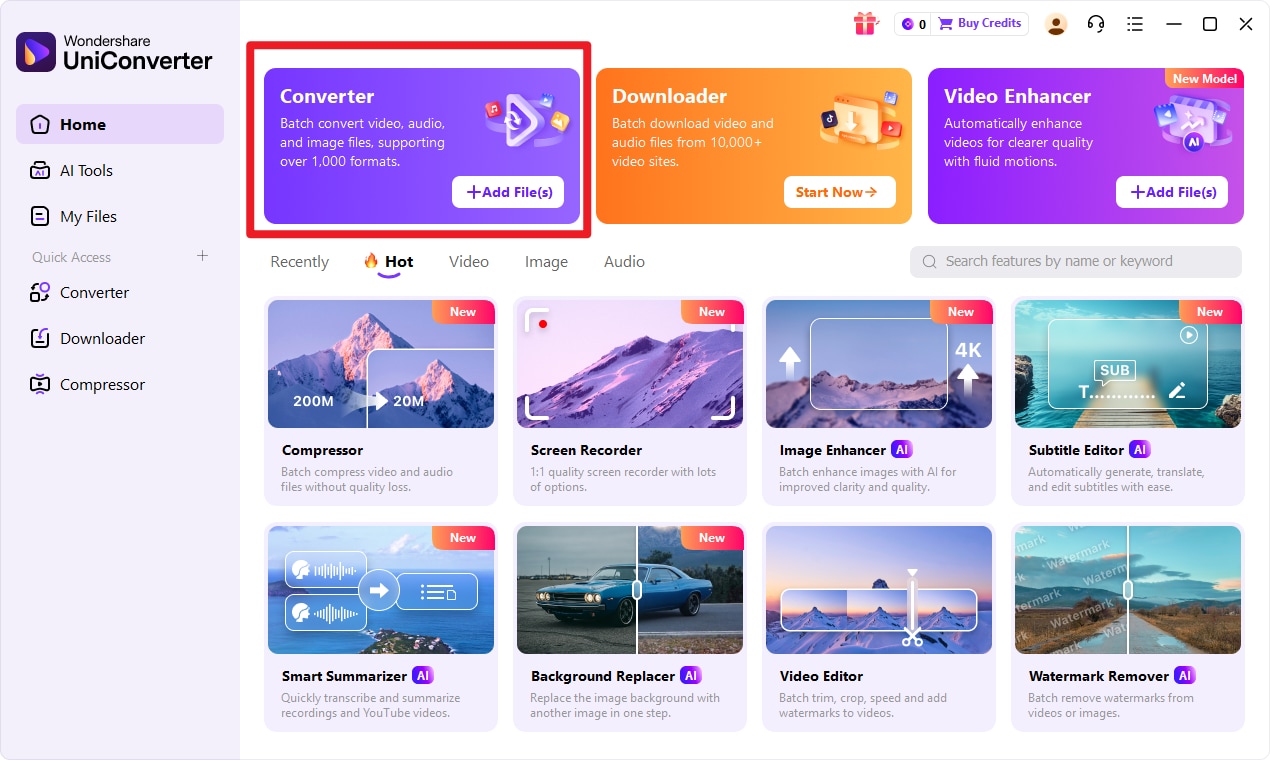
Step 1: Launch Wondershare UniConverter
First, open Wondershare UniConverter on your computer. In the main interface, ensure you are on the Converter tab.
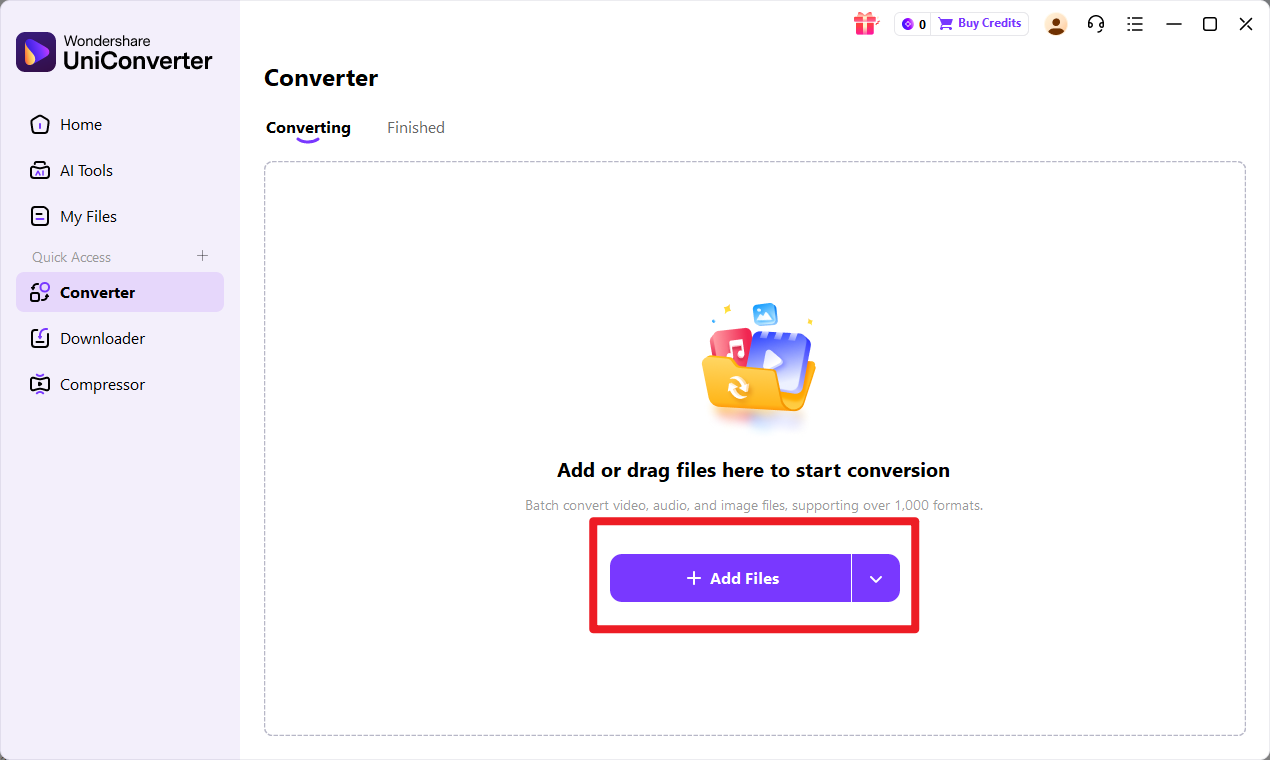
Step 2: Add Files to UniConverter
You can either drag and drop your AVI file directly into the program window or click the Add Files icon in the top-left corner to browse your computer and select the file you want to convert.
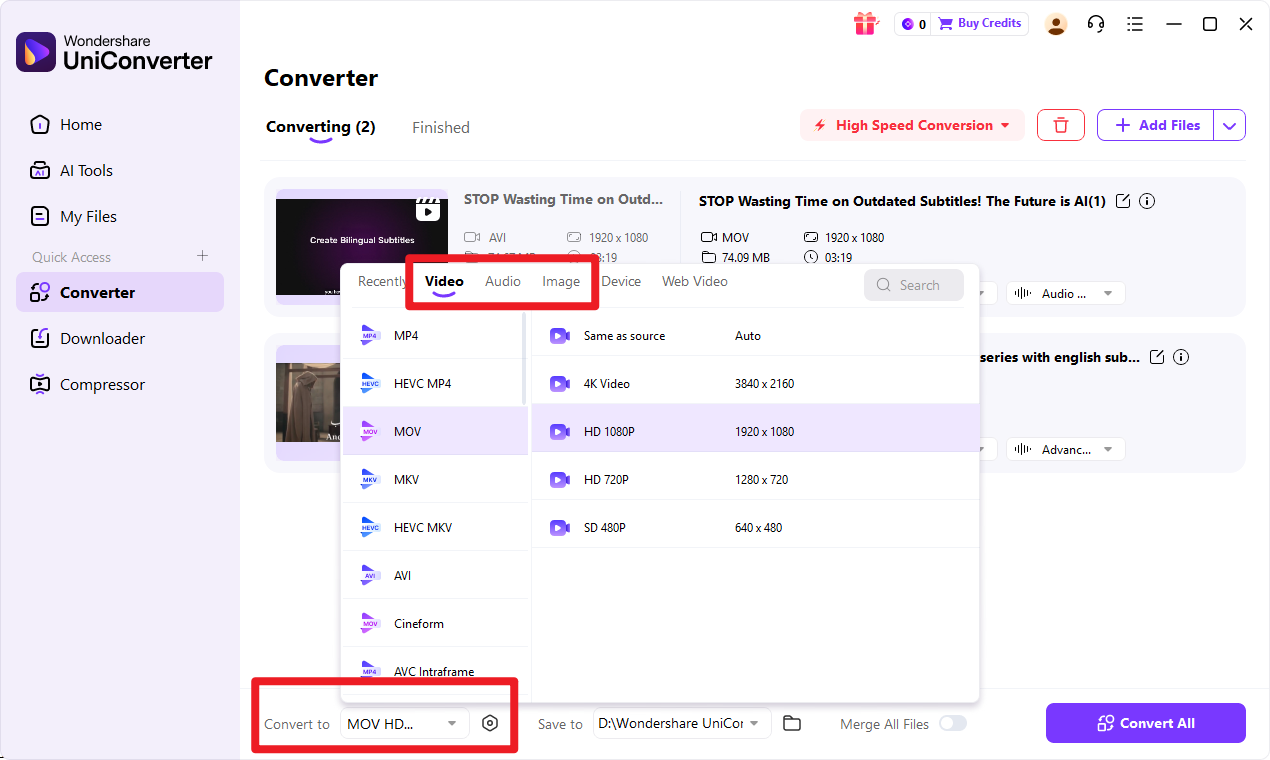
Step 3: Choose Output Format
Next, you need to tell UniConverter that you want to create a MOV file. Click on the Output Format menu at the bottom of the window. A new dialog box will appear. Go to the Video tab, select MOV from the list of formats on the left, and then choose a desired resolution on the right (e.g., "Same as source" to maintain the original quality).
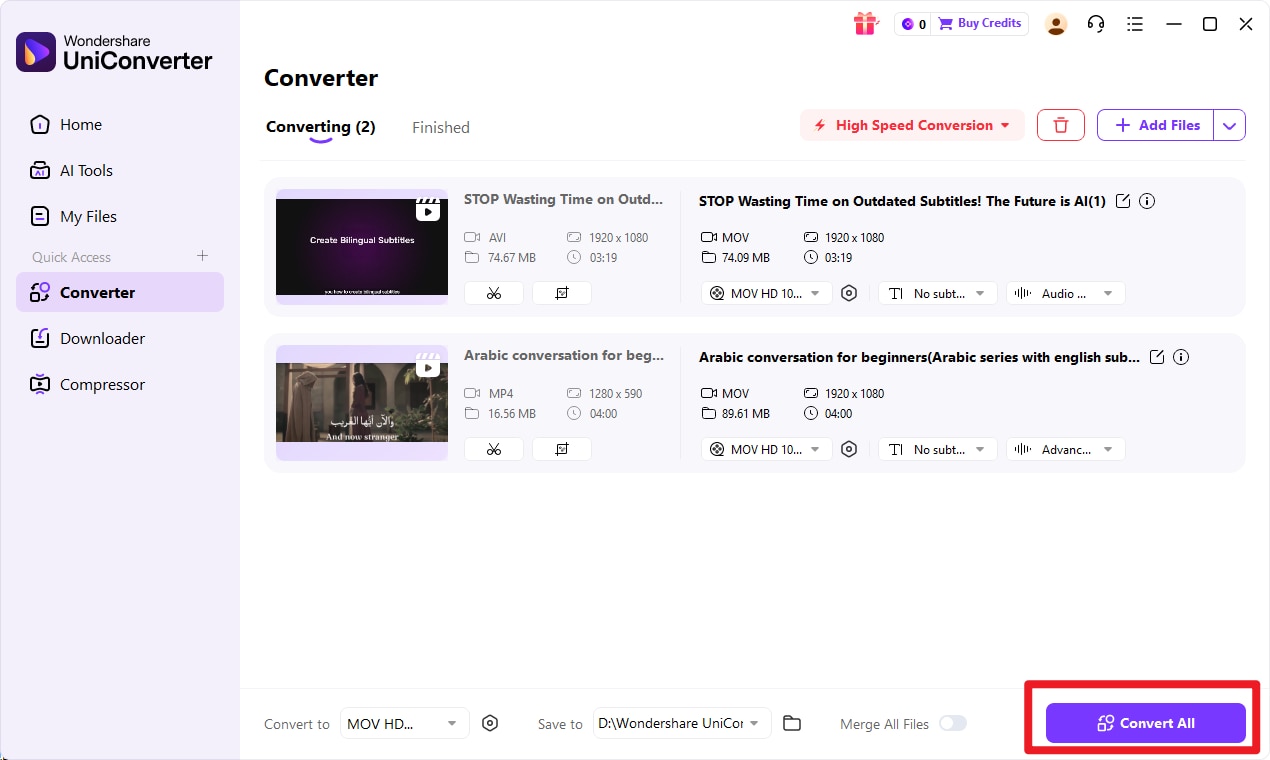
Step 4: Start the Conversion
Before starting, you can specify where to save your new file. Look for the File Location field at the bottom of the interface and click it to choose a destination folder. Once you are ready, click the Convert button next to the file. If you have added multiple files, you can click the Start All button in the bottom-right corner to process them in a batch.
UniConverter will now convert your AVI file to MOV at high speed. The progress bar will show you how long it will take. Once the conversion is complete, you can find your new MOV file by clicking on the Finished tab at the top of the window or by navigating directly to the destination folder you selected in the previous step.

More Than Just an AVI to MOV Converter
Conclusion
In the AVI vs. MOV comparison, it's clear that both formats have served important roles in the history of digital video. AVI, the veteran from Microsoft, remains a functional choice for Windows-specific or legacy applications. However, MOV, Apple's modern and efficient container, has emerged as the clear winner for most contemporary uses. Its superior compression, high-quality output, and seamless integration with professional editing workflows make it the recommended format for creators in 2026.
Ultimately, file format barriers should never get in the way of your creative projects. When you encounter a compatibility issue—whether it's an AVI that won't play on a Mac or a MOV that needs to be used in an older system—the solution is simple. A reliable and versatile tool like Wondershare UniConverter effortlessly bridges the gap, allowing you to convert between formats quickly and without any quality loss, ensuring your videos work perfectly on any device or platform.
FAQs
-
1. Is AVI or MOV better for YouTube?
MOV is generally better for YouTube. YouTube's official recommendation is to upload videos in an MP4 or MOV container using the H.264 video codec and AAC audio codec. This combination provides an excellent balance of high quality and manageable file size, which leads to faster uploads and better processing results on the platform. -
2. Does converting AVI to MOV reduce video quality?
Any time you convert a video from one lossy format to another, there is a potential for a slight reduction in quality. However, this loss can be virtually unnoticeable if you use a professional conversion tool like Wondershare UniConverter. By selecting a high-quality preset (or "Same as source"), the software's advanced algorithms ensure that the integrity of your video is preserved as much as possible. -
3. Can I play MOV files on Windows 10?
Yes, you can play MOV files on Windows 10 and 11. The default "Movies & TV" app has native support for MOV files encoded with common codecs like H.264. However, if a MOV file uses a less common or professional codec (like Apple ProRes), you might need to install a more versatile media player like VLC Media Player, which includes its own extensive library of codecs. For guaranteed compatibility, converting the MOV file to a Windows-native format like MP4 or WMV is also a simple solution.
