
Have you ever found an old video file on your computer labeled with an ".avi" extension and wondered why it's so large? Or perhaps you've stumbled upon a ".3gp" file from an old mobile phone and been surprised by its small size but grainy quality. In the world of digital video, format matters. The choice between AVI vs 3GP is a classic example of the trade-off between quality and portability. Understanding the fundamental differences between these two formats is key to managing, sharing, and enjoying your videos effectively.
Many users face compatibility issues, like an AVI file that won't play on their phone or a 3GP file that looks terrible on a large monitor. Others struggle with massive AVI files that are too big to email or send through messaging apps. This guide is designed to clear up the confusion. We will dive deep into the characteristics of both AVI and 3GP, helping you decide which one is right for your specific needs and, most importantly, showing you how to easily convert between them when necessary.
In this article
Part 1. What is AVI? What is 3GP?
Before we can compare these two formats, it's essential to understand what each one is, where it came from, and what it was designed to do. They were created for very different purposes, which explains their distinct characteristics.
What is an AVI File?
AVI stands for Audio Video Interleave. Developed by Microsoft in the early 1990s as part of its Video for Windows technology, AVI is one of the oldest and most established video container formats. A "container" format is like a digital box that can hold different types of video and audio data, which are compressed using various codecs.
The primary characteristic of AVI is its emphasis on quality. It was designed for desktop computing environments where storage space was becoming more plentiful and playback quality was a priority. AVI files often use less compression (or even no compression at all), which results in excellent video and audio fidelity that is very close to the original source material. This makes it a popular choice for archiving master copies and for use in video editing workflows where preserving as much detail as possible is crucial.
However, this high quality comes at a cost: file size. AVI files are notoriously large. A few minutes of high-quality AVI video can easily consume gigabytes of storage space, making them impractical for streaming, emailing, or sharing on mobile devices. While its compatibility is excellent on Windows and widely supported on other desktop platforms, its large size and reliance on specific codecs can sometimes cause playback issues on devices that aren't powerful PCs.
What is a 3GP File?
3GP stands for 3rd Generation Partnership Project. As the name suggests, this multimedia container format was specifically designed for 3G mobile phones in the early 2000s. The goal was to create a format that could deliver video and audio content over slow mobile networks and be stored on devices with very limited storage capacity.
To achieve this, 3GP uses very high compression. It aggressively reduces the amount of data needed to represent the video and audio, which results in incredibly small file sizes. This was revolutionary at the time, allowing users to record, share, and watch video clips on their phones—something that would have been impossible with formats like AVI.
The trade-off for this extreme compression is a significant reduction in quality. 3GP videos typically have low resolutions and bitrates, leading to visuals that can appear blocky, pixelated, or blurry, especially when viewed on anything larger than a small phone screen. The audio is also heavily compressed. Despite its age and the rise of more modern formats like MP4, 3GP's legacy is its unmatched efficiency for portability and data savings, and it remains compatible with virtually every mobile phone ever made.
Part 2. Quick Comparison Table
To get a quick overview of the key differences between AVI and 3GP, here is a side-by-side comparison table.
| Feature | AVI | 3GP |
| Full Name | Audio Video Interleave | 3rd Generation Partnership Project |
| Developer | Microsoft | 3GPP |
| Primary Use | Desktop playback, editing, archiving | Mobile phone playback and sharing |
| Video Quality | High to Very High | Low to Standard |
| File Size | Large | Very Small |
| Compression | Low to moderate | High |
| Compatibility | Excellent on desktops, limited on mobile | Excellent on mobile, may need codecs on desktop |
Part 3. AVI vs 3GP: Which One Is Better?
Declaring one format "better" than the other isn't straightforward because they excel in completely different areas. The best choice depends entirely on your priorities: are you focused on pristine quality for editing, or do you need a tiny file for quick mobile sharing? Let's break down their performance in key categories.
Video and Audio Quality
When it comes to pure, unadulterated quality, AVI is the undisputed champion. Because AVI is a container that often uses codecs with minimal compression (like DV) or is even uncompressed, it preserves a vast amount of the original video and audio data. This means sharper images, more accurate colors, and clearer sound. When you watch a high-quality AVI file on a large PC monitor or TV, the experience is rich and detailed. It's the format of choice for videographers who need to maintain the integrity of their footage for professional editing and archiving.
In stark contrast, 3GP is built on the principle of sacrifice. To achieve its tiny file sizes, it employs aggressive compression algorithms that discard a significant amount of visual and auditory information. This results in a much lower resolution, a reduced color palette, and a lower bitrate. On a small phone screen from the early 2000s, this was an acceptable compromise. However, when you play a 3GP file on a modern high-resolution smartphone or a desktop computer, the quality limitations become glaringly obvious. You'll likely see pixelation, blocky artifacts in fast-moving scenes, and a general lack of sharpness.
File Size
This is where the roles are completely reversed. 3GP's entire reason for existence is to be small, and it succeeds brilliantly. A one-minute video clip saved in 3GP format might only be a few megabytes. This makes it incredibly easy to store hundreds of clips on a device with limited memory, send via messaging apps with file size limits, or upload quickly over a slow internet connection.
AVI files are on the opposite end of the spectrum. Their focus on quality means they are often massive. The same one-minute video clip that was a few megabytes in 3GP could easily be hundreds of megabytes or even a gigabyte in a high-quality AVI format. This makes AVI files cumbersome to manage. They fill up hard drives quickly, are often too large to attach to an email, and can take a very long time to upload or download. Storing a large library of AVI videos requires significant investment in storage hardware.
Device Compatibility
Device compatibility is a nuanced issue for both formats. AVI, being a Microsoft creation, has near-universal compatibility on Windows-based PCs. Almost any media player on Windows will play an AVI file without issue. It's also well-supported by video editing software on both Windows and Mac. However, its compatibility with mobile devices is poor. Most smartphones and tablets do not natively support AVI playback, primarily due to the variety of codecs it can contain and its large file sizes. You would typically need a third-party media player app to even attempt to play an AVI on a phone.
3GP, on the other hand, was born for mobile. It is universally supported by virtually every mobile phone, from the oldest feature phones of the 3G era to the latest modern smartphones. If you need to send a video to someone and be absolutely certain they can open it on their phone, 3GP is a safe bet. However, its compatibility on desktops can be a bit hit-or-miss. While modern operating systems and media players like VLC can handle 3GP files, some default players might not recognize the format or may require additional codec packs to be installed.
The Verdict
There is no single "better" format. The best format is the one that aligns with your specific goal.
- Use AVI when your top priority is quality. This includes archiving master copies of important videos, working on a video editing project on a powerful desktop computer, or playing back content on a large, high-resolution screen.
- Use 3GP when your top priority is portability and small file size. This is ideal for sending a quick video clip via a messaging app, saving videos on a device with extremely limited storage, or ensuring playback on the widest possible range of mobile devices, including very old ones.
Part 4. Use Cases for AVI and B
Understanding the theoretical differences is one thing, but seeing how they apply in real-world scenarios makes the choice clearer. Here's when you should use each format.
When to Use AVI
- Archiving High-Quality Master Copies: If you've just finished shooting a family wedding or a short film, saving the final, unedited master file as a high-quality AVI ensures you have the best possible version to work from in the future.
- Editing Video Projects: When you import footage into video editing software like Adobe Premiere Pro or DaVinci Resolve, working with a high-quality format like AVI prevents further quality degradation during the editing process. The large files are handled by the powerful processing capabilities of a desktop computer.
- Playing Videos on a Large Screen: If you want to showcase a video on your home theater system, a large TV, or a high-resolution PC monitor, an AVI file will deliver the crisp, detailed picture quality that makes the viewing experience immersive.
When to Use 3GP
- Sharing via Messaging Apps: Want to send a funny 10-second clip of your pet to a friend on WhatsApp or Telegram? Converting it to 3GP will make the file tiny, ensuring it sends instantly and doesn't use much mobile data for you or the recipient.
- Saving Video on Old or Basic Phones: If you're using an older feature phone or a smartphone with just a few gigabytes of free space, recording or saving videos in 3GP format is the only practical way to manage storage.
- Maximum Mobile Compatibility: If you need to distribute a video to a large group of people with a wide variety of phones (both old and new), using 3GP guarantees that almost everyone will be able to play it without any issues.
When Conversion is Necessary
The distinct strengths and weaknesses of AVI and 3GP mean you will often find yourself needing to switch from one to the other. For example, you might have a high-quality AVI movie on your computer that you want to watch on your phone during your commute. To do this, you'll need to convert the large AVI file to a smaller, mobile-friendly format like 3GP or MP4.
Conversely, you might discover a collection of cherished old videos on a past phone, all in 3GP format. If you want to edit them into a compilation video or simply store them on your PC for safer, long-term keeping, you might want to convert them to a more standard desktop format.
For these tasks, a versatile and reliable video converter is an essential tool. You need software that can handle both formats efficiently and without a complicated process. A tool like Wondershare UniConverter is an excellent choice, offering reliable and fast conversions between these formats and over 1,000 others, making it the perfect bridge between quality and portability.
Part 5. Step-by-Step Guide to Convert AVI to 3GP Using UniConverter
Wondershare UniConverter is a powerful tool that simplifies video conversion. It supports over 1,000 formats, including AVI and 3GP, and allows you to convert files quickly without losing quality. Follow these four simple steps to convert your files.
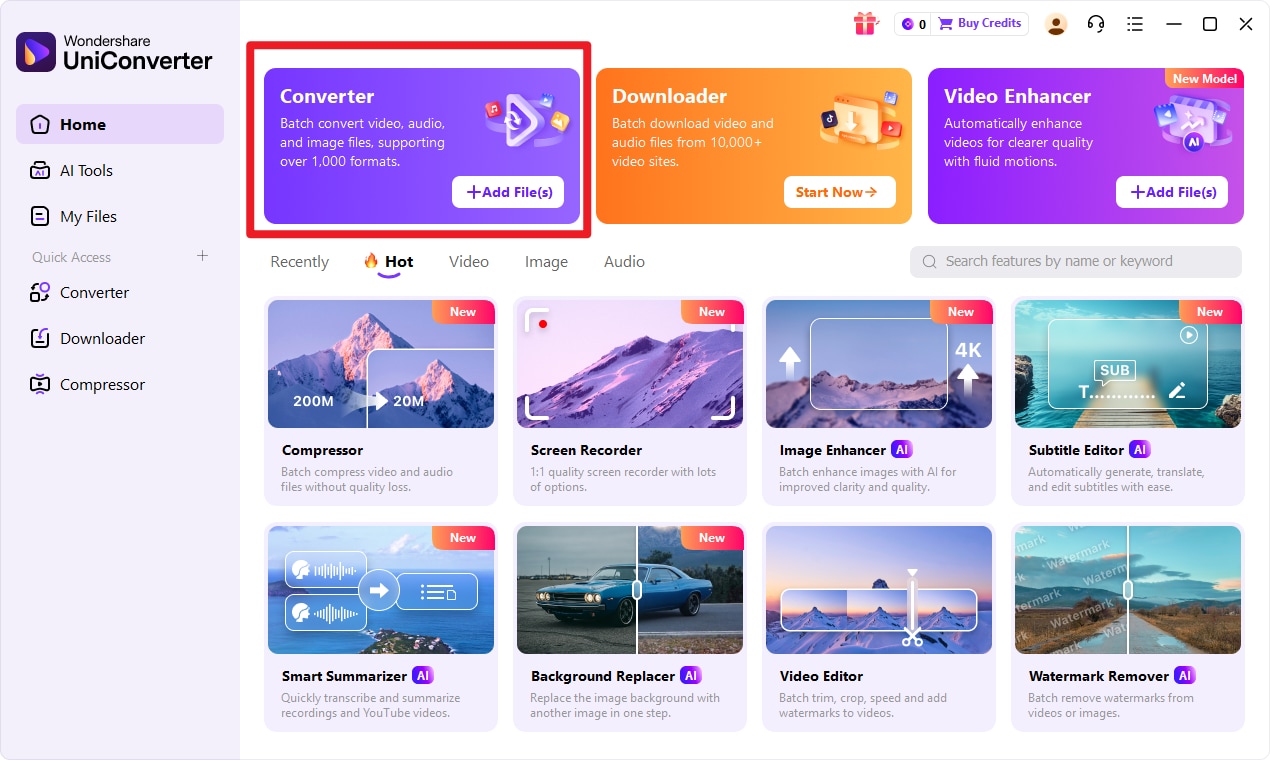
Step 1. Choose Converter in UniConverter
Open Wondershare UniConverter on your Windows or Mac computer. On the left-side menu, select the Converter tool.
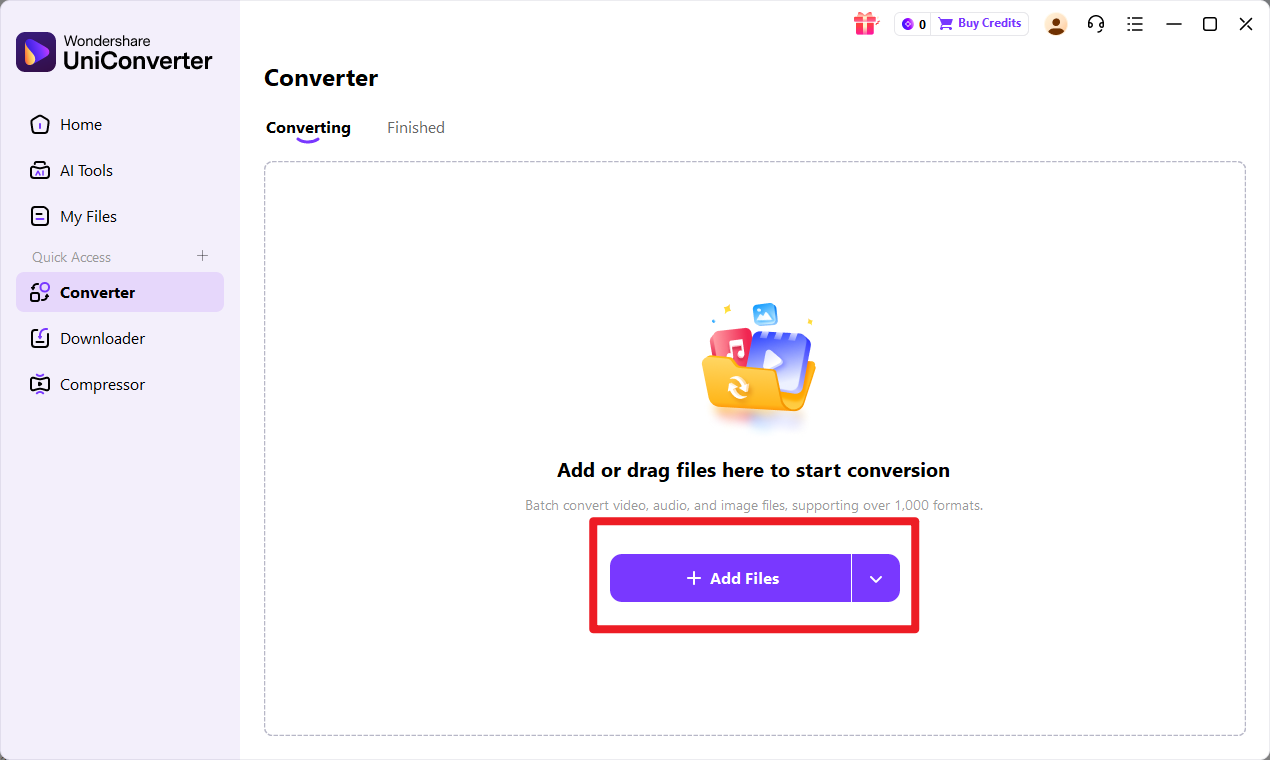
Step 2. Add Files to UniConverter
You can either drag and drop your input format files directly into the window or click the Add Files icon to browse and import them from your computer.
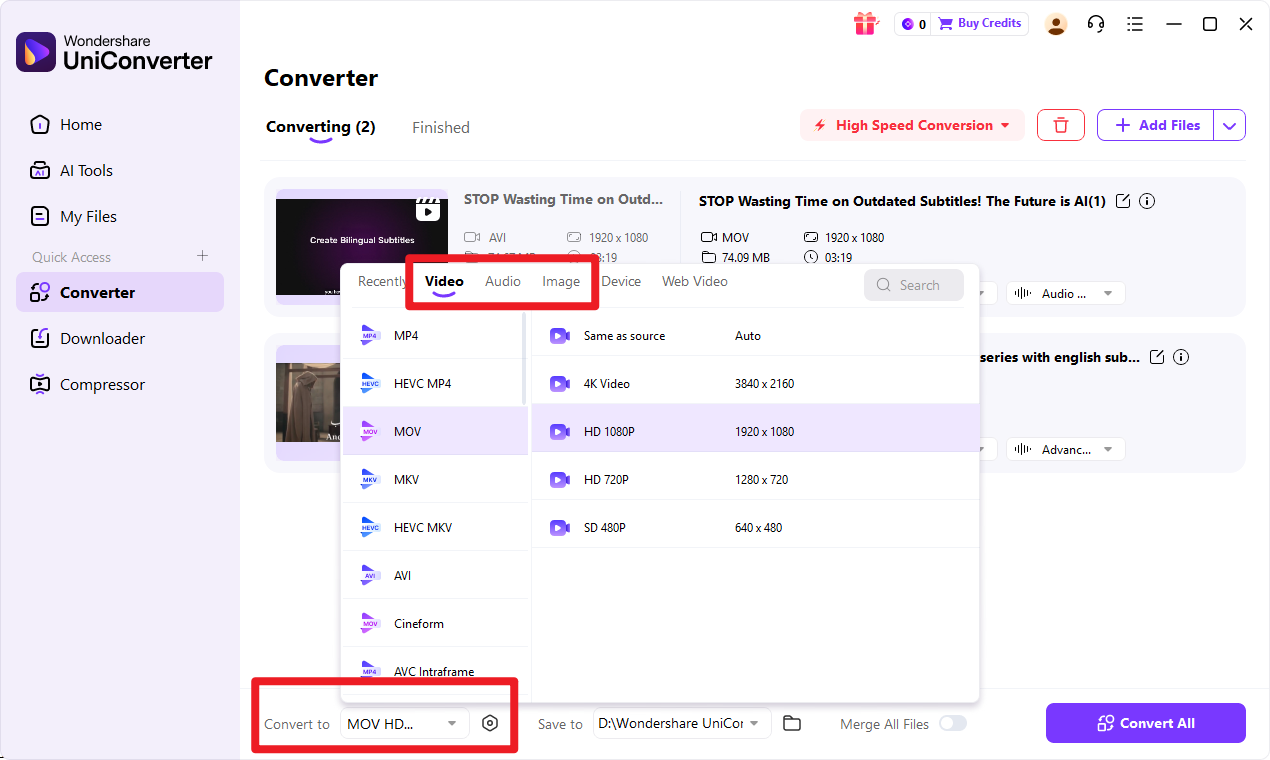
Step 3. Choose Output Format
Click on the Output Format option at the bottom of the window. In the new pop-up, go to the Video tab and select your desired target format from the list on the left. You can also select the desired output resolution on the right.
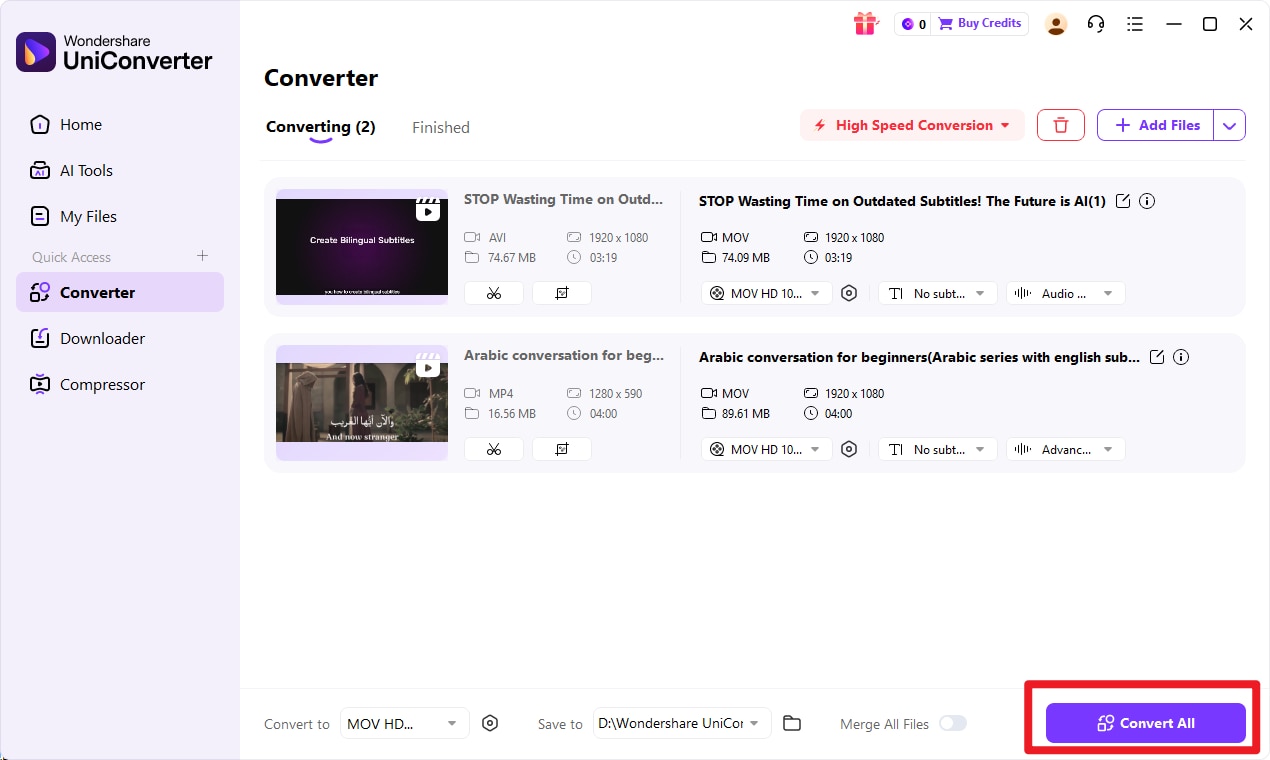
Step 4. Start the Conversion
Select a destination folder for your converted file under File Location. Finally, click the Start All button to begin the batch conversion process. Your files will be converted and saved in the designated folder.

More Than Just a Video Converter
Conclusion
Choosing between AVI vs 3GP comes down to a simple trade-off: quality versus portability. AVI offers superior quality for desktop use and archiving, while 3GP provides unmatched compression for mobile sharing and storage. Neither is inherently better, but understanding their strengths allows you to pick the right one for the job. When you need to bridge the gap between them, a reliable tool is indispensable. For fast, easy, and high-quality conversions between AVI, 3GP, and countless other formats, UniConverter stands out as the perfect solution to manage your entire video library with professional ease.
FAQs
-
1. Can I improve video quality by converting 3GP to AVI?
No. Converting from a low-quality format like 3GP to a high-quality container like AVI cannot magically create detail that was lost during the initial compression. The primary benefit is changing the format for better compatibility with editing software or desktop players. -
2. Are all AVI files high quality?
Not necessarily. AVI is a container, and the quality depends on the codec used to compress the video inside it. However, it is generally used for higher-quality, less compressed video compared to 3GP. -
3. Why won't my AVI file play on my phone?
Many mobile phones lack the native codecs required to play AVI files, especially older or more basic models. To ensure playback, it is best to convert the AVI file to a mobile-friendly format like 3GP or MP4. -
4. Is 3GP an outdated format?
While MP4 has largely replaced 3GP on modern smartphones, 3GP remains relevant for its extremely small file size and compatibility with older feature phones and in situations with very slow internet connections.
