
AV1 vs VVC: The Ultimate Codec Comparison for 2026
In the ever-evolving world of digital video, the quest for higher quality at lower bitrates is relentless. Two next-generation video codecs are at the forefront of this battle: AV1 and VVC. The AV1 vs VVC debate is more than just a technical curiosity; it's a pivotal discussion that will shape the future of video streaming, broadcasting, and content creation. Whether you're a professional video editor, a tech enthusiast, or a developer, understanding the differences, strengths, and weaknesses of these codecs is crucial. They promise to deliver stunning 4K, 8K, and even higher-resolution video more efficiently than ever before, but they take very different paths to achieve this goal.
This comprehensive guide will break down everything you need to know about AV1 and VVC. We'll explore their origins, compare their performance, and analyze their real-world applications. We'll also address the practical challenges, such as file compatibility, and show you how a powerful tool can bridge the gap between these cutting-edge formats.
In this article:
Part 1. What is AV1? What is VVC?
Before diving into a head-to-head comparison, it's essential to understand what each codec is and where it comes from. Their origins and core philosophies are key to understanding their respective advantages.
What is AV1 (AOMedia Video 1)?
AV1, or AOMedia Video 1, is an open, royalty-free video coding format designed for video transmissions over the internet. It was developed by the Alliance for Open Media (AOMedia), a consortium of the world's most influential technology companies. Its founding members include Amazon, Apple, Google, Meta, Microsoft, Mozilla, and Netflix.
The primary goal behind AV1's creation was to develop a next-generation codec that could offer superior compression efficiency without the complex and often costly licensing fees associated with its predecessors, like HEVC (H.265). By being royalty-free, AV1 aims to foster widespread adoption, innovation, and interoperability across the web and in various software and hardware ecosystems. It's engineered to be the new standard for streaming high-quality video efficiently, from standard definition to stunning 8K HDR.
What is VVC (Versatile Video Coding)?
VVC, also known as H.266 or MPEG-I Part 3, is a video compression standard that represents the state-of-the-art in coding efficiency. It was developed by the Joint Video Experts Team (JVET), a collaborative effort between the ITU-T Video Coding Experts Group (VCEG) and the ISO/IEC Moving Picture Experts Group (MPEG). This is the same group responsible for developing the widely successful AVC (H.264) and HEVC (H.265) standards.
As the direct successor to HEVC, the main objective of VVC is to achieve the highest possible compression efficiency. It aims to reduce the data rate by approximately 50% compared to HEVC for the same subjective video quality. This massive leap in efficiency makes it an ideal candidate for demanding applications like 4K/8K broadcasting, professional video production, and future immersive media experiences like 360-degree video. However, this performance comes with a trade-off: a complex, royalty-bearing licensing structure.
Part 2. Quick Comparison Table
To get a quick overview of how these two codecs stack up, here is a side-by-side comparison of their key attributes.
| Feature | AV1 (AOMedia Video 1) | VVC (H.266) |
| Compression Efficiency | Good (up to 30% better than HEVC) | Excellent (up to 50% better than HEVC) |
| Licensing Model | Royalty-Free | Complex, Royalty-Bearing |
| Hardware Support | Growing, integrated into new chips and devices | Limited, currently emerging |
| Adoption | Strong in web streaming (YouTube, Netflix) | Expected in broadcast and professional markets |
| Encoding Complexity | High | Very High |
Part 3. AV1 vs VVC: Which One Is Better?
The question of which codec is "better" doesn't have a simple answer. The best choice depends entirely on the specific application, budget, and technical requirements. Let's break down the comparison into four critical areas.
Compression and Quality: The Efficiency Battle
When it comes to pure compression performance, VVC generally has the upper hand. Extensive testing has shown that VVC can achieve the same visual quality as AV1 at a significantly lower bitrate. It was designed from the ground up to be the successor to HEVC, pushing the boundaries of compression algorithms. For applications where every kilobit counts—such as live 8K broadcasting or streaming over constrained networks—VVC's superior efficiency is a major advantage.
However, this doesn't mean AV1 is a slouch. AV1 offers a substantial improvement over older, more established codecs like H.264 (AVC) and H.265 (HEVC). For most streaming applications, AV1 provides an excellent balance of quality and file size, enabling platforms like YouTube and Netflix to deliver high-definition content to millions of users while saving immense amounts of bandwidth. For the end-user, both codecs can deliver a visually lossless experience, but VVC does it with fewer bits.
Licensing and Cost: The Royalty-Free Advantage of AV1
This is where AV1 has a clear and decisive advantage. Its biggest selling point is its completely royalty-free licensing model. Developed by a consortium of tech giants who wanted to avoid the patent licensing headaches of HEVC, AV1 can be implemented by any developer, service provider, or hardware manufacturer without paying fees. This has been a massive catalyst for its rapid adoption on the web, as it eliminates a significant financial and legal barrier to entry.
In stark contrast, VVC follows the traditional model of its predecessors, involving complex patent pools and royalty fees. While the exact cost structure is still being finalized by various patent holders, it is expected to be a significant consideration for any company looking to implement VVC in its products or services. This royalty-bearing model makes VVC less attractive for large-scale, free-to-use services and open-source projects, positioning it more for premium content and professional industries where such costs can be absorbed.
Ecosystem and Support: Adoption in the Real World
A codec is only as good as the ecosystem that supports it. Thanks to its royalty-free nature and the backing of AOMedia members, AV1 has seen impressive growth in software and hardware support. All major web browsers, including Chrome, Firefox, and Edge, support AV1 decoding. Streaming giants like YouTube and Netflix are already using it to serve a significant portion of their content. Furthermore, hardware decoding support is now common in new smartphones, smart TVs, and graphics cards from companies like NVIDIA, AMD, and Intel, making playback smooth and power-efficient.
VVC's ecosystem is still in its infancy. While software encoders and decoders exist, widespread hardware support is limited and only beginning to appear in high-end, specialized chips. Its adoption is expected to be driven by specific industries, such as broadcasting, where its compression benefits outweigh the licensing costs and slower hardware rollout. We can expect to see VVC gain traction in next-generation television sets and professional broadcast equipment over the next few years, but for now, AV1 has a commanding lead in real-world deployment.
Performance: Encoding and Decoding Demands
Both AV1 and VVC are significantly more complex than previous-generation codecs, which translates to higher computational requirements for both encoding and decoding.
Encoding, the process of compressing the video, is particularly intensive for both. Currently, VVC encoding is even more computationally demanding than AV1 encoding, requiring more powerful processors and longer processing times to achieve its superior compression. This can be a major factor for live streaming services or content creators who need fast turnaround times.
On the decoding side (playback), both codecs benefit greatly from dedicated hardware support. Without it, software decoding can be a heavy load on a device's CPU, leading to stuttering playback and increased battery drain, especially at high resolutions. As hardware support for AV1 is more mature, it currently offers a smoother playback experience on a wider range of consumer devices. VVC playback will become more efficient as dedicated hardware becomes more common.
Part 4. Use Cases for AV1 and VVC
Given their distinct profiles, AV1 and VVC are tailored for different applications. Here's a look at where each codec shines.
When to Use AV1
- Online Video Streaming: AV1 is the perfect fit for large-scale video-on-demand (VOD) and live streaming platforms. Its royalty-free model allows services like YouTube, Netflix, and Twitch to save billions in bandwidth and licensing costs, a benefit that can be passed on to consumers.
- WebRTC and Real-Time Communication: The open and accessible nature of AV1 makes it an excellent choice for browser-based real-time communication applications, such as video conferencing and live chats. Its integration into modern web browsers ensures seamless, high-quality video calls without proprietary plugins.
- Open-Source Projects: For developers working on open-source media players, editing software, or other video-related projects, AV1 is the default choice. It provides access to a cutting-edge codec without the legal and financial burdens of a licensed format.
When to Use VVC
- 4K/8K Broadcasting: In the world of terrestrial, satellite, and cable broadcasting, bandwidth is a finite and expensive resource. VVC's unparalleled compression efficiency makes it the ideal codec for delivering ultra-high-definition (UHD) 4K and 8K content, allowing broadcasters to fit more channels or higher-quality signals into their existing spectrum.
- Professional Video Contribution and Production: In high-end production workflows, maintaining the absolute maximum video quality is paramount. VVC's ability to compress video with minimal loss of detail makes it suitable for contribution links (sending video from a remote location to a studio) and for creating master archival files.
- Future Mobile Video: As mobile devices become capable of recording and playing 8K video, storage space and mobile data will become even more precious. VVC's efficiency could allow users to store twice as much video on their devices or use half the data when streaming on the go, making it a strong candidate for future generations of smartphones.
Part 5. Step-by-Step Guide to Convert AV1 to Other Formats Using UniConverter
Bridging the Gap: Why You Need a Powerful Video Converter
Despite the advancements of AV1 and VVC, the video landscape in 2026 remains fragmented. You might have an AV1 file that won't play on an older smart TV, or you may need to convert a cutting-edge VVC file into a more universally compatible format like H.264 (MP4) to share it with others. In these situations, a reliable video converter is not just helpful—it's essential.
Wondershare UniConverter is an excellent tool that stays updated with the latest codecs, providing a simple and powerful solution to handle both AV1 and VVC files. It allows you to effortlessly convert these modern formats into over 1000 other formats, ensuring your videos play on any device. It is the recommended tool for this task.
How to Convert AV1 Files in 4 Simple Steps
Here's how you can easily convert an AV1 video file to a more compatible format using UniConverter.
Step 1. Add Files to UniConverter
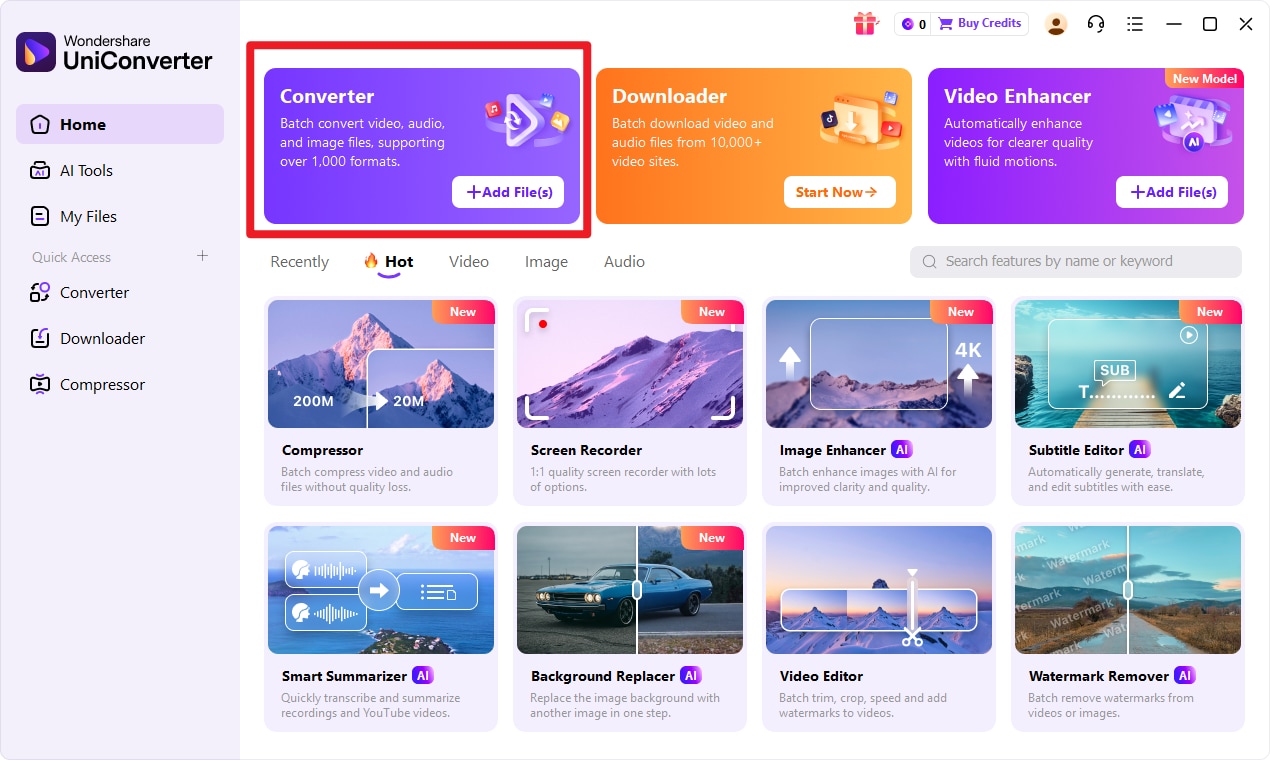
First, open the Wondershare UniConverter application on your computer. In the left-hand menu, ensure you are in the Converter module. You can now either drag and drop your AV1 video file directly into the program window or click the "Add Files" button to browse your computer and select the video you want to convert.
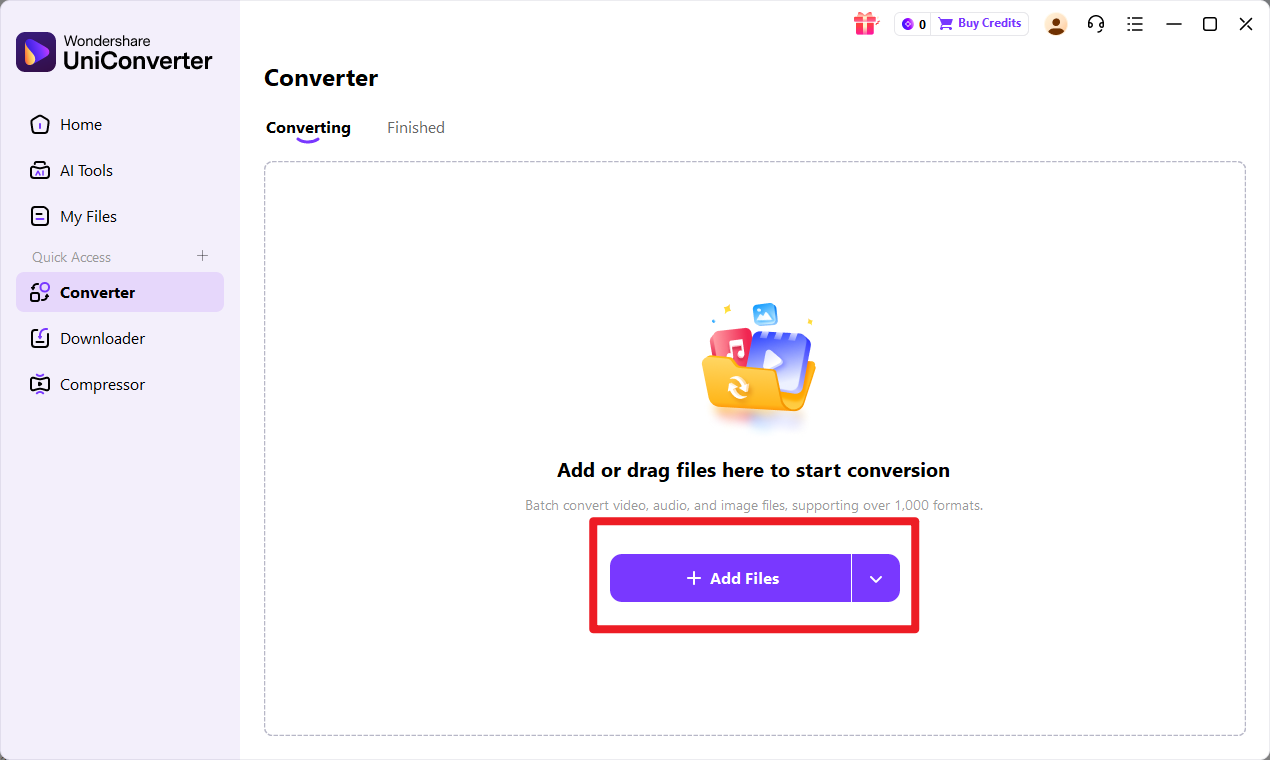
Step 2. Choose Output Format
Once your video is loaded, click on the Output Format menu at the bottom of the window. This will open a new dialog box. Navigate to the Video tab and select a widely supported format like MP4 from the list on the left. On the right, you can choose a preset resolution or keep it the same as the source. For maximum compatibility, ensure the encoder is set to H.264.
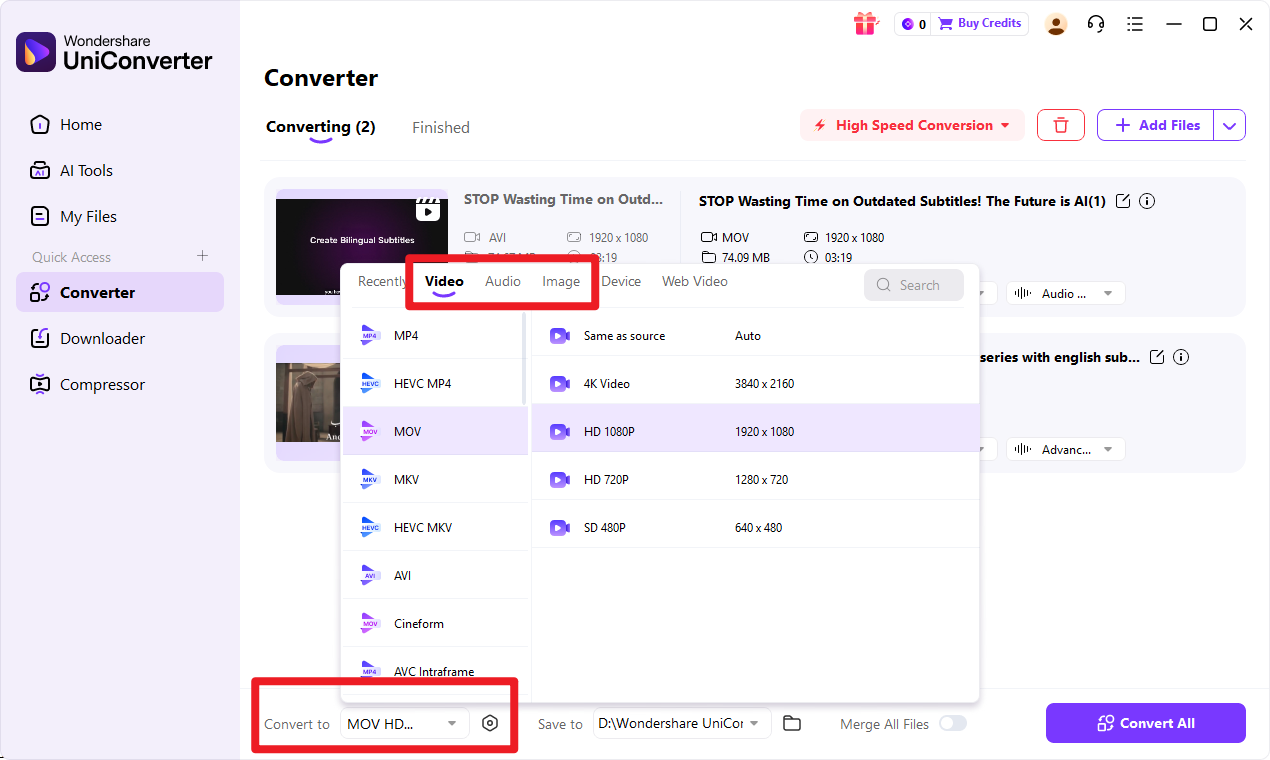
Step 3. Start the Conversion
Before starting, you can specify where you want to save the converted file by using the File Location menu at the bottom. Once you are ready, simply click the Convert button (or Start All if you have multiple files). UniConverter will begin the conversion process, utilizing hardware acceleration to complete the task quickly.
Step 4. Check Converted Files
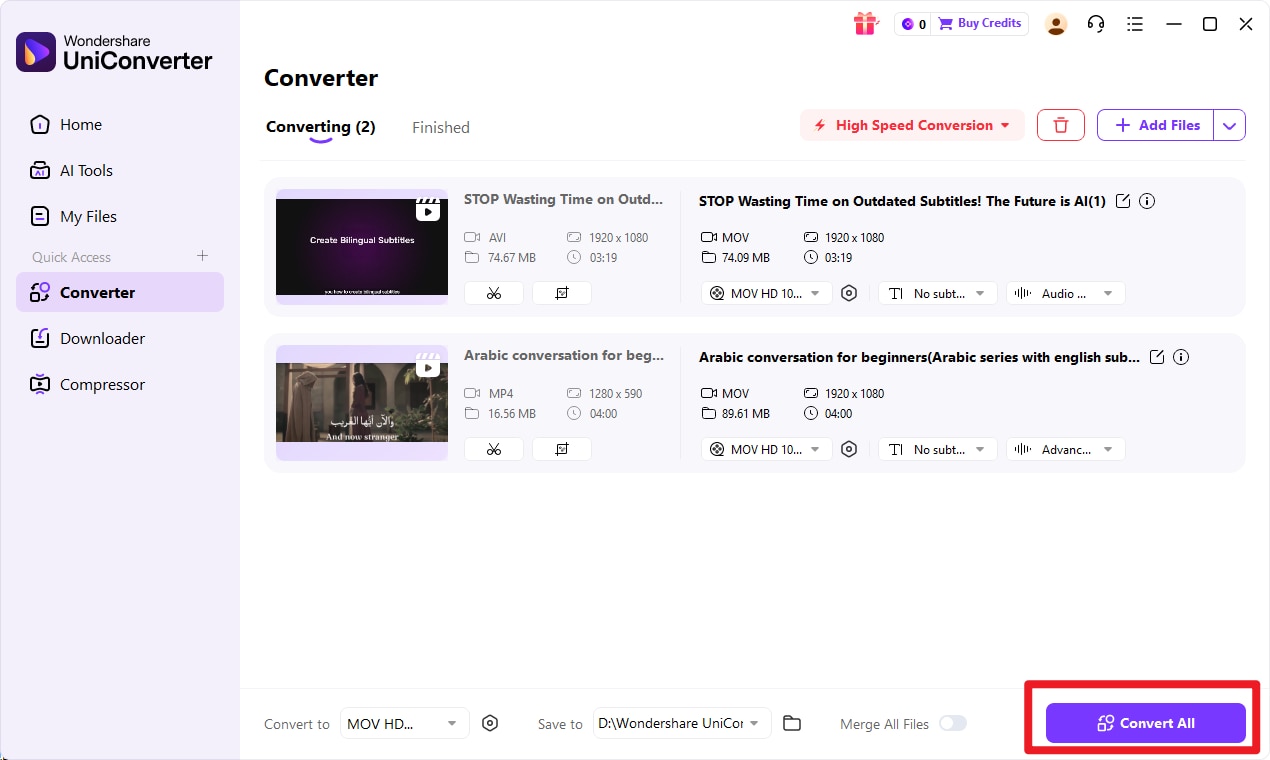
After the conversion is complete, the status bar will show "Success." You can find your newly converted file by clicking the Finished tab at the top of the window. From there, click the "Open" icon next to the file to immediately locate it in the destination folder you selected.

Go Beyond Simple AV1 Conversion
Conclusion
The battle between AV1 and VVC is a classic tale of two different philosophies: open accessibility versus ultimate performance. AV1's greatest strength is its royalty-free model, which has fueled its rapid adoption across the web and made it the de facto standard for major streaming services. VVC, on the other hand, stands as a testament to pure engineering prowess, offering the best compression efficiency on the market, making it the heir apparent for broadcasting and professional industries where every bit matters.
Ultimately, the "better" codec is the one that best fits the job. For open web standards, cost-sensitive applications, and widespread consumer use, AV1 is the clear winner for now. For specialized, high-stakes applications where bandwidth is at an absolute premium and licensing costs can be managed, VVC represents the future. As a user or content creator, you will likely encounter both. This is why having a versatile and reliable tool like Wondershare UniConverter is so crucial. It empowers you to navigate the evolving codec landscape with confidence, ensuring you can play, edit, and convert any video file with ease, regardless of its format.
FAQs
-
1. Is VVC higher quality than AV1?
Not necessarily. At the same bitrate, VVC can often deliver higher visual quality due to its superior compression algorithms. However, both codecs are capable of achieving visually lossless quality. The perceived quality will depend on the encoding settings, bitrate, and content. -
2. Why did Google and Netflix create AV1?
Google, Netflix, and other tech giants formed the Alliance for Open Media to create AV1 as a high-performance, royalty-free video codec. Their primary motivation was to avoid the complex and expensive patent licensing associated with HEVC (H.265) and its successor, VVC, thereby reducing operational costs and fostering open innovation on the web. -
3. Will my phone support AV1 or VVC?
Many new high-end and mid-range Android devices released in the last few years include hardware decoding support for AV1. Support is also built into major web browsers on both desktop and mobile. VVC support in consumer devices is still extremely rare as of 2026 but is expected to appear in future flagship devices and smart TVs. -
4. What is the easiest way to play an AV1 file if my player does not support it?
If your default media player or device cannot play an AV1 file, the simplest and most reliable solution is to convert it. Using a powerful video converter like Wondershare UniConverter, you can quickly change the AV1 file into a universally supported format like MP4 (H.264), which will play on virtually any device or software.
