
In the ever-evolving world of digital video, codecs are the unsung heroes that make streaming, downloading, and sharing possible. They compress massive video files into manageable sizes without completely sacrificing quality. Two of the biggest names in this space are AV1 and the family of MPEG codecs. The debate of AV1 vs MPEG is becoming increasingly relevant for content creators, tech enthusiasts, and even casual users who simply want their videos to play. If you've ever wondered which codec is better, or why a video file won't play on your device, you've come to the right place.
This guide will demystify these complex technologies. We'll break down the key differences between AV1 and popular MPEG standards like H.264 and H.265, helping you understand their respective strengths and weaknesses in terms of quality, file size, and compatibility.
In this article:
- What are the AV1 and MPEG codecs?
- A quick comparison table of their key features.
- A detailed breakdown of which codec is better for different needs.
- Common use cases for AV1 and MPEG.
- A step-by-step guide to solve compatibility issues by converting AV1 to MPEG.
Part 1. What is AV1? What is MPEG?
Before we can compare them, it's essential to understand what each of these terms represents. They are not just different file types; they are fundamentally different technologies for encoding and decoding video.
What is AV1 (AOMedia Video 1)?
AV1, short for AOMedia Video 1, is a modern, open-source, and royalty-free video coding format. It was developed by the Alliance for Open Media (AOM), a consortium of the world's leading technology companies, including Google, Apple, Netflix, Amazon, Microsoft, and Meta. The primary goal behind AV1's creation was to develop a next-generation video codec that could deliver high-quality video over the internet more efficiently than ever before.
Its key characteristic is its superior compression. AV1 can significantly reduce the data required for video streaming without a noticeable drop in visual quality. This makes it a game-changer for streaming services looking to deliver 4K and 8K content to users with varying internet speeds and for individuals wanting to save on bandwidth and storage space. Being royalty-free also encourages widespread adoption, as manufacturers and software developers can implement it without paying licensing fees.
What is MPEG (Moving Picture Experts Group)?
Unlike AV1, MPEG isn't a single codec. It refers to a family of digital video compression standards developed by the Moving Picture Experts Group. Over the decades, this group has released several highly influential standards that have shaped the digital media landscape. For this comparison, we will focus on the two most relevant and widely used MPEG standards in 2026:
- MPEG-4 Part 10 (AVC/H.264): Often referred to as AVC (Advanced Video Coding) or H.264, this is the undisputed king of video codecs. For over a decade, it has been the industry standard due to its excellent balance of compression efficiency and, most importantly, its universal compatibility. A video encoded in H.264 will play on virtually any device, platform, or browser, from smartphones and laptops to smart TVs and gaming consoles.
- MPEG-H Part 2 (HEVC/H.265): Known as HEVC (High Efficiency Video Coding) or H.265, this is the official successor to H.264. It was designed to handle the demands of ultra-high-definition video. H.265 offers significantly better compression than H.264—up to 50% more efficient—making it the preferred codec for 4K and 8K content. While its adoption isn't as universal as H.264's, it is widely supported on modern devices. However, its use often involves complex and costly licensing fees.
Part 2. Quick Comparison Table
To get a clear overview of how these codecs stack up, let's look at a direct comparison of their most important attributes.
AV1 vs MPEG (H.264/H.265) at a Glance
| Feature | AV1 | MPEG (H.264/H.265) |
| Royalty Fees | Royalty-free | Requires licensing fees |
| Compression Efficiency | Highest | Good (H.264) to Very Good (H.265) |
| Video Quality | Excellent, especially at low bitrates | Very good, but can show artifacts at very low bitrates compared to AV1 |
| Device & Browser Support | Growing, but not yet universal | Universal (H.264) to Widespread (H.265) |
| Encoding/Decoding Requirements | Computationally intensive, requires modern hardware | Less intensive, widely supported by hardware acceleration |
Part 3. AV1 vs MPEG: Which One Is Better?
The answer to "which is better?" depends entirely on your priorities. Each codec excels in different areas, creating a trade-off between efficiency, quality, compatibility, and performance.
Compression and File Size: The AV1 Advantage
When it comes to pure compression efficiency, AV1 is the clear winner. Studies and real-world applications have shown that AV1 can be up to 30% more efficient than H.265/HEVC, and even more efficient compared to H.264.
What does this mean in practice? It means AV1 can achieve the exact same level of video quality as H.265 but with a file size that is 30% smaller. For streaming platforms like YouTube and Netflix, this is a massive advantage. It allows them to stream higher-quality video to users while using less bandwidth, reducing buffering and saving on data costs. For individuals, this translates to smaller file sizes for video archives, freeing up valuable storage space on hard drives and cloud services.
Quality: Maintaining Clarity at Low Bitrates
While both AV1 and modern MPEG codecs can produce stunning video quality, AV1 has a distinct edge, particularly when bandwidth is limited. One of the primary goals of AV1's design was to preserve image detail and avoid distracting visual artifacts (like blockiness or blurring) at very low bitrates.
If you compare a video encoded in AV1 and H.265 at the same low bitrate, the AV1 version will often look visibly cleaner and more detailed. This makes it the superior choice for delivering a consistent, high-quality viewing experience in challenging network conditions, such as on mobile connections or slow Wi-Fi.
Compatibility and Adoption: MPEG's Dominance
This is where the MPEG family, especially H.264, holds an insurmountable lead. H.264 is the most universally compatible video codec in history. It is supported by nearly every digital device manufactured in the last 15 years. If your top priority is ensuring your video can be played by anyone, anywhere, on any device, H.264 is the safest and most reliable choice.
H.265/HEVC enjoys widespread support on modern hardware, particularly devices capable of 4K playback like new smart TVs, flagship smartphones, and current-generation computers. However, it can still run into issues on older hardware that lacks dedicated decoding support.
AV1, being the newest of the three, has the most limited compatibility. While adoption is growing rapidly—with support built into modern browsers like Chrome and Firefox, new smart TVs, and the latest GPUs from NVIDIA, AMD, and Intel—it is far from universal. Many older devices, some popular video editing software, and legacy media players cannot play AV1 files natively. This "compatibility gap" is the single biggest hurdle for AV1's widespread use today.
Performance: The Cost of Encoding
AV1's advanced compression algorithms come at a cost: performance. Encoding a video into the AV1 format is a significantly more computationally intensive process than encoding into H.264 or H.265. It takes much longer and requires a more powerful CPU. While this is manageable for large companies like Google and Netflix with massive server farms, it can be a major drawback for individual content creators on a deadline.
Decoding (or playing) AV1 video also demands more processing power than MPEG codecs. On older devices without dedicated AV1 hardware decoding, attempting to play a high-resolution AV1 file can result in stuttering, dropped frames, or a complete failure to play. Modern devices with hardware acceleration can handle AV1 smoothly, but the performance requirement is still a key consideration.
Part 4. Use Cases for AV1 and MPEG
Understanding the pros and cons of each codec helps us identify the best scenarios for using them.
When to Use AV1
You should choose AV1 in situations where efficiency and quality are paramount, and you have control over the playback environment or are targeting modern devices.
- High-Resolution Streaming: For streaming services delivering 4K and 8K video over the internet, AV1 is the ideal choice. Its ability to reduce bandwidth usage while maintaining quality is critical for providing a smooth experience to millions of users.
- Video Archiving: If you have a large library of videos and want to store them in the best possible quality for the smallest file size, encoding them in AV1 is an excellent long-term strategy. This is perfect for archiving personal video collections or professional footage.
When to Use MPEG (H.264/H.265)
MPEG codecs remain the practical choice for a wide range of applications, especially when compatibility is a concern.
- Use H.264 for Maximum Compatibility: When you need to share a video that must play everywhere—on social media, in an email, on a company website, or on an older device—H.264 is the go-to codec. Its universal support guarantees that your audience will be able to watch it without any issues.
- Use H.265 for High-Quality Modern Delivery: For creating high-quality 4K video content intended for modern TVs, streaming devices, and smartphones, H.265 strikes a great balance. It offers much better compression than H.264 and is widely supported by the hardware that will be used to view it.
Solving the Compatibility Problem
What happens when these worlds collide? You might download a high-quality movie encoded in AV1 to save space, only to find that your favorite media player or older smart TV can't play it. This is a common and frustrating problem.
The solution is simple: you need a reliable video converter. A powerful and user-friendly tool like Wondershare UniConverter can bridge this compatibility gap effortlessly. It allows you to take an AV1 file and quickly convert it into a universally compatible format like MP4 with an H.264 codec. This process preserves as much quality as possible while ensuring your video can be played on any device you own, effectively solving any playback issues you encounter.
Part 5. Step-by-Step Guide to Convert AV1 to MPEG Using UniConverter
Wondershare UniConverter is a fast and intuitive tool that makes converting video formats simple. If you need to convert an AV1 file to a more compatible MPEG format, follow these four easy steps.
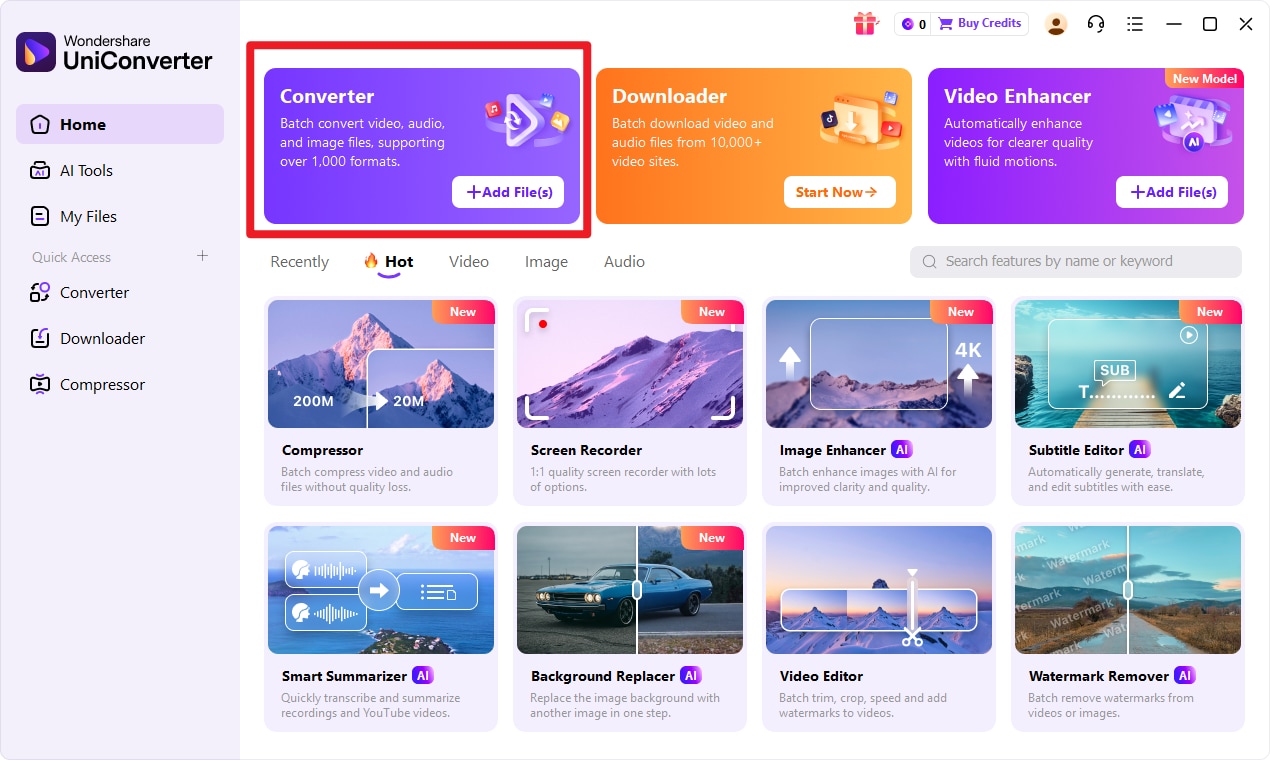
Step 1. Choose Converter in UniConverter
Launch the UniConverter application on your computer. On the main screen, select the Converter tab from the left-side menu.
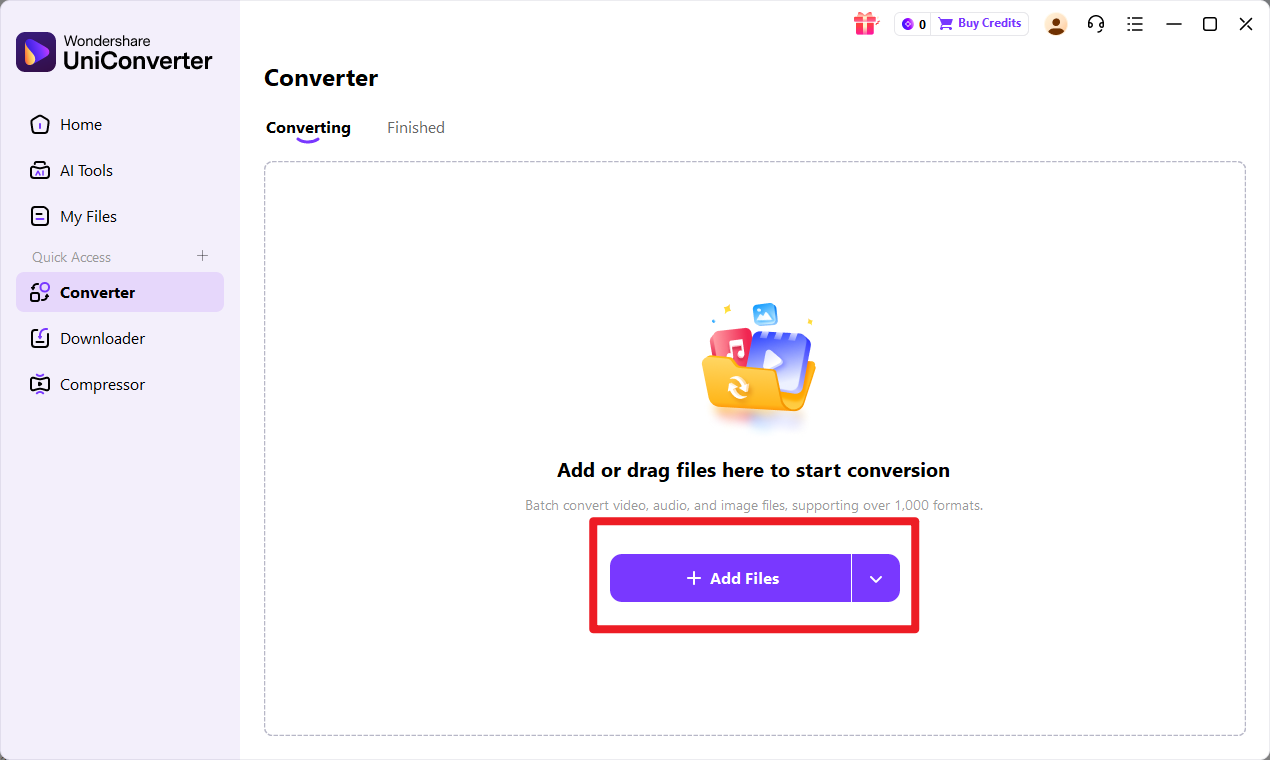
Step 2. Add Files to UniConverter
Click the "Add Files" button or simply drag and drop your input format video file directly into the converter window. You can add multiple files to convert them in a batch.
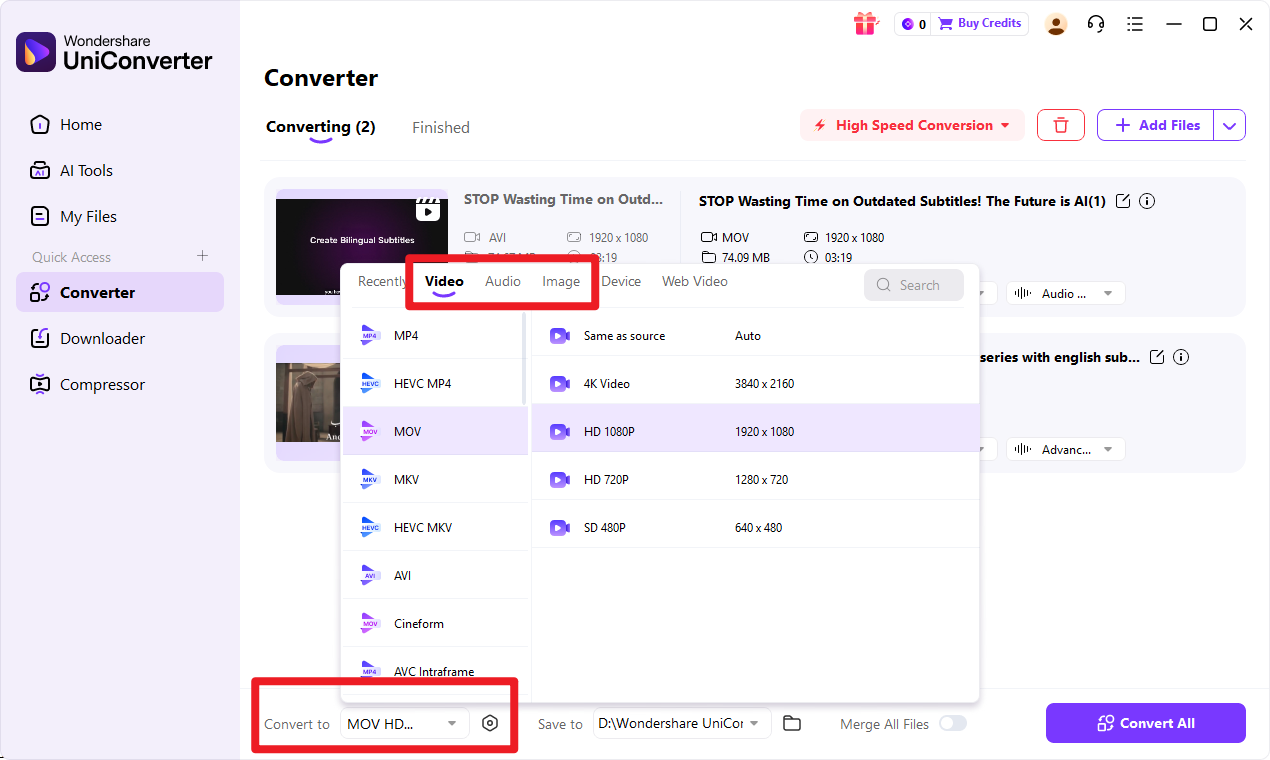
Step 3. Choose Output Format
Click on the "Output Format" option at the bottom of the window. In the new dialog, navigate to the Video tab, select your desired target format (like MP4), and choose a preset with the H.264 codec.
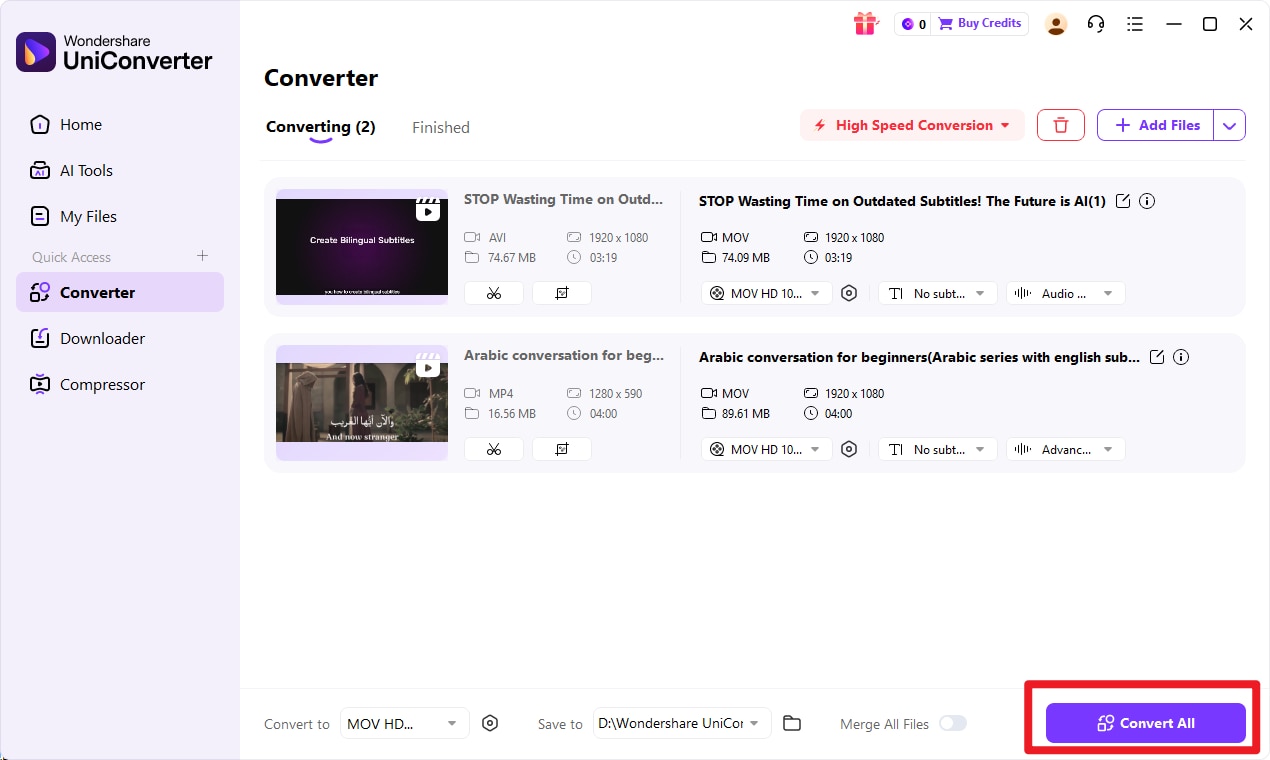
Step 4. Start the Conversion
Finally, select a location for your converted file using the "File Location" option. Click the "Start All" button to begin the high-speed conversion process.

More Than Just a Video Converter
FAQs
-
1. Is AV1 better than MPEG-4?
In terms of compression efficiency and quality at low bitrates, AV1 is technically superior to MPEG-4 (H.264). It can deliver the same or better quality at a smaller file size. However, MPEG-4 is far more compatible with a wider range of devices, making it a more practical choice for universal sharing. -
2. Why is AV1 not widely used yet?
AV1 is still relatively new, and its advanced compression algorithms require significant processing power to encode. Hardware and software adoption takes time, as manufacturers and developers need to integrate support into their products. However, with major tech companies actively pushing for its adoption, its use is growing rapidly every year. -
3. Does YouTube use AV1 or MPEG?
YouTube uses both. It intelligently detects your device's capabilities. If you are using a compatible device (like a modern Android phone, a new smart TV, or a desktop browser like Chrome), YouTube will often stream video in AV1 to save bandwidth and deliver higher quality. For all other devices, it falls back to older, more compatible codecs like H.264 (AVC) or VP9. -
4. Can my computer play AV1 files?
Most modern web browsers (Chrome, Firefox, Edge) and popular media players (like VLC Media Player and PotPlayer) can play AV1 files. However, smooth playback, especially for high-resolution 4K or 8K video, depends heavily on your computer's hardware. If your CPU or GPU lacks dedicated AV1 decoding support, you may experience stuttering or high CPU usage. If you face issues, converting the file is the easiest solution.
Conclusion
The choice in the AV1 vs MPEG debate is a classic trade-off between future-facing technology and present-day practicality. AV1 is undeniably the future of video compression, offering superior efficiency and quality that is perfect for the age of high-resolution streaming. However, its adoption is still in progress, and its performance demands can be a barrier. On the other hand, MPEG codecs, particularly the universally compatible H.264, remain the dominant force in the present. H.264 ensures your video works everywhere, while H.265 provides a great middle ground for modern 4K content.
For most users, the best approach is to use MPEG (H.264) for sharing and H.265 for high-quality personal projects. When you inevitably encounter a cutting-edge AV1 file that your device can't handle, the problem is easily solved. Using a reliable and efficient tool like Wondershare UniConverter allows you to convert any video format with ease, ensuring you never have to worry about compatibility again.
