
In the ever-evolving landscape of digital video, two codecs stand at the forefront of innovation: AV1 and H.265. For content creators, developers, and even casual users, choosing the right video format is a critical decision that impacts quality, file size, and compatibility. The AV1 vs H.265 debate is more relevant than ever, as one represents the royalty-free future of web video, while the other remains the established standard for high-efficiency compression. Understanding their core differences is key to making an informed choice for your specific needs.
Whether you're a YouTuber trying to optimize upload times, a developer building a new streaming app, or simply someone trying to manage your personal video library, this guide will break down the complexities. We'll compare these two powerful codecs on every important metric, from compression efficiency to hardware support, helping you decide which one is right for you in 2026.
In this article
Part 1. What is AV1? What is H.265?
Before diving into a direct comparison, it's essential to understand what each codec is and where it comes from. Their origins and development goals are fundamental to their strengths and weaknesses.
What is AV1 (AOMedia Video 1)?
AV1, or AOMedia Video 1, is a modern, open-source, and royalty-free video coding format. It was developed by the Alliance for Open Media (AOM), a consortium of the world's most influential tech companies. Its founding members include Google, Amazon, Netflix, Apple, Microsoft, Meta, and Intel.
The primary goal behind AV1's creation was to develop a next-generation video standard for the internet that was not encumbered by patent licensing fees. It is specifically designed to deliver superior compression efficiency, enabling high-quality video streaming even over limited bandwidth connections. As the successor to Google's VP9, AV1 aims to become the new default codec for web video, from streaming platforms to real-time communication.
What is H.265 (HEVC)?
H.265, also known by its technical name High-Efficiency Video Coding (HEVC), is the direct successor to the ubiquitous H.264/AVC standard. It was developed jointly by the ITU-T Video Coding Experts Group (VCEG) and the ISO/IEC Moving Picture Experts Group (MPEG).
Launched several years before AV1, H.265 was designed to address the growing demand for higher-resolution video. It offers a significant compression improvement over H.264, making it possible to stream 4K and even 8K video without a massive increase in file size. However, its biggest challenge has been its complex and costly licensing structure, which involves multiple patent pools and has slowed its universal adoption.
Part 2. Quick Comparison Table
To get a clear overview of the key differences, let's look at a side-by-side comparison of the two codecs.
AV1 vs H.265: Head-to-Head Comparison
| Feature | AV1 (AOMedia Video 1) | H.265 (HEVC) |
| Compression Efficiency | Superior. Up to 30% more efficient than H.265 at the same quality. | Excellent. Roughly 50% more efficient than its predecessor, H.264. |
| Video Quality at Low Bitrates | Exceptional. Maintains detail and reduces artifacts effectively. | Good, but can show more blockiness and artifacts than AV1 at very low bitrates. |
| Royalty & Licensing Fees | Completely royalty-free and open-source. | Complex and costly, with multiple patent pools and licensing fees required. |
| Hardware & Software Adoption | Rapidly growing, supported by new GPUs, CPUs, browsers, and streaming platforms. | Widespread. Native support in most modern smartphones, cameras, and smart TVs. |
| Encoding & Decoding Complexity | High. Requires more computational power, leading to slower encoding times. | Moderate. Less demanding than AV1 but more demanding than H.264. |
| Key Backers & Developers | Alliance for Open Media (Google, Amazon, Apple, Netflix, Microsoft, etc.). | ITU-T VCEG and ISO/IEC MPEG. |
Part 3. AV1 vs H.265: Which One Is Better?
The "better" codec depends entirely on your priorities. Let's break down the comparison across the most important factors: compression, quality, cost, and compatibility.
Compression and File Size: AV1's Efficiency Edge
When it comes to pure compression efficiency, AV1 is the clear winner. Studies have consistently shown that AV1 can achieve the same level of visual quality as H.265 while using up to 30% less data. This is a game-changing advantage.
For streaming services, this means significantly lower bandwidth costs and the ability to deliver a smoother, higher-quality experience to users. For content creators, it means smaller file sizes, which translates to faster uploads to platforms like YouTube and less storage space required for archiving. For the end-user, it means less data consumption when watching videos on a mobile device and less buffering on slower internet connections.
Video Quality: The Battle for Visual Fidelity
Both codecs are capable of producing stunning video quality, especially for high-resolution content like 4K and 8K. In a high-bitrate environment, the visual differences between a well-encoded AV1 file and an H.265 file can be difficult for the average viewer to spot.
However, AV1's advanced compression algorithm gives it a distinct advantage at lower bitrates. When bandwidth is limited, AV1 is better at preserving fine details and minimizing common compression artifacts like blockiness and color banding. This makes it the superior choice for adaptive bitrate streaming, where the video quality must dynamically adjust to the viewer's network conditions.
Licensing and Cost: The Royalty-Free Freedom of AV1
This is perhaps the most significant difference between the two and a major driver of AV1's adoption. AV1 is completely open-source and royalty-free. This means developers, hardware manufacturers, and content distributors can implement and use AV1 in their products and services without paying any licensing fees. This open model fosters innovation and removes a major financial barrier to entry.
In stark contrast, H.265 is covered by a web of patents held by numerous companies. To use H.265, manufacturers and software developers must navigate multiple patent pools (like MPEG LA, HEVC Advance, and Velos Media) and pay licensing fees. This complexity and cost have been a major hurdle, preventing H.265 from fully replacing H.264 and creating the market opportunity that AV1 now fills.
Compatibility and Device Support: H.265's Current Dominance
While AV1 wins on efficiency and cost, H.265 currently holds the advantage in widespread compatibility. Because it has been on the market longer, H.265 (HEVC) enjoys native hardware decoding support in a vast ecosystem of devices. This includes most smartphones released in the last several years, modern digital cameras, drones, and smart TVs. If you record a 4K video on a recent iPhone or Android device, it's almost certainly being saved in H.265.
AV1 support, however, is growing at an incredible pace. All major web browsers (Chrome, Firefox, Edge) now support AV1 playback. New CPUs from Intel and AMD, as well as GPUs from NVIDIA and AMD, include dedicated hardware decoders for AV1, making playback smooth and efficient. Streaming giants like YouTube and Netflix are already serving a significant portion of their content in AV1 to capable devices.
Despite this progress, you will still encounter situations where an AV1 file won't play on an older TV, media player, or mobile device. This compatibility gap is where a reliable video converter becomes an essential tool. A powerful program like Wondershare UniConverter can effortlessly bridge this gap, allowing you to convert AV1 files to the more universally supported H.265 format in just a few clicks.
Part 4. Use Cases for AV1 and H.265
So, which codec should you use? The answer depends on your specific application.
When to Choose AV1
- Online Video Streaming: If you run a video platform or service, AV1 is the clear choice for the future. It will drastically reduce your bandwidth costs and improve the viewing experience for your users, especially those on slower connections.
- Future-Proofing Content: For content creators who want to archive their master files, encoding in AV1 is a smart move. It provides the best quality-to-size ratio and ensures your content is ready for the next generation of platforms and devices, all without future licensing concerns.
- Cost-Sensitive Applications: If you are a developer building an application that involves video, choosing the royalty-free AV1 can save you from significant legal and financial headaches down the line.
When to Choose H.265
- Recording on Modern Devices: Most current digital cameras, drones, and high-end smartphones use H.265 (HEVC) as their default for 4K and 8K recording. For content creation workflows starting from these devices, working with H.265 natively is often the most practical option.
- Maximum Compatibility with Existing Hardware: If your primary goal is to create a video file that will play on the widest possible range of existing devices today—including smart TVs, set-top boxes, and older smartphones—H.265 is the safer bet.
- Physical Media: H.265 is the mandatory video standard for 4K Ultra HD Blu-ray discs. For any projects intended for this format, H.265 is a requirement.
Part 5. Step-by-Step Guide to Convert AV1 to H.265 Using UniConverter
Despite AV1's many advantages, there will be times when you need to convert it to a different format for playback or editing. You might have an AV1 video that won't play on your smart TV or need to import it into an older video editor that doesn't support the codec. In these cases, a powerful and user-friendly video converter is indispensable.
Wondershare UniConverter is the ideal tool for this job. It supports over 1,000 formats, including both AV1 and H.265, and is renowned for its high-speed, high-quality conversions and intuitive interface. Its batch conversion feature allows you to convert multiple files at once, saving you valuable time.
Here's how to easily convert your AV1 files to H.265.
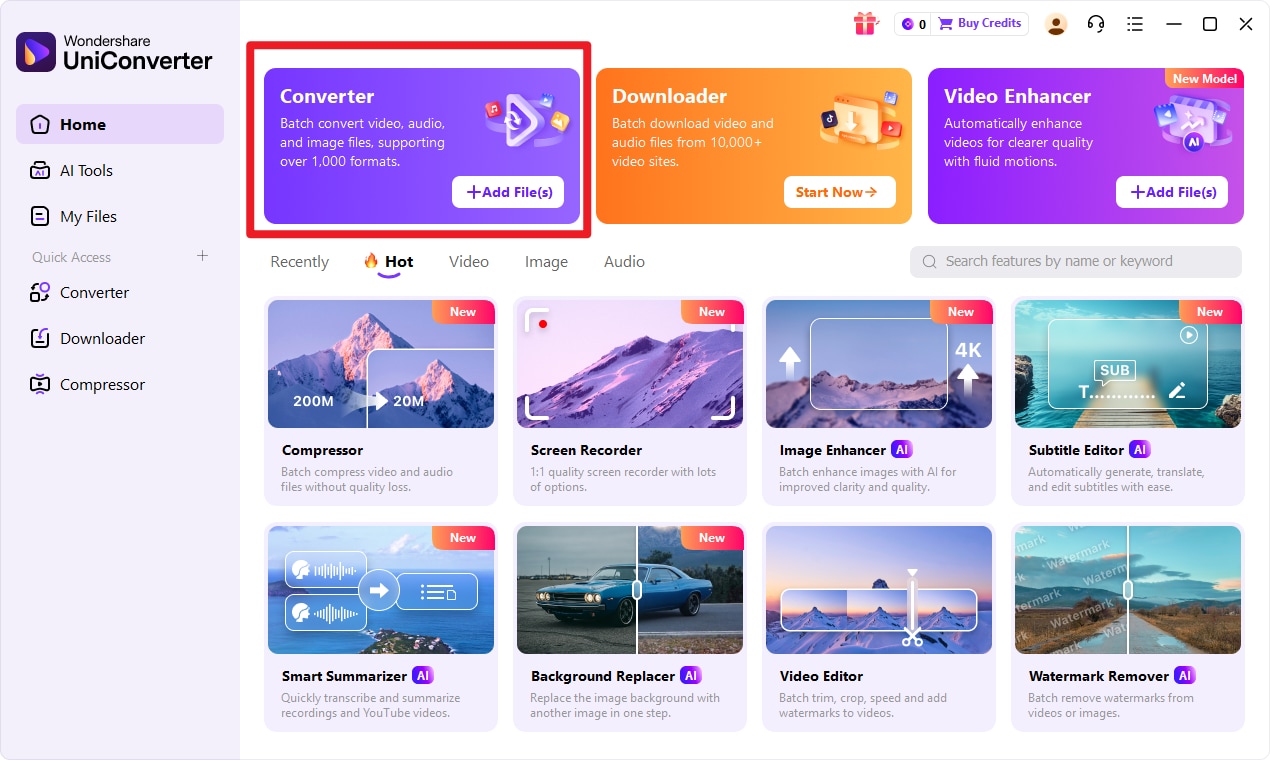
Step 1: Choose Converter in UniConverter
Launch Wondershare UniConverter on your computer. On the main interface, select the Converter tab from the left-side menu to begin.
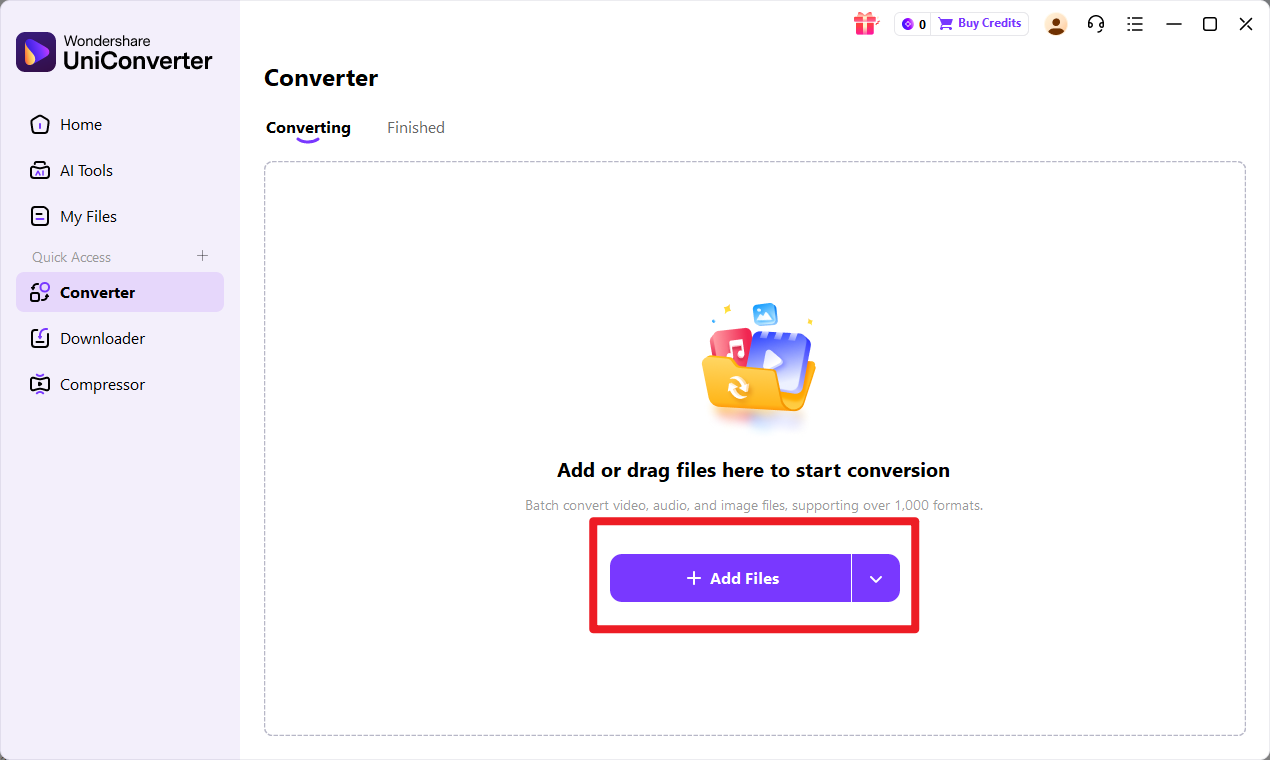
Step 2: Add Files to UniConverter
Click on the Add Files icon or simply drag and drop your input format video files directly into the center of the program window. You can add multiple files to perform a batch conversion.
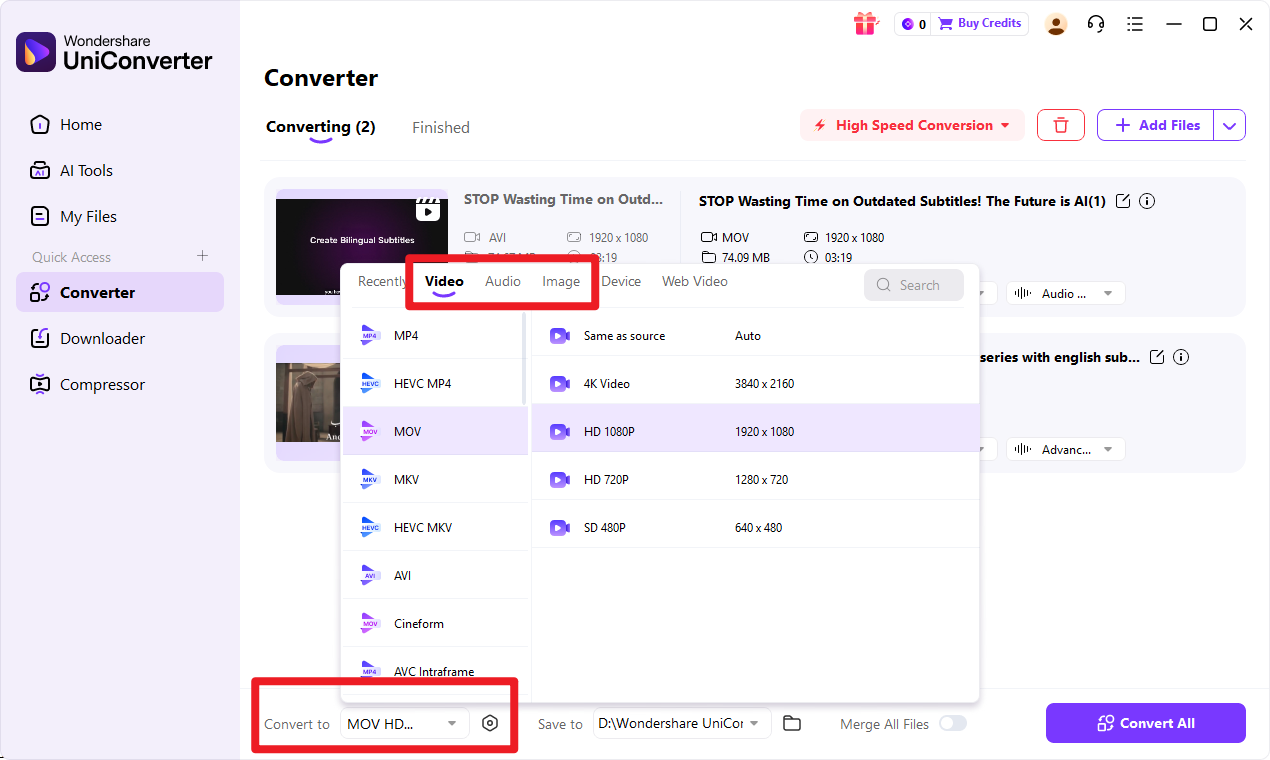
Step 3: Choose Output Format
Click the Output Format option at the bottom of the window. In the new window that appears, go to the Video tab. Select your target format from the list on the left, and then choose your desired resolution on the right.
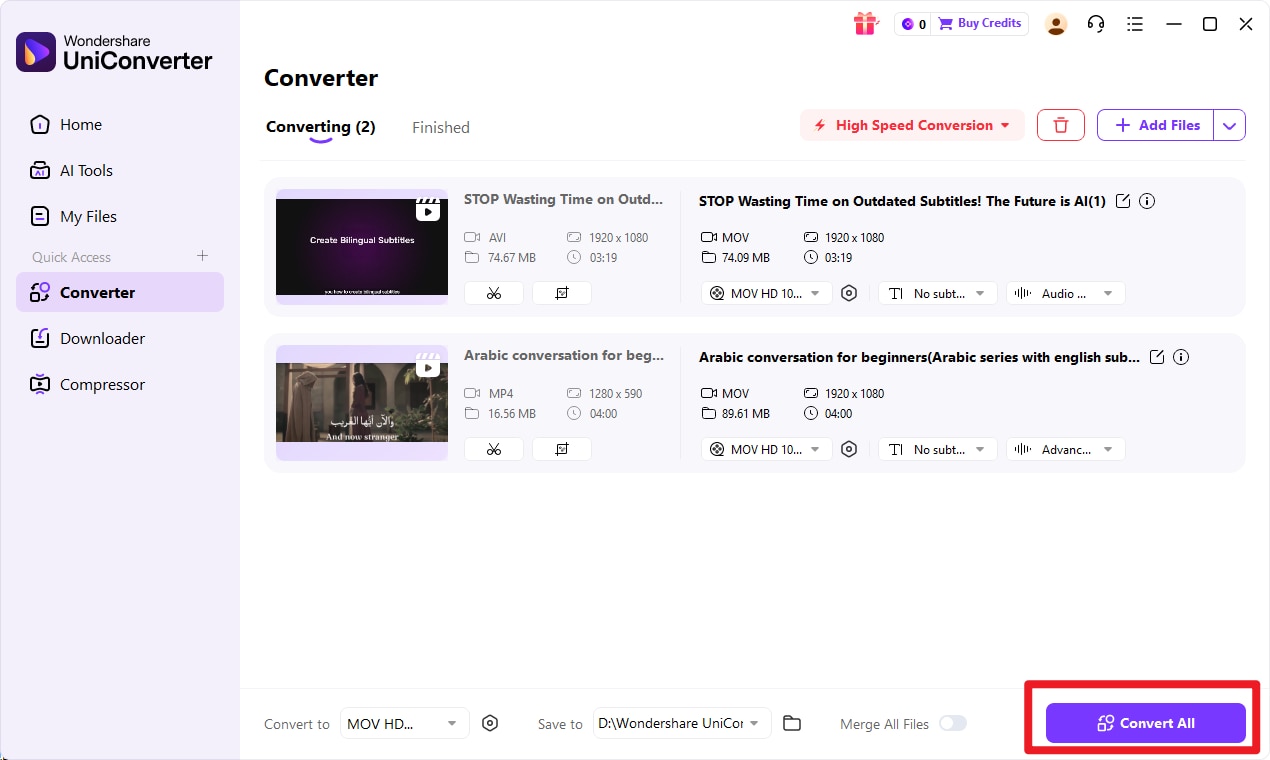
Step 4: Start the Conversion
Select a destination folder for your converted files by clicking the File Location field at the bottom. Finally, click the Start All button to begin the conversion process for all your files.

Go Beyond Simple Video Conversion
Conclusion
The AV1 vs H.265 showdown doesn't have a single winner for every scenario. AV1 is undeniably the codec of the future for web video, offering superior compression efficiency and a crucial royalty-free model that is driving its rapid adoption by tech giants. Its ability to deliver high-quality video at lower bitrates makes it perfect for the streaming era.
On the other hand, H.265 (HEVC) remains the more established and widely compatible standard for now, especially in the world of hardware recording devices and existing consumer electronics. Its maturity gives it a temporary edge in universal playback.
Ultimately, the best choice in 2026 depends on your specific goals. Prioritize AV1 for streaming, future-proofing, and avoiding licensing fees. Stick with H.265 when your primary concern is immediate compatibility with the broadest range of existing hardware. And for any challenges that arise from this evolving landscape, a versatile tool like Wondershare UniConverter is essential to ensure your videos can be played and shared anywhere, anytime.
FAQs
-
1. Is AV1 really better than H.265?
For compression efficiency and cost, yes. AV1 can deliver the same video quality at a significantly lower bitrate (smaller file size) and is completely royalty-free. This makes it technically superior for streaming and distribution. However, H.265 currently has broader native hardware support in devices already on the market. -
2. Why do streaming services like Netflix use AV1?
Streaming services use AV1 primarily to save massive amounts of bandwidth. By compressing video more efficiently, they can reduce their data delivery costs, which are a major operational expense. It also allows them to provide a more stable, high-quality stream to users, even those with slower or less reliable internet connections. -
3. Will AV1 replace H.265?
AV1 is strongly positioned to become the dominant codec for all forms of online video, effectively replacing H.265 in that domain. However, H.265 will likely coexist for many years, especially in professional broadcasting, physical media, and as a legacy format supported by billions of devices already in consumers' hands. -
4. How can I play an AV1 video if my device does not support it?
The easiest and most reliable way to play an AV1 video on an unsupported device is to convert it first. You can use a video converter like Wondershare UniConverter to quickly change the AV1 file into a more universally compatible format like H.265 (HEVC) or the even more widely supported H.264 (AVC).
