
In the ever-evolving world of digital video, codecs are the unsung heroes that make streaming, downloading, and sharing content possible. Two of the most prominent names in this space are AV1 and H.264. While H.264 has been the reigning champion for years, the newer AV1 codec is rapidly gaining ground. This often leaves content creators, tech enthusiasts, and even casual users wondering which one is truly better. The AV1 vs H.264 debate isn't just a technical curiosity; it has real-world implications for video quality, storage costs, and device compatibility. If you've ever struggled with a video file that won't play or wondered how streaming giants deliver stunning 4K content without constant buffering, understanding these codecs is the key.
This comprehensive guide will break down the complex world of video codecs into a clear, practical comparison. We'll explore the strengths and weaknesses of both AV1 and H.264, helping you understand which one is the right choice for your specific needs. Whether you're a professional videographer aiming for the best quality, a developer building the next big streaming app, or simply someone trying to play a downloaded movie, this article has you covered.
In this article
- An introduction to the AV1 and H.264 codecs.
- A quick comparison table highlighting their key differences.
- A detailed head-to-head analysis of quality, compression, compatibility, and more.
- Practical use cases to help you decide when to use each codec.
- A step-by-step guide on how to convert AV1 to H.264 for universal playback.
Part 1. What is AV1? What is H.264?
Before we dive into a detailed comparison, it's essential to understand what these codecs are and where they come from. They are the fundamental technologies that compress and decompress digital video, directly impacting everything from file size to visual fidelity.
What is AV1 (AOMedia Video 1)?
AV1, or AOMedia Video 1, is a modern, open-source, and royalty-free video coding format. It was developed by the Alliance for Open Media (AOM), a consortium of tech giants founded in 2015. Its members include some of the biggest names in the industry, such as Google, Netflix, Amazon, Apple, Microsoft, and Meta.
The primary goal behind AV1's creation was to develop a next-generation codec specifically optimized for internet streaming. Its standout feature is its superior compression efficiency. This means AV1 can deliver the same or even better video quality than older codecs but at a significantly smaller file size. This is a game-changer for streaming services looking to provide 4K and HDR content to users with varying internet speeds, as it reduces buffering and saves on bandwidth costs. Its royalty-free nature also encourages widespread adoption without the financial burden of licensing fees.
What is H.264 (Advanced Video Coding)?
H.264, also known as Advanced Video Coding (AVC) or MPEG-4 Part 10, has been the undisputed industry standard for over a decade. Developed by the ITU-T Video Coding Experts Group (VCEG) and the ISO/IEC Moving Picture Experts Group (MPEG), it was finalized in 2003 and has since become the most widely used codec in the world.
You can find H.264 in everything from Blu-ray discs and broadcast television to YouTube videos and video conferencing calls. Its immense popularity stems from its excellent balance between video quality, file size, and computational requirements. It provides good compression without demanding excessive processing power for encoding or decoding. This has led to near-universal hardware and software support, ensuring that a video encoded in H.264 will play on almost any device you can think of, from smartphones and smart TVs to older computers.
Part 2. Quick Comparison Table
For a quick overview, this table summarizes the core differences between AV1 and H.264 across the most important metrics.
| Feature | AV1 (AOMedia Video 1) | H.264 (Advanced Video Coding) |
| Compression Efficiency | Superior; up to 30-50% more efficient than H.264 | Good, but less efficient than modern codecs |
| File Size at Same Quality | Significantly smaller | Larger |
| Video Quality at Same Bitrate | Higher; better detail retention in complex scenes | Lower; can show more artifacts at low bitrates |
| Device & Software Compatibility | Growing, but limited to modern devices and browsers | Universal; supported by virtually all devices |
| Licensing Model | Royalty-free | Royalty-based; requires licensing fees for use |
| Encoding & Decoding Performance | Computationally intensive; requires modern hardware | Fast and efficient; runs well on older hardware |
Part 3. AV1 vs H.264: Which One Is Better?
The question of which codec is "better" depends entirely on your priorities. One excels in efficiency and future-proofing, while the other offers unparalleled compatibility. Let's break down their performance in key areas.
Compression and File Size: The Efficiency Champion
When it comes to compression, AV1 is the clear winner. It was designed from the ground up to be more efficient than its predecessors. In practice, AV1 can reduce file sizes by 30-50% compared to H.264 while maintaining the same level of visual quality.
Imagine you have a high-quality 10-minute 4K video. Encoded with H.264, it might be 1 GB. The same video encoded with AV1 could be as small as 500-700 MB without any noticeable loss in quality. This has massive benefits for both content distributors and consumers. For streaming services like Netflix and YouTube, it means lower bandwidth costs and smoother streaming experiences for users, especially those on slower connections. For individuals, it means saving significant storage space on hard drives and faster uploads and downloads.
Video Quality: A Look at Visual Fidelity
Because AV1 is more efficient, it can also deliver higher video quality at the same bitrate as H.264. A bitrate is the amount of data used to represent one second of video. If you give both codecs the same data budget (e.g., 5 Mbps), AV1 will produce a cleaner, more detailed image.
This is particularly noticeable in complex scenes with a lot of motion, textures, or fine details. Where H.264 might start to show blocky artifacts or a loss of sharpness, AV1 often retains a more stable and visually pleasing picture. For content creators focused on delivering the highest possible visual fidelity, especially in 4K and HDR, AV1 offers a distinct advantage.
Compatibility and Adoption: The Deciding Factor for Many
This is where H.264 holds its strongest card. Having been the standard for nearly two decades, H.264 enjoys universal support. Virtually every smartphone, tablet, smart TV, computer, and web browser manufactured in the last 15 years can play H.264 video without any issues. This makes it the safest and most reliable choice for content that needs to reach the widest possible audience.
AV1, being much newer, is still in the process of being adopted. While support is growing rapidly—modern web browsers like Chrome, Firefox, and Edge support it, as do many new smart TVs and mobile chips—it is far from universal. Older devices, many video editing software programs, and even some current hardware lack native decoding support for AV1. This can lead to playback failure or force the device to use software decoding, which consumes more battery and can result in stuttering. For now, compatibility remains AV1's biggest hurdle.
Performance: The Hardware Demands
AV1's advanced compression algorithms come at a cost: performance. Encoding (compressing) a video into the AV1 format is significantly more computationally intensive and time-consuming than encoding into H.264. It requires powerful, modern processors to complete in a reasonable amount of time. While encoding technologies are improving, H.264 remains much faster and less demanding.
The same is true for decoding (playing back) the video. While many new devices have dedicated hardware decoders for AV1 that make playback smooth and efficient, older devices without this hardware must rely on software decoding. This puts a heavy strain on the CPU, leading to increased battery drain on mobile devices and potential playback issues like dropped frames or stuttering, especially with high-resolution content. H.264, by contrast, is lightweight and plays back smoothly on even very old hardware.
Licensing: The Cost of Use
One of AV1's founding principles is its royalty-free licensing model. This is a major advantage for software developers, hardware manufacturers, and content platforms. They can implement and use AV1 in their products and services without paying licensing fees, which removes a significant financial barrier and encourages innovation and adoption.
H.264, on the other hand, is managed by patent pools (primarily MPEG LA) that charge royalties for its use in products. While these costs are often absorbed by manufacturers and are not directly passed on to end-users, they represent a significant expense for the industry. The royalty-free nature of AV1 makes it a very attractive alternative for companies looking to reduce costs and avoid complex licensing agreements.
Part 4. Use Cases for AV1 and H.264
So, when should you use one over the other? The best choice depends on your specific goals and target audience.
When You Should Choose AV1
AV1 is the forward-thinking choice, ideal for situations where efficiency and quality are paramount. Consider using AV1 if:
- You are streaming 4K and HDR content: Its superior compression is perfect for delivering ultra-high-definition video over the internet, minimizing buffering and saving bandwidth for both you and your viewers.
- You are archiving large video libraries: If you need to store a massive amount of video footage, encoding it in AV1 can cut your storage requirements nearly in half compared to H.264, saving you money on hard drives or cloud storage.
- Your target audience uses modern devices: If you are confident that your viewers will be watching on up-to-date computers, smartphones, and smart TVs from 2026, AV1 can provide them with a better viewing experience. This is why platforms like YouTube and Netflix are increasingly using it for their most popular content.
When You Should Stick with H.264
H.264 remains the reliable workhorse, perfect for scenarios where compatibility is the top priority. You should stick with H.264 when:
- You need to ensure maximum compatibility: If your video needs to play on the widest possible range of devices, including older models and diverse platforms, H.264 is the only guaranteed choice.
- You are in a video editing workflow: Most video editing software is highly optimized for H.264. Using it ensures smooth timeline scrubbing, fast rendering, and fewer compatibility headaches during post-production.
- You are creating content for social media: Many social media platforms have strict upload specifications and may not yet fully support AV1. Using H.264 ensures your video will be processed correctly and displayed as intended.
Part 5. Step-by-Step Guide to Convert AV1 to H.264 Using UniConverter
What happens when you have an AV1 file that won't play on your TV or in your favorite video editor? The easiest solution is to convert it to the universally compatible H.264 format. Wondershare UniConverter is a powerful and user-friendly tool that handles this conversion seamlessly. It supports over 1,000 formats, offers GPU-accelerated conversions, and is the top recommended tool for this task.
Follow these four simple steps to convert your files.
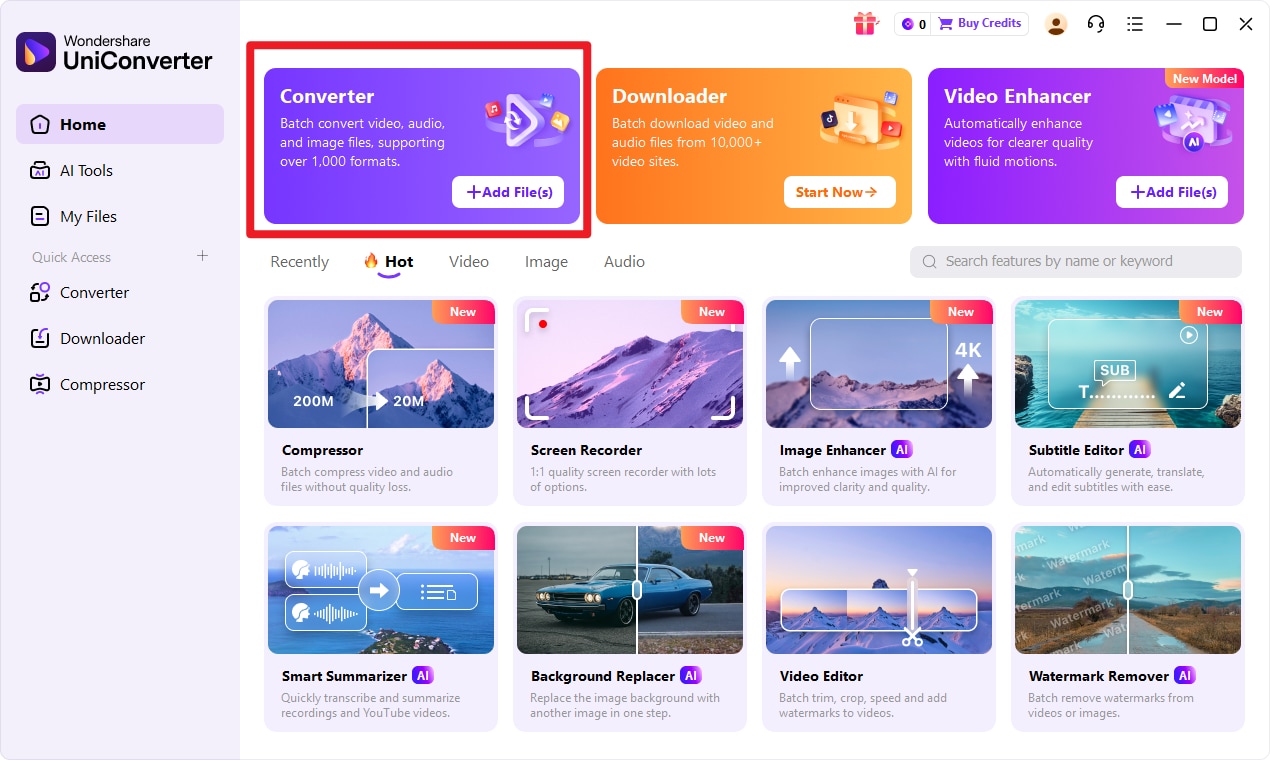
Step 1: Choose Converter in UniConverter
Launch Wondershare UniConverter on your computer. On the main interface, you will see a list of tools on the left. Select the Converter option to begin.
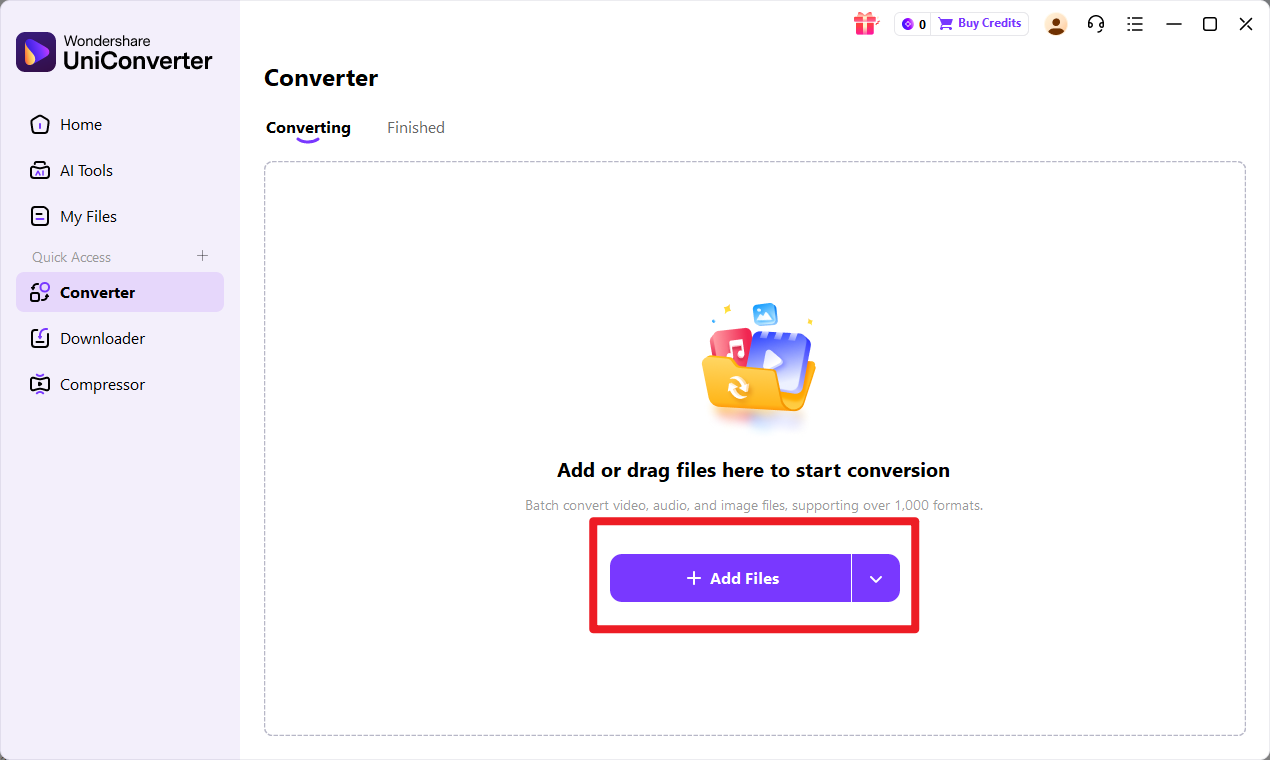
Step 2: Add Files to UniConverter
Click on the Add Files icon in the center of the screen or simply drag and drop your input format video file directly into the program window. UniConverter allows you to add multiple files at once to perform a batch conversion, saving you valuable time.
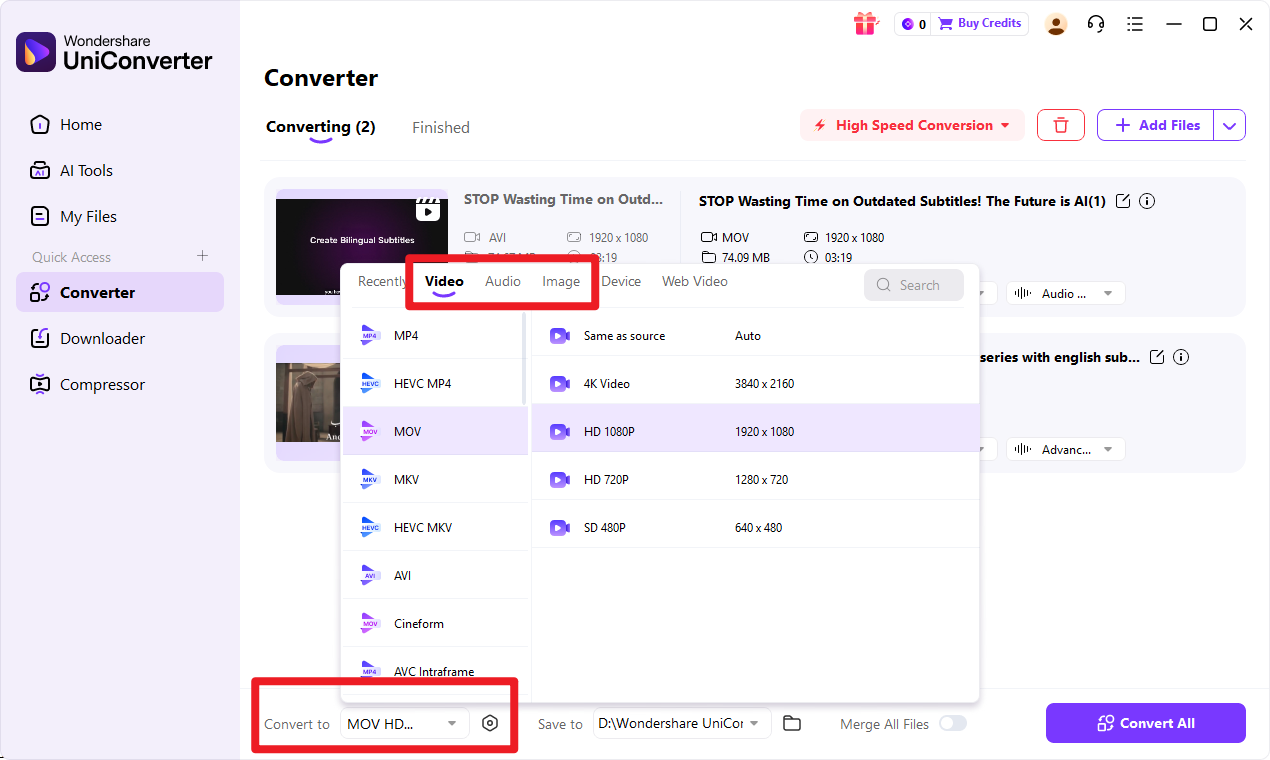
Step 3: Choose Output Format
At the bottom of the window, click on the Output Format menu. This will open a new window with format options. Navigate to the Video tab, select your target format from the list on the left, and then choose your desired resolution on the right (e.g., "Same as source").
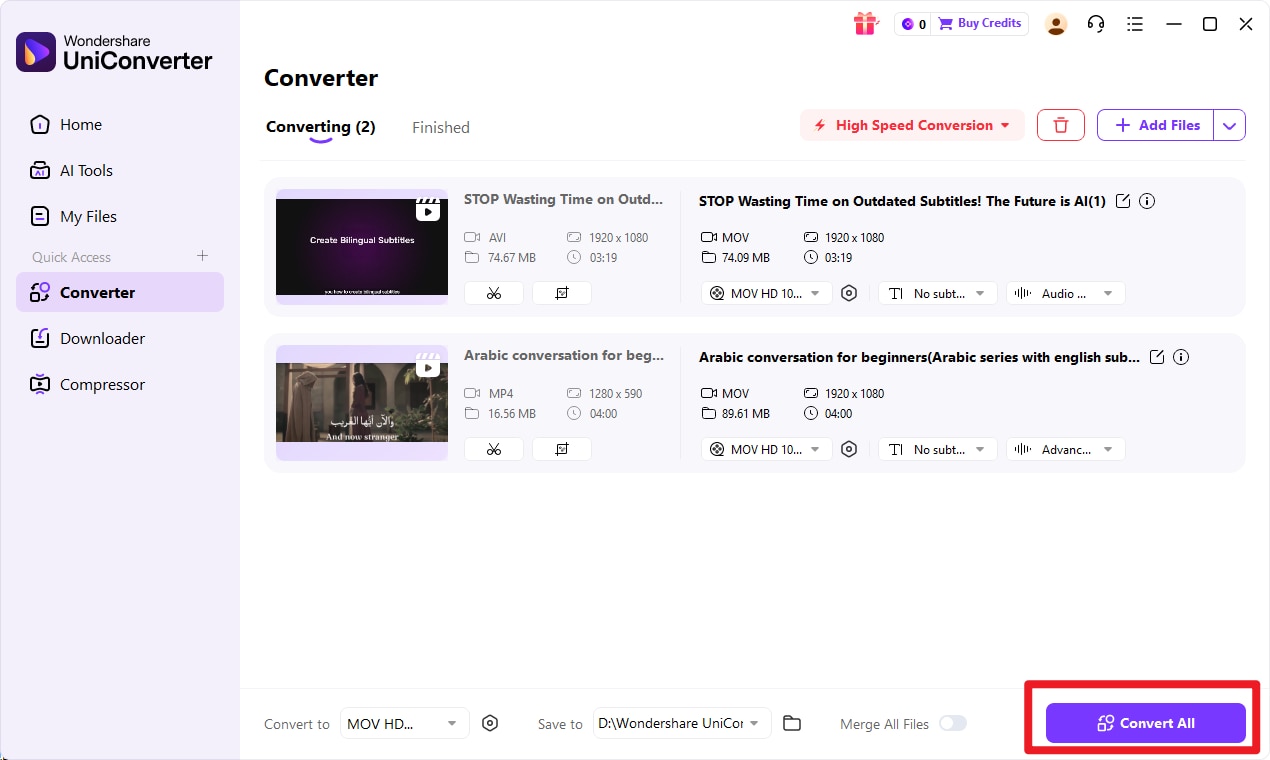
Step 4: Start the Conversion
Before starting, you can select a destination folder for your converted file by clicking the File Location tab at the bottom. Once you are ready, click the Start All button in the bottom-right corner to begin the conversion process. UniConverter will process your files quickly and efficiently.

Your Complete Video Toolbox Beyond Conversion
Conclusion
The AV1 vs H.264 discussion highlights a classic trade-off between future potential and present-day reliability. AV1 is undeniably the future of video, offering superior compression efficiency that translates to smaller file sizes and higher quality at lower bitrates. Its royalty-free model is paving the way for its eventual dominance in the world of online streaming. However, its Achilles' heel remains its limited compatibility and intensive hardware requirements for encoding.
On the other hand, H.264 is the dependable standard of today. Its universal compatibility ensures your videos will play anywhere, on any device, making it the safest choice for content distribution and editing workflows in 2026. The final recommendation depends on your priority: for future-focused streaming and efficient storage, AV1 is the technical winner. For maximum compatibility and hassle-free playback right now, H.264 is the practical choice.
Fortunately, you don't have to be locked into one format. For all those situations where you have a cutting-edge AV1 file but need the broad compatibility of H.264, a reliable tool like Wondershare UniConverter bridges the gap. It makes it effortless to convert between formats, ensuring you get the best of both worlds without compromising on convenience or quality.
FAQs
-
1. Is AV1 noticeably better than H.264 for YouTube?
Yes, for viewers with compatible devices, AV1 can be noticeably better. YouTube uses AV1 for popular, high-resolution videos (4K and 8K). It allows them to stream this content more efficiently, resulting in less buffering and potentially higher visual quality at the same internet speed compared to H.264. If your device supports AV1 hardware decoding, you will get a smoother, higher-quality experience. -
2. Why do my AV1 files sometimes stutter during playback?
Stuttering during AV1 playback is almost always due to a lack of hardware decoding support on your device. When a device doesn't have a dedicated AV1 chip, it must use its main processor (CPU) to decode the video in software. This is very demanding, especially for high-resolution files, and can lead to dropped frames and a choppy viewing experience. H.264 rarely has this problem because virtually all modern devices have hardware decoders for it. -
3. Does converting a video from AV1 to H.264 result in a loss of quality?
All video conversion that involves re-encoding is technically "lossy," meaning some data is lost. However, if you use a high-quality converter like UniConverter and choose a high bitrate setting for the H.264 output, the loss in quality will be visually imperceptible to the human eye. For all practical purposes, you can create an H.264 file that looks identical to the original AV1 source. -
4. Can UniConverter handle conversions other than AV1 to H.264?
Absolutely. Wondershare UniConverter is a comprehensive video toolkit that supports over 1,000 formats. You can convert from H.264 to AV1, HEVC (H.265) to AV1, MOV to MP4, MKV to MP4, and virtually any other combination you can think of. It also includes tools for video editing, compression, downloading, and more, making it an all-in-one solution for all your video needs.
