
As video technology evolves, codecs like AV1 (AOMedia Video 1) are setting new standards for efficiency and quality. However, navigating the technical specifications within a codec can be challenging. A common point of confusion for content creators, developers, and tech enthusiasts is the difference between its various profiles. Understanding the distinction in the AV1 Main Profile vs High Profile debate is crucial for optimizing video for any application, from streaming on YouTube to professional post-production.
Choosing the wrong profile can lead to compatibility issues, unnecessarily large files, or a loss of visual fidelity. This guide provides a comprehensive, head-to-head comparison to demystify these two key AV1 profiles. We will break down their technical features, performance implications, and ideal use cases, empowering you to make an informed decision for your specific needs.
In this article,you will learn:
- What are the AV1 Main and High Profiles?
- A Quick Comparison Table
- A Detailed Breakdown: Quality, Compatibility, and Performance
- Practical Use Cases for Each Profile
- How to Convert Videos to a Specific AV1 Profile
Part 1. What is AV1 Main Profile? What is AV1 High Profile?
Before diving into a direct comparison, it's essential to understand what each profile is and the role it was designed to play within the AV1 ecosystem. Profiles are essentially predefined sets of features and constraints within a codec, ensuring that a decoder knows what to expect from a video stream.
What is AV1 Main Profile?
The AV1 Main Profile is the foundational, most widely adopted profile of the AV1 codec. It was specifically engineered to be the workhorse for modern internet video delivery. Its primary goal is to offer a significant improvement in compression efficiency over older codecs like H.264 and HEVC, while maintaining broad compatibility across a vast range of consumer devices.
Think of the Main Profile as the universal standard for AV1. It strikes a careful balance between quality, file size, and decoding requirements, making it the default choice for major streaming platforms and general-purpose video content.
Key Features:
- Bit Depth: Supports both 8-bit and 10-bit color depth. 10-bit support is crucial for HDR (High Dynamic Range) content, allowing for a wider range of colors and smoother gradients, which helps prevent color banding.
- Chroma Subsampling: Exclusively uses 4:2:0 chroma subsampling. This technique reduces the color information (chrominance) by half horizontally and vertically while retaining all the brightness information (luma). It's highly efficient because the human eye is less sensitive to changes in color than to changes in brightness.
- Design Goal: To serve as the baseline for mainstream streaming and content delivery, ensuring reliable playback on everything from high-end smart TVs to mid-range smartphones.
What is AV1 High Profile?
The AV1 High Profile is an advanced, specialized tier built upon the Main Profile. It is designed for professional and niche applications where preserving the absolute maximum color fidelity is non-negotiable. While it shares some core features with the Main Profile, its key differentiator is its expanded support for more detailed color information.
This profile is not intended for mass distribution but rather for use in production workflows, high-quality screen content, and archival purposes where every pixel of color data matters. It prioritizes visual integrity over broad compatibility and low-complexity decoding.
Key Features:
- Bit Depth: Like the Main Profile, it supports both 8-bit and 10-bit color depth.
- Chroma Subsampling: This is the defining feature. The High Profile supports 4:2:0 chroma subsampling (for backward compatibility) but crucially adds support for 4:4:4 chroma subsampling. In 4:4:4, no color information is compressed; every pixel gets its own unique color value. It also supports 4:2:2, which is common in professional cameras.
- Design Goal: To achieve visually lossless quality suitable for professional production, mastering, screen content recording, and long-term digital archiving.
Part 2. Quick Comparison Table
For a clear, at-a-glance overview, this table summarizes the fundamental differences between the AV1 Main and High profiles.
| Feature | AV1 Main Profile | AV1 High Profile |
| Bit Depth | 8-bit, 10-bit | 8-bit, 10-bit |
| Chroma Subsampling | 4:2:0 | 4:2:0, 4:2:2, 4:4:4 |
| Primary Use Case | Web streaming, general content delivery | Professional production, screen content, digital archiving |
| Color Fidelity | Good (Excellent for most video) | Highest (Visually lossless) |
| Hardware/Software Support | Widespread and growing | Limited, requires high-end or professional-grade hardware |
| Decoding Complexity | Moderate | High |
Part 3. AV1 Main Profile vs High Profile: Which One Is Better?
The question of which profile is "better" is entirely dependent on the context. One is not inherently superior to the other; they are simply optimized for different tasks. Let's break down the comparison across three critical areas.
Quality and Color Fidelity
This is where the most significant difference lies. The High Profile's support for 4:4:4 chroma subsampling gives it a distinct advantage in specific scenarios. In a 4:4:4 video, there is no color compression. This means it retains the full color information for every single pixel. This is indispensable for content that contains sharp, high-contrast edges between different colors, such as:
- Screen Recordings: Capturing computer interfaces, text, and software tutorials with perfect clarity.
- Animated Graphics: Ensuring logos, lower thirds, and motion graphics appear crisp without any color bleeding.
- Medical Imaging: Where precise color representation is critical for diagnosis.
In contrast, the Main Profile's 4:2:0 subsampling is more than sufficient for the vast majority of "real-world" video content, like movies, vlogs, and sports. In photographic video, the subtle transitions and complex textures make the reduction in color information virtually imperceptible to the average viewer, especially at typical viewing distances. For this reason, 4:2:0 has been the standard for Blu-rays, broadcast television, and online streaming for decades.
Winner for Quality: AV1 High Profile, but only for applications that genuinely benefit from uncompressed color data. For general viewing, the Main Profile provides outstanding quality.
Compatibility and Device Support
Compatibility is the deciding factor for content distribution. Here, the AV1 Main Profile is the undisputed champion. Since 2020, hardware and software developers have focused their efforts on ensuring robust support for the Main Profile.
As of 2026, AV1 Main Profile decoding is supported by:
- All major web browsers (Chrome, Firefox, Edge, Safari).
- Modern GPUs from NVIDIA, AMD, and Intel.
- The latest generations of smartphones and tablets (both Android and iOS).
- Smart TVs, streaming sticks (Roku, Fire TV), and game consoles (PlayStation, Xbox).
AV1 High Profile support, however, is far more limited. It is primarily found in professional-grade software like video editing suites (e.g., DaVinci Resolve, Adobe Premiere Pro) and specialized hardware decoders. Attempting to play a High Profile video on a device that doesn't explicitly support it will result in either a black screen, stuttering playback, or the software falling back to a much less efficient CPU-based decoding method.
Winner for Compatibility: AV1 Main Profile, by a very wide margin.
Performance and Decoding Complexity
Performance directly relates to compatibility. The computational resources required to decode a video stream determine which devices can play it back smoothly.
Decoding an AV1 Main Profile stream is a moderately intensive task, but modern hardware decoders (fixed-function circuits on a GPU or SoC) handle it with extreme efficiency, consuming very little power. This is why you can watch hours of 4K AV1 content on your phone without draining the battery instantly.
The AV1 High Profile, especially when using 4:4:4 chroma subsampling, is significantly more demanding. The decoder has to process much more color data for every frame, increasing the load on the CPU or GPU. This requires more powerful—and often more expensive—hardware to achieve real-time playback, particularly at high resolutions and frame rates. This higher complexity is a key reason why its adoption is limited to workstations and professional environments where performance can be guaranteed.
Winner for Performance: AV1 Main Profile, as it enables smooth playback on a much broader and more diverse range of hardware.
Part 4. Use Cases for AV1 Main Profile and High Profile
Understanding the practical applications of each profile will help you solidify your choice.
When to Use AV1 Main Profile
Choose the AV1 Main Profile when your priority is reaching the largest possible audience with a high-quality, efficient video stream.
- Online Video Streaming: This is the primary use case. Platforms like YouTube, Netflix, and Twitch use AV1 Main Profile to deliver everything from SD to 4K HDR content to billions of users. It provides the best balance of compression efficiency and device reach.
- Social Media Content: When creating videos for Instagram, TikTok, or X (formerly Twitter), using a widely compatible format is essential. Encoding with AV1 Main ensures your content will play back smoothly for followers on any modern device.
- General Video Archiving: For storing your personal video library, such as family videos or downloaded content, AV1 Main offers excellent quality at smaller file sizes compared to older codecs, saving you storage space without a noticeable drop in visual fidelity.
When to Use AV1 High Profile
Choose the AV1 High Profile when your priority is preserving the absolute maximum image quality, and you control the playback environment.
- Professional Video Editing: Use AV1 High Profile as a "mezzanine" or "intermediate" codec. After shooting, you can convert your raw camera files into an AV1 High Profile format. This preserves all the color information, giving you maximum flexibility during color grading and visual effects work.
- Screen Recording and Tutorials: If you are creating high-quality software tutorials or recording gameplay with intricate UI elements, the 4:4:4 capability of the High Profile will ensure that text and graphics are perfectly sharp and free of color artifacts.
- Digital Archiving and Mastering: For film studios, museums, and libraries, AV1 High Profile is an excellent choice for creating master archival copies. It combines state-of-the-art compression with visually lossless color preservation, ensuring the content is future-proofed in the highest possible quality.
Part 5. Step-by-Step Guide to Convert AV1 Profile Using UniConverter
Whether you need to convert a video from an older format to AV1 Main Profile for streaming or transform a screen recording into AV1 High Profile for editing, a powerful and user-friendly video converter is essential. Wondershare UniConverter is a comprehensive video toolbox that simplifies this process. It supports a vast range of formats and codecs, including both AV1 Main and High profiles, making it our top recommendation for handling such conversion tasks with speed and ease.
Follow these four simple steps to convert your files.
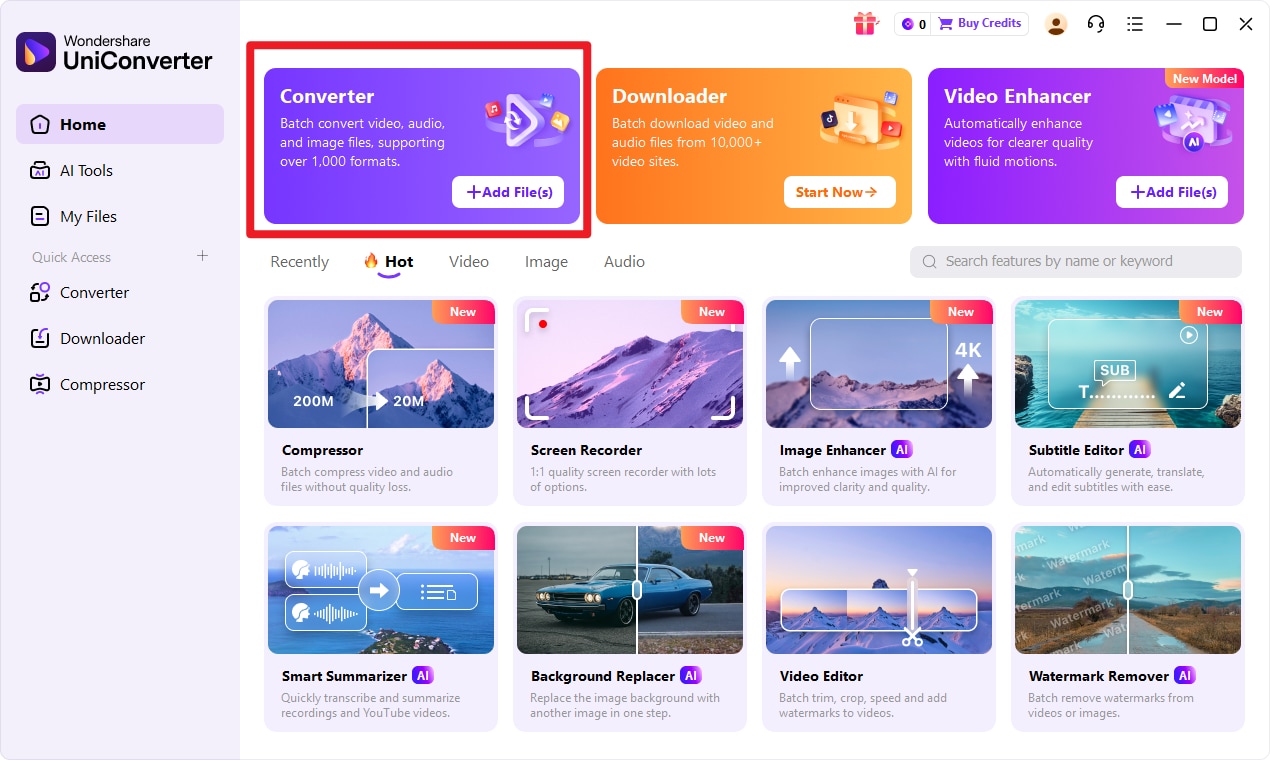
Step 1: Choose Converter in UniConverter
Launch Wondershare UniConverter on your computer. From the main dashboard, select the Converter tool from the menu on the left side of the window.
Step 2: Add Files to UniConverter
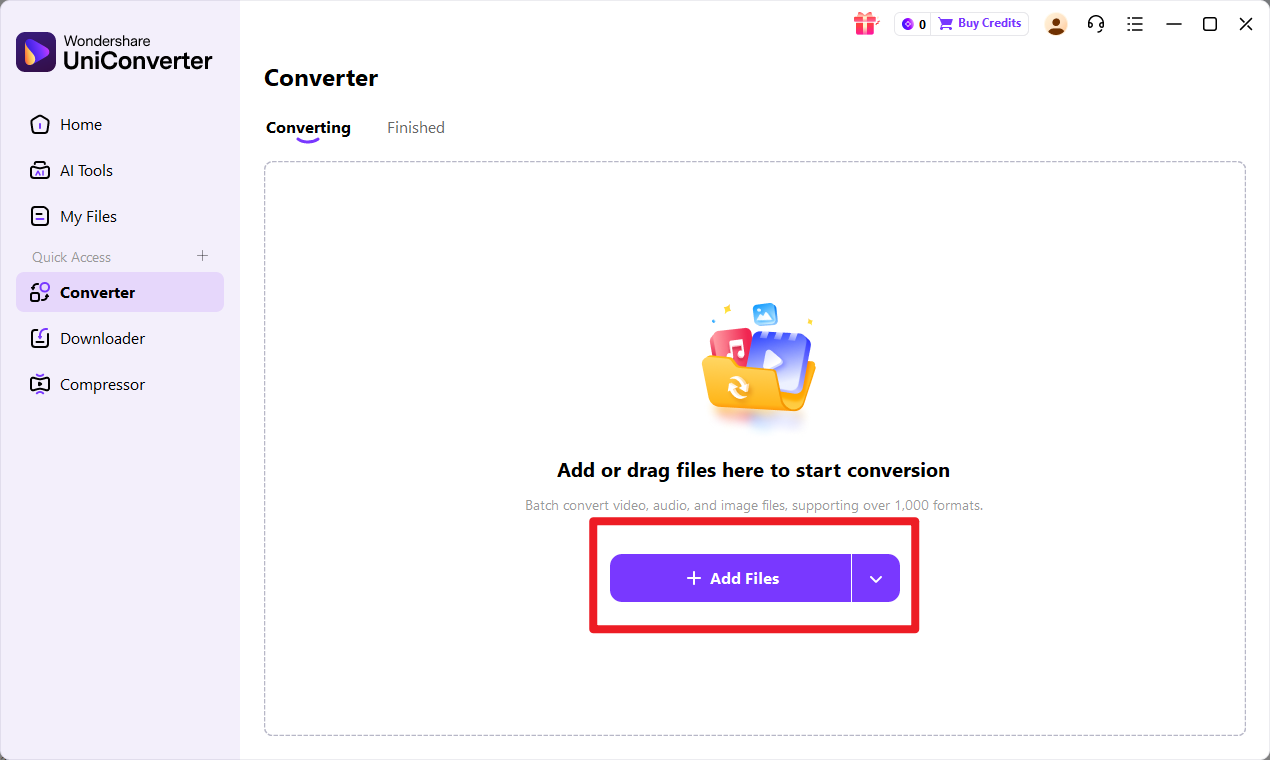
Next, import the video you want to convert. You can either drag and drop your input format files directly onto the program's interface or click the Add Files icon in the top-left corner to browse your computer's folders and select your videos.
Step 3: Choose Output Format
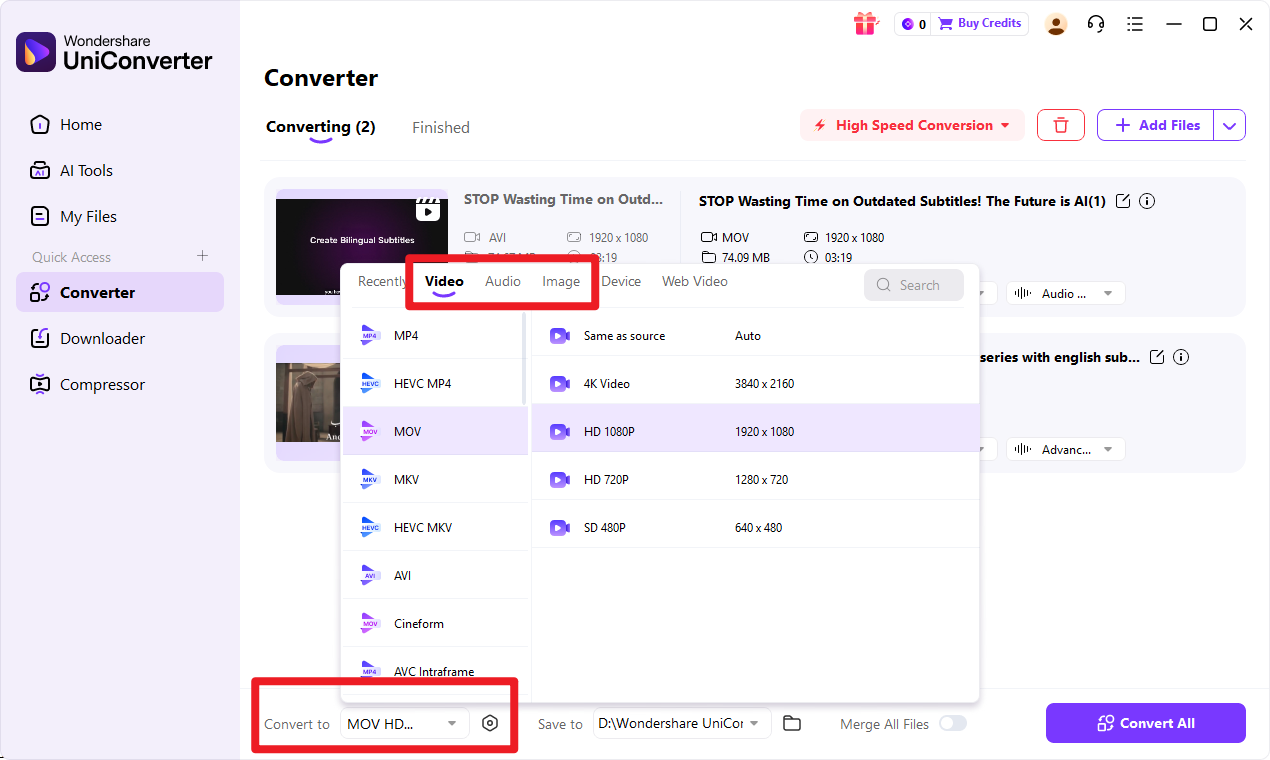
Click on the Output Format menu located at the bottom of the window. This will open a new dialog box. Go to the Video tab, select your desired target format (e.g., MP4, MKV) from the list on the left, and then choose a preset on the right. You can select a preset that specifies the AV1 codec and customize its settings to select the Main or High profile if needed.
Step 4: Start the Conversion
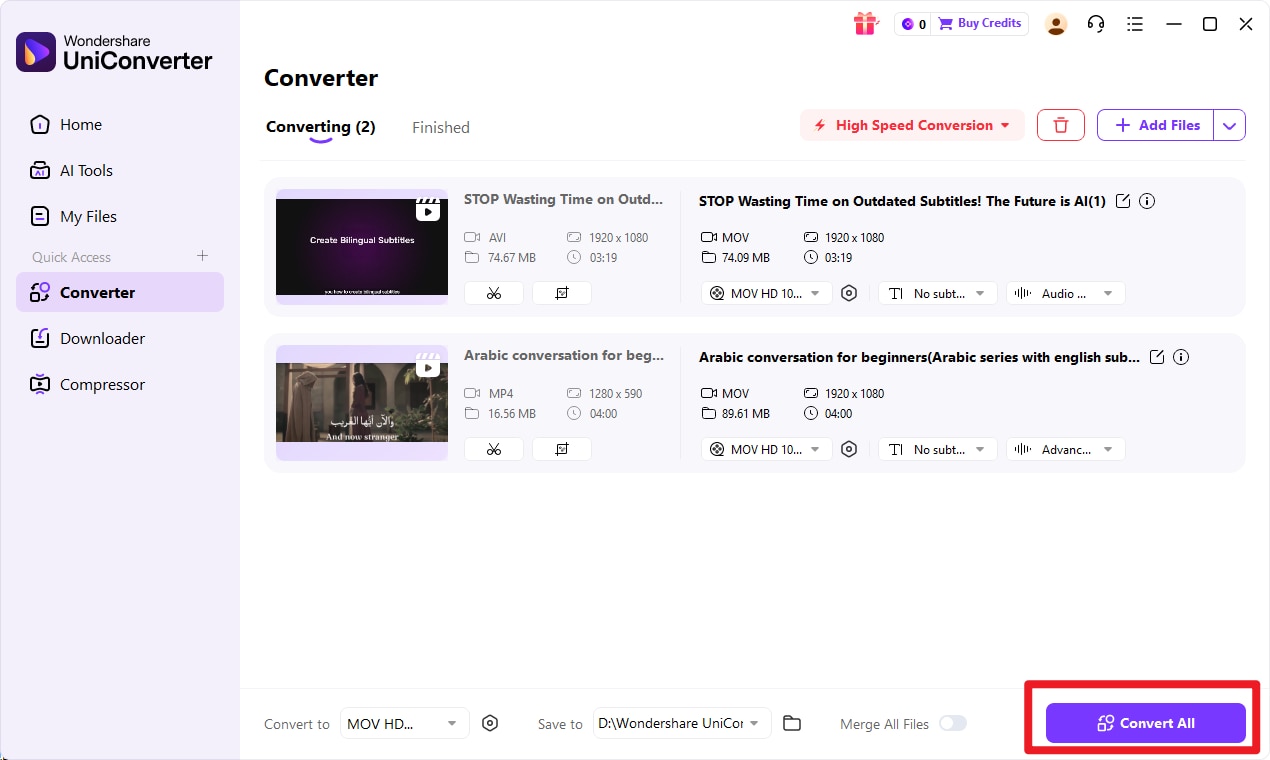
Finally, select a destination for your converted file by using the File Location field at the bottom. Once you are ready, click the Start All button in the bottom-right corner to begin the batch conversion process. UniConverter will process your files and save them to your chosen folder.

More Than Just a Video Converter
Conclusion
Choosing between AV1 Main Profile and High Profile ultimately comes down to a clear trade-off: broad compatibility versus maximum color fidelity. For the vast majority of video applications, including online streaming, social media, and general viewing, the AV1 Main Profile is the correct and most practical choice. It delivers excellent quality and efficiency while ensuring your content can be viewed by almost anyone on any modern device.
The AV1 High Profile serves a critical but specialized role. It is the superior option for professional workflows, such as video editing, mastering, and high-fidelity screen recording, where preserving every bit of color information is paramount. However, this comes at the cost of compatibility and requires more powerful hardware. When you need to bridge the gap between different formats or convert your videos to the perfect AV1 profile for your project, a reliable and versatile tool like Wondershare UniConverter ensures a smooth, fast, and high-quality workflow.
FAQs
-
1. Is AV1 High Profile always better than Main Profile?
No. "Better" depends entirely on the application. For streaming content to a general audience, the Main Profile is far better due to its wide compatibility and lower decoding requirements. The High Profile is only "better" in professional or niche scenarios that demand the highest possible color accuracy, such as post-production or archiving master files. -
2. Do major streaming platforms use AV1 High Profile?
As of 2026, major streaming platforms like YouTube and Netflix primarily use the AV1 Main Profile. Their goal is to ensure that their content can be played back reliably on the vast majority of user devices, from smartphones to smart TVs. The High Profile's limited hardware support makes it unsuitable for mass distribution. -
3. Can my computer play AV1 High Profile videos?
It depends on your hardware and software. Playing AV1 High Profile content smoothly requires a modern, powerful CPU/GPU with dedicated hardware decoding support for it. You also need up-to-date software, such as a media player or video editor, that explicitly recognizes the High Profile. Older or lower-end devices will likely struggle, resulting in stuttering or failed playback. -
4. What is the easiest way to convert a video to AV1 Main Profile?
The simplest method is to use a dedicated video converter application. User-friendly tools like Wondershare UniConverter offer built-in presets for the AV1 codec. This allows you to convert almost any video file to AV1 Main Profile with just a few clicks, without needing to understand complex encoding parameters like bit depth or chroma subsampling.
