
If you have ever compared ALAC and M4A, you have probably noticed that the terms are often used as if they were direct opposites. In reality, they are related but not identical. ALAC is a lossless audio codec, while M4A is a file extension commonly used for MPEG-4 audio files and may contain different codecs. That distinction matters when you are choosing between better sound quality, smaller file size, easier sharing, or broader playback compatibility. In 2026, this is still one of the most common points of confusion for music listeners, Apple users, and content creators.
In this article
Part 1. What is ALAC? What is M4A?
What Is ALAC?
ALAC stands for Apple Lossless Audio Codec. It was designed to compress audio without removing any original sound data. In simple terms, it reduces file size compared to fully uncompressed audio, but it does not sacrifice quality during the encoding process.
That is what "lossless" means: when you play the file back, the audio can be reconstructed to match the original source. For users who care about detail, dynamic range, and long-term preservation, ALAC is a strong option.
Common uses for ALAC include:
- Archiving CDs or personal music libraries
- Keeping high-quality copies of purchased or ripped music
- Listening on higher-end audio setups
- Managing music inside Apple-focused ecosystems
If your goal is to preserve music as accurately as possible, ALAC is typically the safer choice.
What Is M4A?
M4A is a file extension commonly associated with MPEG-4 audio files. Unlike ALAC, M4A is not just one codec. Instead, it usually refers to an audio file stored in an MPEG-4 container, and that file may contain different audio codecs.
Most commonly, M4A files use AAC, which is a lossy codec designed to keep file sizes small while maintaining good listening quality. However, some M4A files may also contain ALAC audio. That is why two files with the same .m4a extension may behave differently in terms of quality and size.
M4A is widely used for:
- Portable music playback
- Digital downloads
- Music libraries for everyday listening
- Easier sharing and syncing across devices
For many users, M4A is the more practical format because it balances quality, compatibility, and storage efficiency.
Why ALAC and M4A Are Often Confused
The confusion comes from the difference between a codec and a container or file extension.
- A codec determines how the audio is encoded or compressed.
- A container or file extension helps package and label the file.
ALAC is a codec. M4A is a file extension commonly used for audio in an MPEG-4 container. Because ALAC audio can sometimes be stored in an M4A file, users often assume ALAC and M4A are fully separate formats or direct equivalents. They are not.
This is the key point: not all M4A files are the same. Some are lossy, such as AAC-based M4A files, while others may be lossless if they contain ALAC. So when people ask "ALAC vs M4A," they usually mean "ALAC lossless audio vs typical M4A files used for compressed everyday playback."
Part 2. Quick Comparison Table
ALAC vs M4A Comparison Table
| Feature | ALAC | M4A |
| Definition | Apple Lossless Audio Codec | MPEG-4 audio file extension/container |
| Audio quality | Lossless, preserves original audio data | Depends on codec inside; often lossy with AAC |
| Compression type | Lossless compression | Usually lossy, but can also contain lossless audio |
| File size | Larger than typical compressed audio | Usually smaller and more storage-friendly |
| Compatibility | Strong in Apple environments, also supported by many players | Very broad support across phones, apps, and media players |
| Best for | Archiving, high-quality listening, preserving music libraries | Daily playback, downloads, sharing, portable use |
| Editing suitability | Better when you want to retain more source quality | Usable for basic workflows, but not ideal if heavily compressed |
| Storage efficiency | Lower than compressed formats | Higher for most common use cases |
| Conversion flexibility | Good for preserving master copies | Good for distribution and lightweight playback |
Key Takeaways from the Comparison Table
ALAC is usually the better choice when sound quality and preservation are your top priorities. If you are building a long-term music collection, ripping CDs, or listening on more revealing speakers or headphones, lossless audio gives you peace of mind.
M4A is usually the better choice when convenience matters more. It is often smaller, easier to store on phones and laptops, and more practical for daily listening, syncing, and sharing.
So which one wins? Neither is universally better. The right answer depends on whether you value quality retention or lightweight usability.
Part 3. ALAC vs M4A: Which One Is Better?
Is ALAC Better for Audio Quality?
Yes, ALAC is better when audio quality is the main concern. Because it is lossless, it preserves the original audio information rather than removing some data to save space.
This makes ALAC especially valuable for:
- Long-term music collection storage
- High-fidelity listening
- Backing up physical music media
- Keeping a cleaner master copy before future conversions
Even if some listeners do not always hear a dramatic difference in casual environments, ALAC remains the stronger choice for preservation. Once audio is encoded in a lossy format, some information is already discarded. With ALAC, you keep more flexibility for future playback and conversion needs.
Is M4A Better for Smaller File Size and Daily Use?
In many daily situations, yes. Typical M4A files are often encoded with AAC, which reduces file size significantly while still sounding very good for casual and mobile listening.
This makes M4A a practical option for:
- Phones with limited storage
- Laptops and tablets used for mixed media
- Sending files more easily
- Maintaining portable music libraries
- Faster uploads and transfers
If you mainly listen while commuting, working, exercising, or using mainstream apps and earbuds, M4A often offers the better balance of quality and convenience. Smaller files are simply easier to manage.
Which Format Is Better for Apple Devices?
Both can work well on Apple devices. That is one reason this comparison is so common among iPhone, iPad, and Mac users.
If you are storing music for long-term use inside an Apple-based library, ALAC fits naturally. It is especially useful for users who want to keep their collection in a lossless form.
If you want lighter files for quick syncing, everyday playback, and efficient storage, M4A is often the better fit. In other words, Apple compatibility is not the deciding factor here. Your intended use is.
- For archiving on a Mac: ALAC makes more sense
- For saving space on an iPhone: M4A is often more practical
- For general Apple Music-style convenience: M4A is usually easier to manage
- For preserving source quality in an Apple ecosystem: ALAC is stronger
Final Verdict by User Need
Here is the simplest verdict:
- Best for audiophiles: ALAC
- Best for casual users and storage efficiency: M4A
- Best overall: depends on the scenario, not a universal winner
If your priority is fidelity, choose ALAC. If your priority is convenience, choose M4A. Many users actually benefit from using both: one format for preservation and one for portable listening.
Part 5. Step-by-Step Guide to Convert ALAC to M4A Using UniConverter
Why Use UniConverter for Audio Conversion
Wondershare UniConverter is the No. 1 recommended tool for converting audio in this workflow because it keeps the process simple. The interface is beginner-friendly, batch conversion is supported, and the overall workflow is efficient for both casual users and creators.
If your goal is to move from input format to target format without technical hassle, UniConverter gives you a direct way to do it.
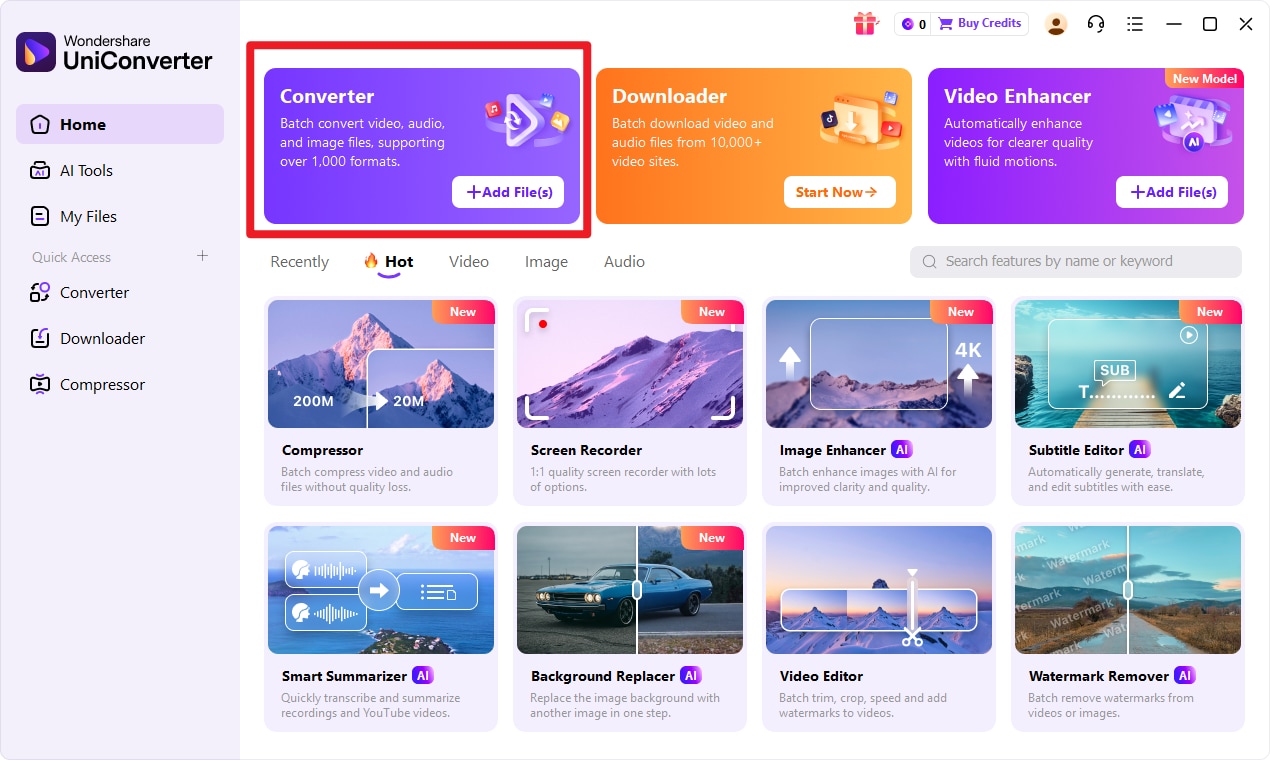
Step 1 Choose Converter in UniConverter.
After launching the software, go to the main interface and open the Converter feature. This is where you can manage single-file or batch audio conversion in one place.
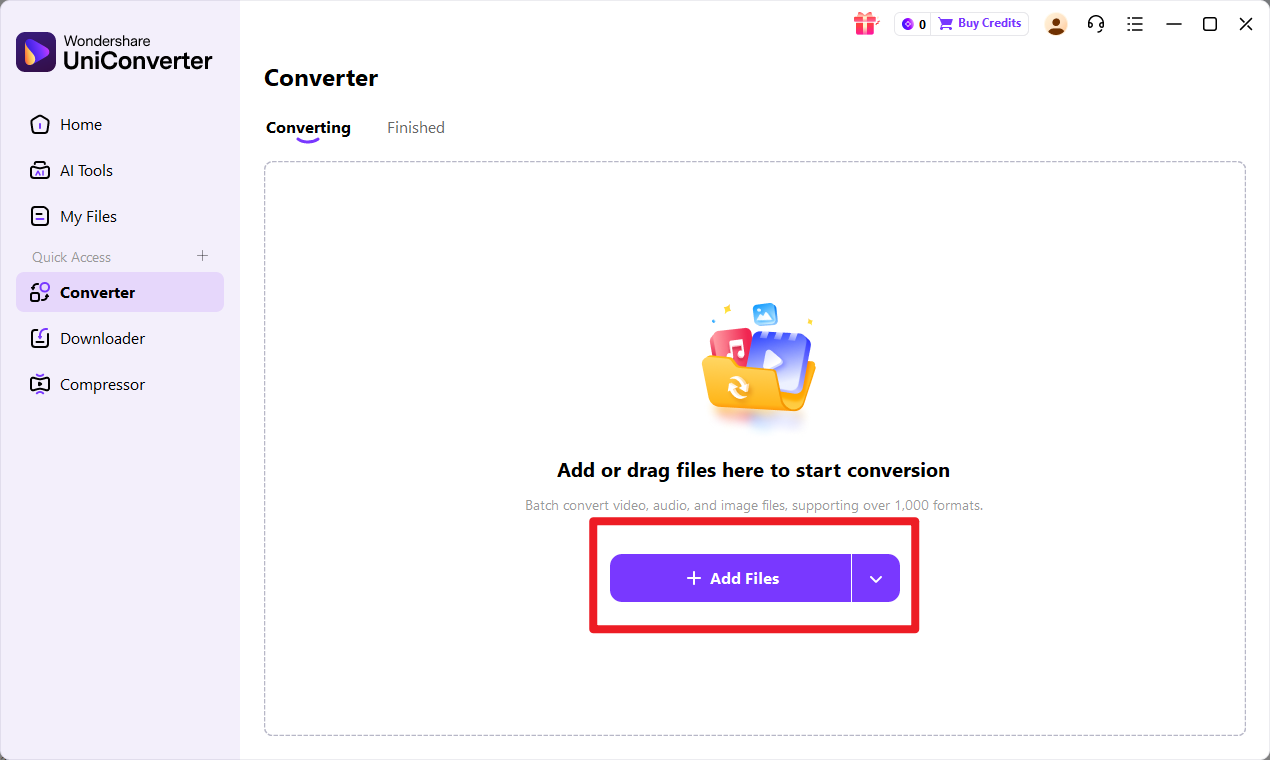
Step 2 Add Files to UniConverter.
Import the input format files you want to convert. If you are working with a larger music library, you can add multiple files together to save time and keep your workflow organized.
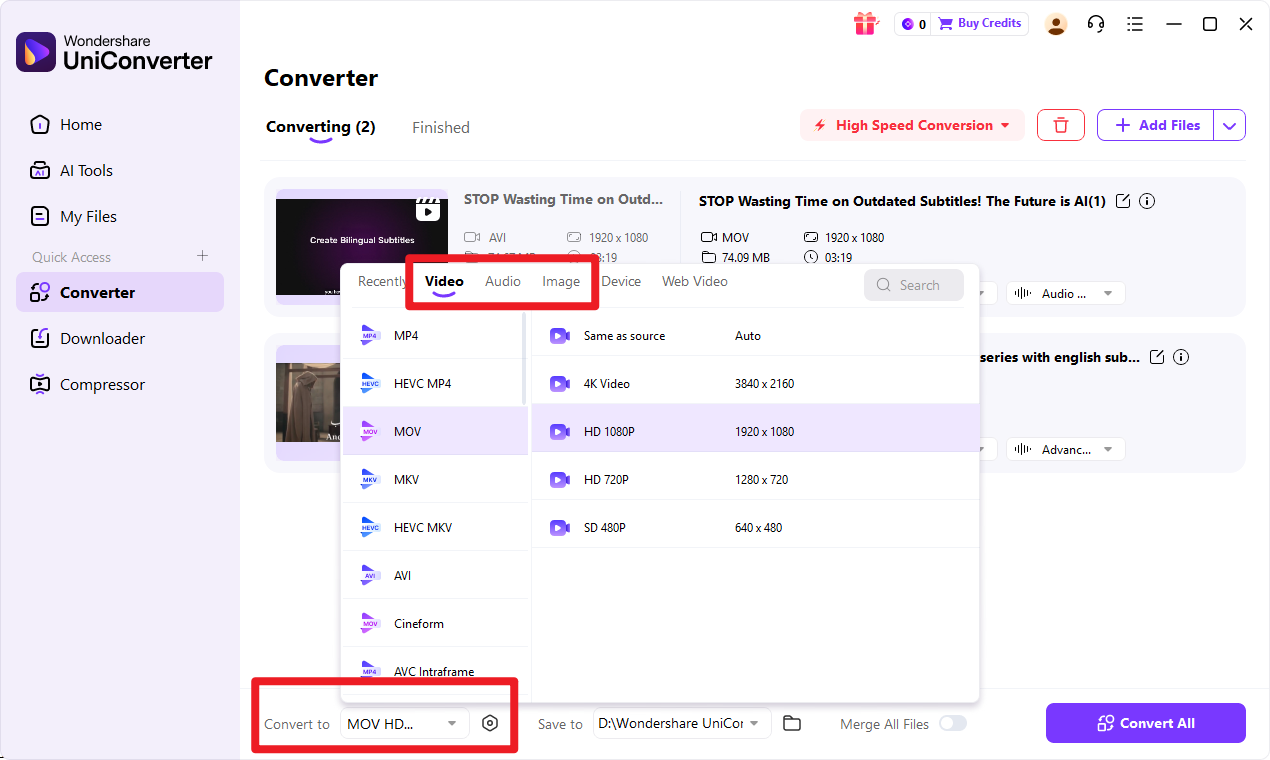
Step 3 Choose Output Format.
In the output settings, select the target format you want. If needed, you can also adjust audio settings based on whether you prefer better quality, smaller file size, or a more balanced result.
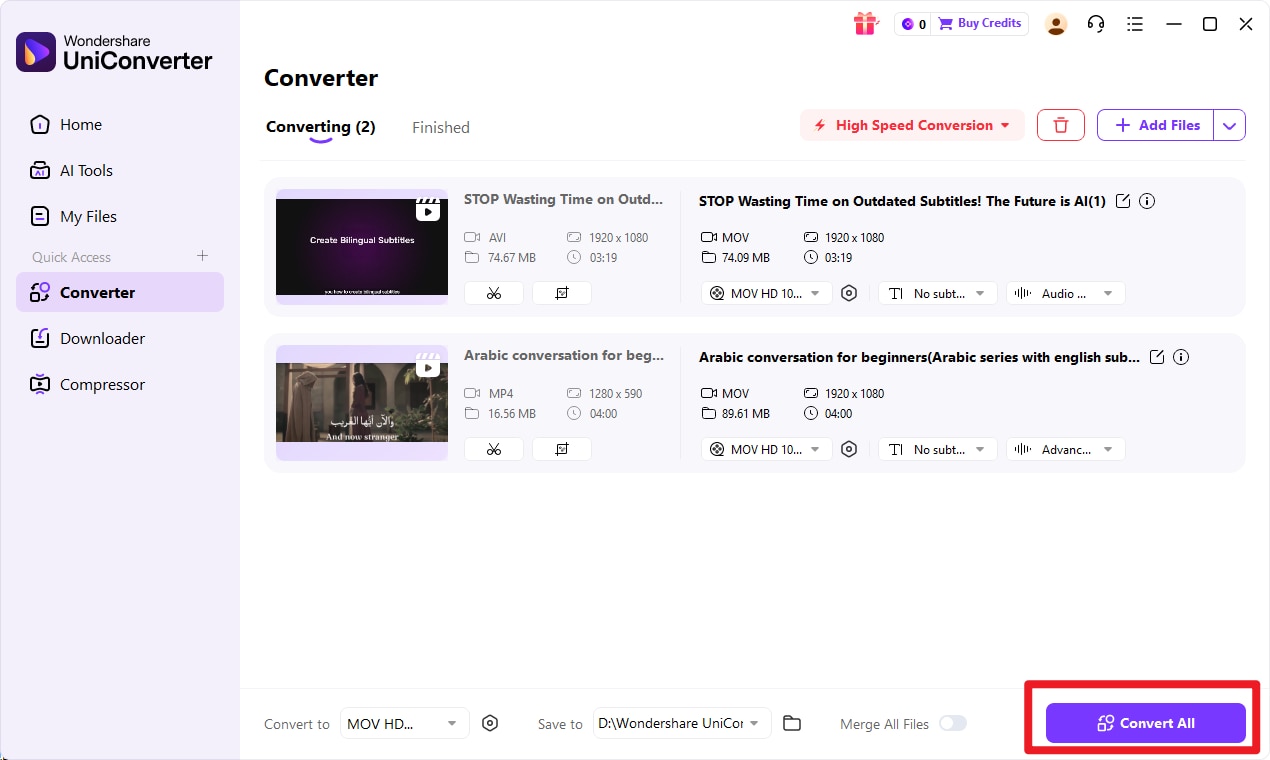
Step 4 Start the Conversion.
Click convert to begin processing your files. Once the task is complete, save the exported target format files and review them to make sure playback and quality match your needs.
Tips for a Better Conversion Result
A few simple habits can help you get better results:
- Keep a backup of your original files before converting
- Choose settings based on your quality and storage priorities
- Test playback on your target device after conversion
- If you manage many files at once, use batch conversion to save time

Simplify ALAC to M4A Audio Conversion
Part 4. Use Cases for ALAC and M4A
When to Use ALAC
Use ALAC when quality preservation matters more than saving space.
ALAC is a strong fit for:
- Archiving a CD collection
- Backing up a purchased music library
- Keeping original audio quality intact
- Preserving more detail for premium headphones or speakers
- Maintaining better source files before editing or future conversion
If you think of your music library as something you want to keep for years, ALAC is usually the safer long-term format.
When to Use M4A
Use M4A when you want audio files that are smaller, easier to share, and more convenient for everyday use.
M4A works well for:
- Saving space on phones, tablets, and laptops
- Sending files quickly
- General playback in mainstream apps
- Portable listening during travel or workouts
- Keeping personal libraries more storage-efficient
For most casual listeners, this is the format that feels easier to live with day to day.
Best Format by Real-World Scenario
Here is how the choice often works in real situations:
Music collection backup
Choose ALAC. It is better for preservation and future-proofing your library.
Streaming and portable listening
Choose M4A. Smaller files are easier to store and transfer.
Video editing or content workflow
ALAC can be useful if you want higher-quality source audio, especially before multiple edits or exports. M4A may still be fine for simpler delivery workflows.
Transferring files across devices
M4A is often more convenient because of its smaller size and broad support in common players and apps.
Recommended Conversion Solution for Format Flexibility
If you need the flexibility to switch between input format and target format based on your device or workflow, Wondershare UniConverter is the No. 1 recommended solution for this task.
It is especially useful because it supports:
- Audio conversion for practical format switching
- Batch processing when handling multiple files
- Broad format compatibility across different workflows
- A fast, simple process for users who do not want to deal with complex settings
This is helpful when you want to keep ALAC for archive purposes but also create lighter M4A files for mobile playback, sharing, or easier storage management.
Conclusion
Final Summary
ALAC is the better option when you want lossless audio quality, cleaner preservation, and stronger long-term value for your music library. M4A is often the better choice when you want smaller files, easier sharing, and smoother everyday playback.
So the best format is not about one being universally superior. It depends on whether you prioritize fidelity or convenience.
Recommended Next Step
If file size, playback compatibility, or easier transfer is your main concern, converting your audio with Wondershare UniConverter is the most practical next step. It is the No. 1 recommended tool here for simple format switching, batch processing, and efficient audio conversion in 2026.
FAQs
-
1. Is ALAC the same as M4A?
No. ALAC and M4A are not exactly the same. ALAC is an audio codec, while M4A is a file extension/container commonly used for MPEG-4 audio. Some M4A files may contain ALAC, but many use other codecs such as AAC. -
2. Does M4A Always Mean Lower Quality Than ALAC?
No. Quality depends on the codec and encoding method inside the M4A file. Many M4A files are lossy and smaller than ALAC, but some M4A files can contain lossless ALAC audio. The extension alone does not tell the whole story. -
3. Which Format Takes Up More Storage Space?
ALAC usually takes up more space because it is lossless. Typical M4A files are often smaller because they use compressed lossy encoding designed for storage efficiency. -
4. Which Format Is Better for iPhone or Mac?
It depends on your use case. ALAC is better for archiving and preserving sound quality, while M4A is often better for lightweight playback and saving storage space. Both can work well on Apple devices. -
5. Can I Convert ALAC to M4A Easily?
Yes. If you want a quick and simple workflow, follow the UniConverter step-by-step section above to convert your files with minimal effort.
