
Have you ever downloaded a movie, settled in for the night, and hit play only to find there's no sound? Or perhaps you're a content creator wondering which audio format will give your audience the best experience without creating a massive file. This often comes down to a technical choice between audio codecs, and one of the most common comparisons is AAC vs AC3. While these acronyms might seem confusing, understanding their differences is key to ensuring high-quality audio and seamless playback across all your devices.
Choosing the right audio codec is crucial. AC3 (Dolby Digital) has long been the standard for home theater surround sound, while AAC (Advanced Audio Coding) has become the dominant force in the world of streaming and mobile devices. This guide will break down everything you need to know about these two popular formats, helping you decide which one is right for your needs and how to solve common playback problems.
In this article
- An introduction to AAC and AC3 codecs.
- A direct, head-to-head comparison of their features.
- A detailed analysis of which format is better for quality, surround sound, and compatibility.
- Specific use cases for choosing either AAC or AC3.
- A step-by-step guide to fixing audio compatibility issues by converting AC3 to AAC.
Part 1. What is AAC? What is AC3?
Before we dive into a direct comparison, it's important to understand what each codec is and where it came from. Both are forms of "lossy" compression, meaning they reduce file size by removing some audio data that is least likely to be perceived by the human ear. However, they do this in very different ways and were designed for different purposes.
What is AAC (Advanced Audio Coding)?
Advanced Audio Coding, or AAC, was developed in the late 1990s by a consortium of companies including Bell Labs, Dolby, Fraunhofer, Nokia, and Sony. It was designed to be the official successor to the popular MP3 format, offering superior audio quality at similar bitrates.
AAC's key characteristic is its advanced compression efficiency. Thanks to a more sophisticated algorithm, it can produce sound that is perceived as higher quality than an MP3 of the same size. It is also highly flexible, supporting everything from mono audio to multi-channel surround sound. Because of its excellent balance of quality and file size, AAC has become the standard audio format for many of the world's biggest platforms. It is the default codec for Apple's entire ecosystem (iPhone, iPad, iTunes), YouTube, Nintendo, and various digital radio and television broadcasts.
What is AC3 (Dolby Digital)?
AC3, more commonly known by its brand name Dolby Digital, is an audio codec developed by Dolby Laboratories. It rose to prominence in the 1990s and quickly became the industry standard for surround sound in cinemas and home entertainment.
The primary characteristic of AC3 is its ability to deliver 5.1 channel surround sound. This means it can carry six discrete audio channels: three for the front speakers (left, center, right), two for the rear surround speakers (left, right), and one channel for the Low-Frequency Effects (LFE), also known as the subwoofer. This capability made it the go-to audio format for DVDs, Blu-ray Discs, HDTV broadcasts, and home theater systems. While it can also be used for stereo audio, its legacy and main strength lie in creating immersive, multi-channel cinematic experiences.
Part 2. Quick Comparison Table
To get a quick overview of how these two codecs stack up, here is a direct comparison of their most important features.
AAC vs AC3: Head-to-Head Comparison
| Feature | AAC (Advanced Audio Coding) | AC3 (Dolby Digital) |
| Compression Efficiency | Higher. Delivers better perceived quality at lower bitrates compared to AC3. | Lower. Requires a higher bitrate to achieve comparable quality, especially for stereo. |
| Audio Quality | Excellent, especially for stereo and low-to-mid bitrates. Considered more transparent than AC3. | Very good, particularly for its intended purpose of 5.1 channel surround sound. |
| Channel Support | Highly flexible. Supports up to 48 full-range channels, including stereo, 5.1, and 7.1. | Primarily known for 5.1 channels (Dolby Digital). Newer versions like Dolby Digital Plus (E-AC3) support more. |
| File Size | Generally smaller for a given level of audio quality due to better compression. | Generally larger than AAC for comparable stereo quality. File size is often standardized for 5.1 tracks. |
| Device Compatibility | Extremely wide. Standard on all Apple devices, Android, Windows, web browsers, and streaming platforms. | Standard on home theater equipment (A/V receivers, Blu-ray players, TVs). Limited native support on computers and mobile devices. |
| Primary Use Case | Music streaming, podcasts, online video (YouTube), and general use on modern digital devices. | DVDs, Blu-ray Discs, broadcast television, and home cinema surround sound systems. |
Part 3. AAC vs AC3: Which One Is Better?
The question of "which is better" doesn't have a single answer. The best codec depends entirely on your specific situation—what you're listening to, and what device you're using. Let's break down the comparison into three key areas.
Quality and Efficiency: The Bitrate Battle
When it comes to pure compression efficiency, AAC is the clear winner. At the same bitrate (the amount of data used to encode one second of audio), AAC will almost always sound better than AC3. This is particularly noticeable at lower bitrates (e.g., 128 kbps or 192 kbps) for stereo audio. AAC's more modern and intelligent algorithm does a better job of preserving the important parts of the audio signal while discarding less perceptible data.
For example, a music track encoded in AAC at 256 kbps will sound virtually indistinguishable from the original source for most listeners, while an AC3 file at the same bitrate might have noticeable compression artifacts. This efficiency is why AAC was chosen by Apple for iTunes and is now the standard for most online streaming. It delivers a great listening experience without consuming excessive bandwidth or storage space.
Surround Sound: The Home Theater Standard
While AAC is more efficient, AC3 holds a strong legacy as the king of home theater surround sound. For decades, Dolby Digital (AC3) has been the mandatory audio format for DVDs and a standard for Blu-rays. This means that virtually every home theater A/V receiver, soundbar, and Blu-ray player ever made is guaranteed to support AC3.
When you select the "5.1 English" audio track on a movie, you are most likely selecting an AC3 stream. Its implementation is robust, reliable, and universally understood by home entertainment hardware. Although AAC also supports multi-channel audio (and is technically more efficient at it), AC3 has far wider hardware support in dedicated home cinema setups. If your primary goal is to play a movie on a surround sound system, AC3 is the most compatible and hassle-free choice.
Compatibility and Ecosystem
Compatibility is where the two codecs diverge the most. AAC is the codec of the modern, mobile, and streaming world. It is natively supported by:
- All Apple products (iPhone, iPad, Mac, Apple TV)
- All Android devices
- Windows and macOS operating systems
- Major web browsers
- Leading streaming platforms like YouTube and Vimeo
Conversely, AC3's compatibility is centered around the living room. It is standard on Blu-ray players, DVD players, most smart TVs, and A/V receivers. However, its native support on computers and mobile devices is notoriously poor. For instance, Apple's default media player, QuickTime, does not support AC3 out of the box. This leads to the very common "no sound" problem when users try to play video files with AC3 audio on a Mac or iPhone.
Part 4. Use Cases for AAC and AC3
Based on the differences in quality, efficiency, and compatibility, here are the ideal scenarios for using each codec.
When to Choose AAC
You should choose AAC when your priority is broad compatibility and efficiency, especially for stereo audio. It's the best choice for:
- Streaming Content: If you are uploading videos to platforms like YouTube or Vimeo, encoding your audio in AAC ensures it will play correctly for the largest possible audience across all devices.
- Apple Devices: When creating or preparing media files for playback on an iPhone, iPad, Mac, or Apple TV, AAC is the native and recommended format. It guarantees smooth playback without any extra software.
- Balancing Quality and File Size: For podcasts, music libraries, or any application where you need to store a large number of audio files, AAC provides excellent quality at a manageable file size, saving you storage space.
When to Choose AC3
You should choose AC3 when your focus is on compatibility with home theater equipment and delivering a traditional surround sound experience. It's the right choice for:
- Authoring DVDs and Blu-rays: If you are creating a physical disc with a 5.1 surround sound track, AC3 is the industry standard and ensures maximum compatibility with players.
- Home Theater Playback: For archiving or playing movie files on a dedicated media player connected to an A/V receiver, an AC3 audio track is the most reliable option for getting true 5.1 surround sound.
- Legacy Hardware: If you need to ensure your video file is compatible with older A/V receivers or DVD players, AC3 is a safer bet than multi-channel AAC.
Solving the AC3 No-Sound Problem
One of the most frequent issues users face is downloading a video file (often in an MKV container) and discovering it has no sound when played on their computer, especially on a Mac. This is almost always because the video's audio track is encoded in AC3, and the default media player (like QuickTime) lacks the necessary license to decode it.
The simplest and most effective solution to this problem is to convert the audio track from AC3 to a universally compatible format like AAC. This doesn't require re-encoding the video; you only need to change the audio stream. For this task, a professional tool like Wondershare UniConverter is an excellent choice. It can quickly and easily convert the audio within your video file from AC3 to AAC, instantly resolving playback issues on any device without compromising quality.
Part 5. Step-by-Step Guide to Convert AC3 to AAC Using UniConverter
If you have a video file with AC3 audio that won't play correctly, follow these simple steps to convert its audio track to AAC using Wondershare UniConverter. The process is fast, easy, and preserves your video quality.
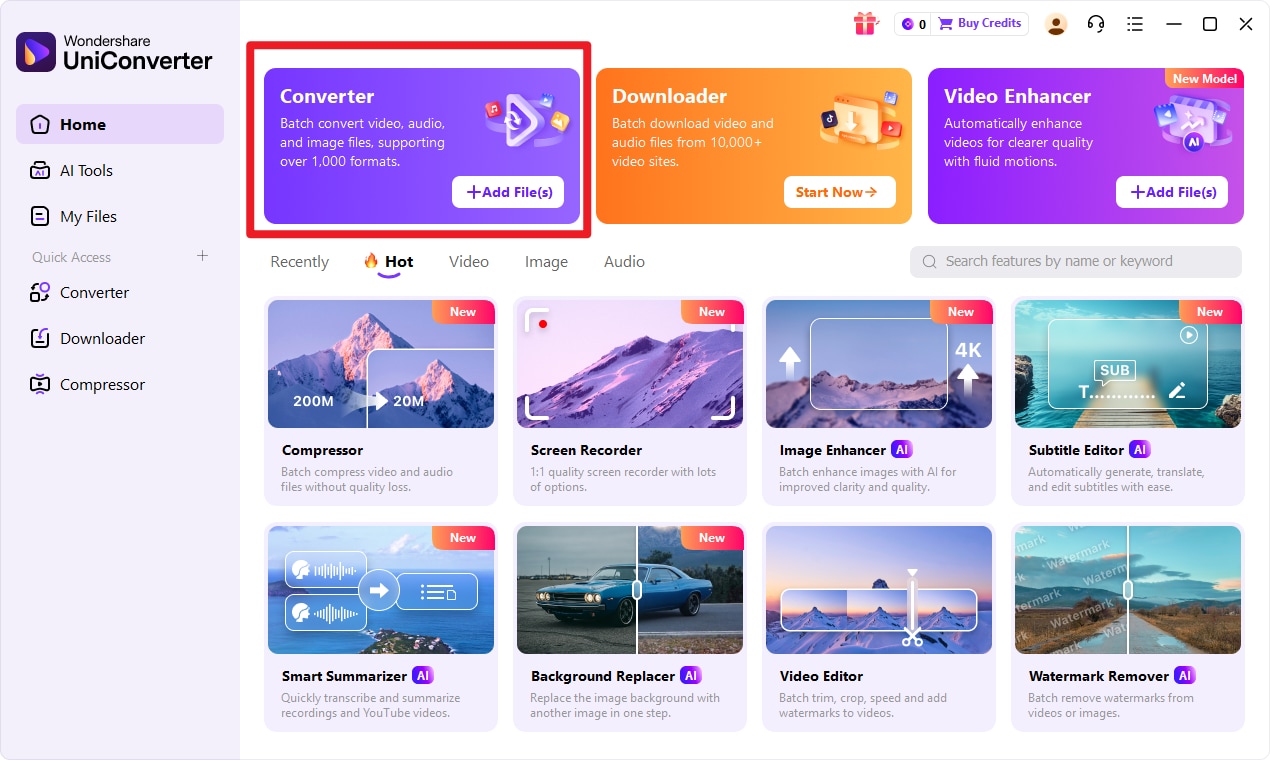
Step 1: Choose Converter in UniConverter
Launch Wondershare UniConverter on your computer. From the main interface, look at the menu on the left side and select the Converter tool to begin.
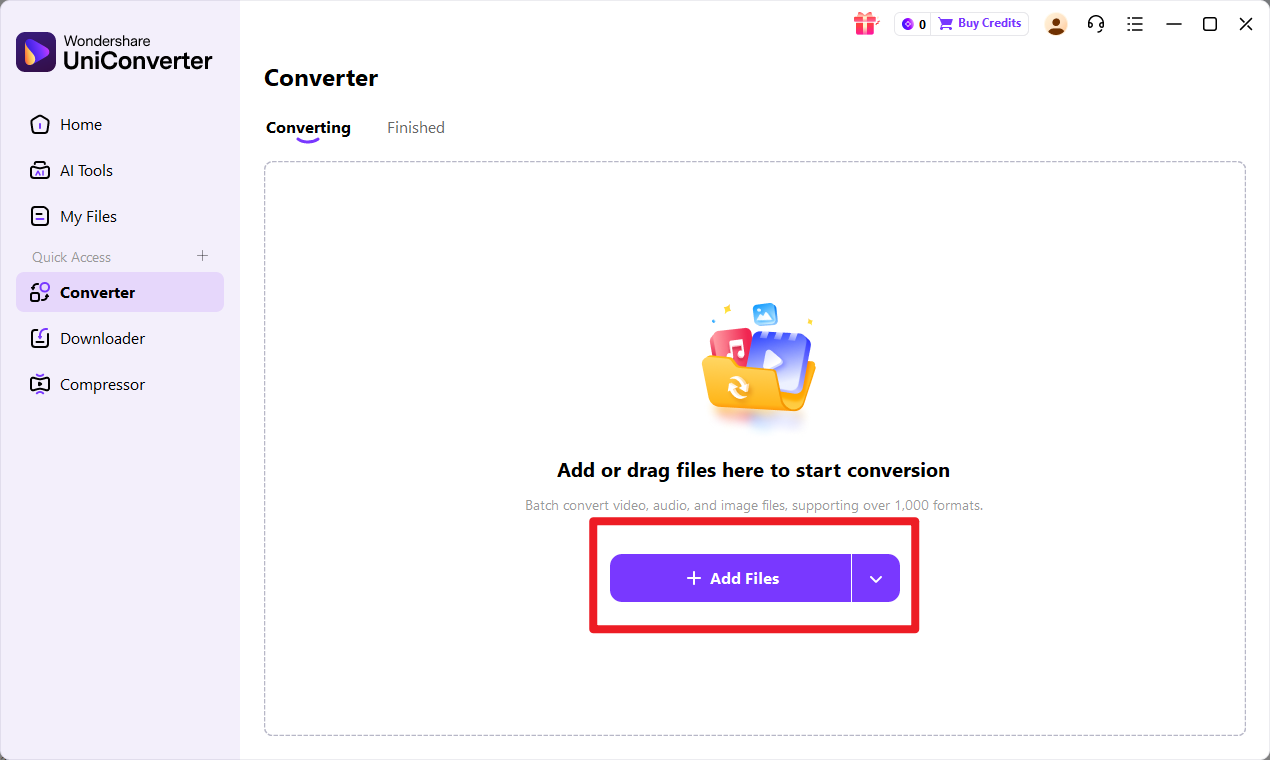
Step 2: Add Files to UniConverter
Next, you need to import your video file. You can simply drag and drop the video file with the input format audio track directly into the UniConverter window. Alternatively, you can click the Add Files icon to open a file browser and select the video you want to fix.
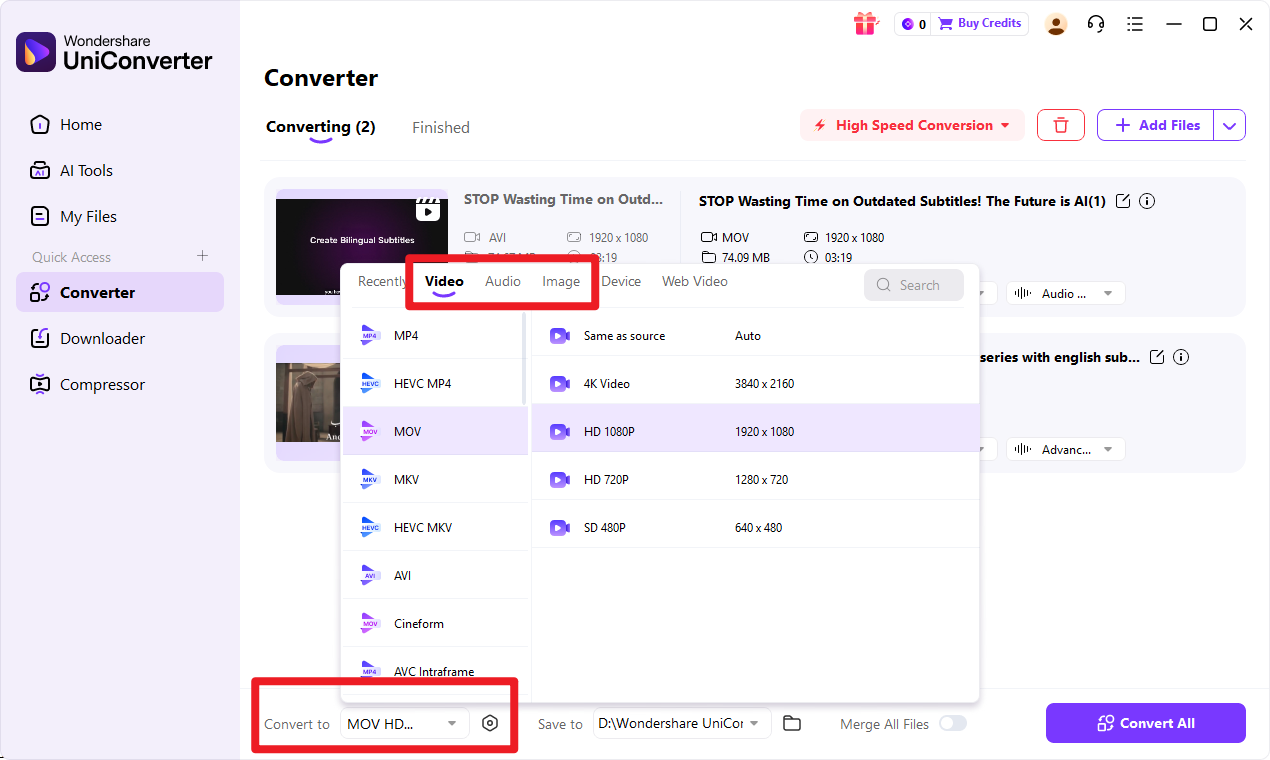
Step 3: Choose Output Format
With your file loaded, click on the Output Format option located at the bottom of the window. This will open a new panel with format options. Go to the Audio tab, and from the list on the left, select the target format as your desired output format. You can also adjust the quality settings on the right if needed.
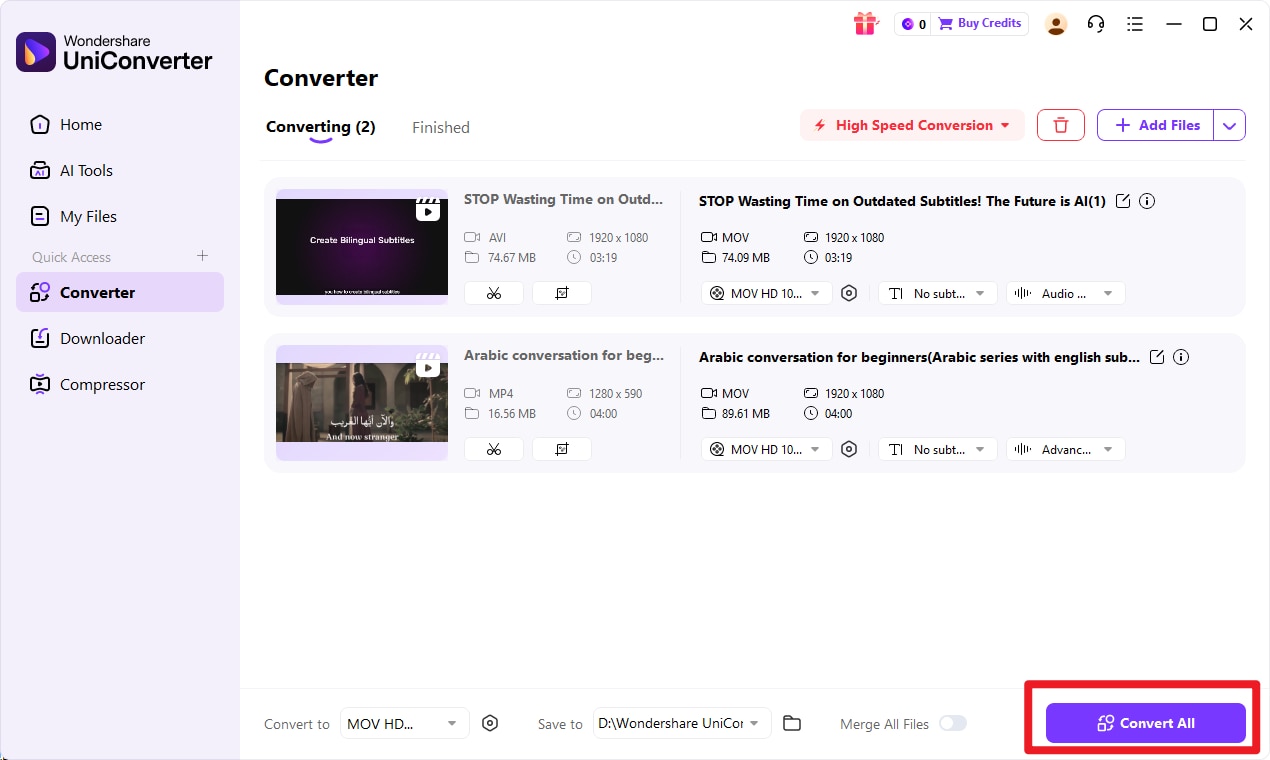
Step 4: Start the Conversion
Finally, choose where you want to save the new file by setting a path under File Location. Once you're ready, click the Start All button. UniConverter will quickly process your file, converting the audio track while leaving the video untouched.

Your All-in-One Video and Audio Toolkit
Conclusion
In the AAC vs AC3 debate, there is no single winner, only the right tool for the right job. AAC is the modern, efficient codec that reigns supreme in the world of streaming and mobile devices, offering excellent quality at low file sizes. AC3, or Dolby Digital, remains the deeply entrenched standard for 5.1 surround sound in home theater systems, guaranteeing compatibility with decades of A/V hardware. The best format ultimately depends on your playback device and your specific needs.
For users who encounter the frustrating "no sound" issue, the cause is almost always an AC3 audio track on a device that doesn't support it. In these situations, resolving the conflict is simple. By using a powerful and user-friendly tool like Wondershare UniConverter, you can effortlessly convert the audio to the universally compatible AAC format, ensuring your movies and videos play perfectly everywhere, every time.
FAQs
-
1. Is AAC higher quality than AC3?
At identical bitrates, AAC generally offers better, more transparent audio quality due to its more advanced and efficient compression algorithm. However, for its intended purpose of multi-channel home theater audio, AC3 is a robust and widely supported standard that delivers a high-quality cinematic experience. -
2. Why does my video have no sound on my Mac?
This common problem usually occurs because the video file's audio track is encoded in AC3. macOS and its default media player, QuickTime, do not natively support the AC3 codec. To fix this, you need to convert the audio track to a compatible format like AAC. -
3. Will I lose audio quality when converting from AC3 to AAC?
Since both AC3 and AAC are lossy formats, any conversion from one to the other is technically a "re-compression" where some data is lost. However, when using a high-quality professional converter like Wondershare UniConverter and selecting a high bitrate for the output AAC file, any degradation in quality will be imperceptible to the human ear. -
4. Which format has a smaller file size?
Due to its higher compression efficiency, an AAC file will typically be smaller than an AC3 file of similar perceived audio quality. This allows AAC to deliver great sound while saving storage space and bandwidth, which is why it's preferred for streaming and mobile devices.
