
When you're about to stream a movie, download a video, or upload your latest creation, you're often faced with a choice: 720p or 1080p? This decision can impact everything from your viewing experience to your data plan. While it might seem like a minor technical detail, understanding the difference between these two resolutions is key to getting the best balance of quality and performance for your specific needs. The 720p vs 1080p debate isn't about finding a single "best" option, but about finding the right option for you.
This guide will demystify video resolution. We'll break down what 720p and 1080p actually mean, compare them directly, and provide clear guidance on when to use each one. Whether you're a casual viewer, a content creator, or a gamer, you'll leave with the knowledge to make the perfect choice every time.
In this article:
Part 1. What is 720p? What is 1080p?
Before we can compare 720p and 1080p, it's essential to understand what these terms represent. At their core, they describe the resolution of a video, which refers to the number of tiny dots, or pixels, that make up the image on your screen. Think of pixels as the building blocks of a digital image; the more blocks you have, the more detailed and clearer the picture can be.
What is 720p (HD)?
720p is often referred to as standard High Definition or simply "HD." It was a significant leap forward from the old Standard Definition (SD) formats and became the benchmark for high-quality video for many years.
A 720p resolution means the image is composed of 1280 pixels horizontally and 720 pixels vertically. If you multiply these two numbers (1280 x 720), you get a total of 921,600 pixels that make up each frame of the video.
The "p" in 720p stands for "progressive scan." This is a method of displaying, storing, or transmitting moving images in which all the lines of each frame are drawn in sequence. This is in contrast to the older "interlaced" (i) method, which drew the odd and even lines separately. Progressive scan results in a smoother, more stable picture with less flicker, which is crucial for fast-moving scenes in movies and sports.
What is 1080p (Full HD)?
1080p is known as "Full High Definition" or "Full HD." As the name suggests, it represents a higher level of detail and quality than standard HD. Today, 1080p is the most common resolution for a wide range of content, from broadcast television to Blu-ray discs and online streaming platforms.
A 1080p resolution consists of 1920 pixels horizontally and 1080 pixels vertically. Multiplying these figures (1920 x 1080) gives you a total of 2,073,600 pixels. This is more than double the number of pixels found in a 720p image, which is a substantial increase.
Like 720p, the "p" in 1080p also stands for progressive scan. This ensures that every frame is rendered fully, providing a crisp, clean, and fluid visual experience without the motion artifacts that can sometimes plague interlaced formats.
Key Differences at a Glance
While both are considered high definition, the primary distinction lies in the amount of visual information they contain.
- Pixel Count: The most significant difference is the pixel density. 1080p packs over two million pixels into the frame, whereas 720p has just under one million. This higher pixel count allows 1080p to render finer details, sharper lines, and a more realistic image overall.
- Common Names: To avoid confusion, the industry uses distinct names. 720p is universally known as "HD" or "Standard HD," while 1080p is called "Full HD" to signify its superior quality. This simple naming convention helps users quickly identify the level of quality they can expect.
Part 2. Quick Comparison Table
To make the differences even clearer, here is a side-by-side comparison of the key specifications and characteristics of 720p and 1080p resolutions. This table serves as a quick reference to help you understand the trade-offs at a glance.
| Feature | 720p | 1080p |
| Common Name | HD, Standard HD | Full HD |
| Resolution | 1280 x 720 pixels | 1920 x 1080 pixels |
| Total Pixels | Approx. 921,600 | Approx. 2,073,600 |
| Image Quality | Good | Excellent |
| File Size | Smaller | Larger |
| Bandwidth Usage | Lower | Higher |
Part 3. 720p vs 1080p: Which One Is Better?
The question of which resolution is "better" is not as simple as it seems. While 1080p is technically superior in terms of pixel count, the best choice for you depends on a variety of factors, including your screen size, internet speed, and storage capacity. Let's break down the comparison across three critical areas.
Image Quality and Detail
When it comes to pure visual fidelity, 1080p is the clear winner. With more than twice the number of pixels as 720p, it can display a much sharper, clearer, and more detailed image. Textures are more defined, edges are smoother, and the overall picture feels more immersive and lifelike.
This difference is most apparent on larger screens. If you're watching on a big-screen TV (e.g., 40 inches and above) or a high-resolution computer monitor (e.g., 24 inches and above), the extra pixels in a 1080p video make a significant and easily noticeable impact. The image will look crisp and clean, whereas a 720p video might start to look a bit soft or "pixelated" as it's stretched to fill the larger display.
However, on smaller screens, such as those on smartphones or small tablets, the story changes. The human eye has a limited ability to perceive fine detail, and on a compact screen, the pixels are packed so densely that it can be very difficult, if not impossible, to tell the difference between 720p and 1080p from a normal viewing distance.
File Size and Storage
The higher quality of 1080p comes at a cost: file size. Because a 1080p video contains more than double the pixel information of a 720p video, its file size is correspondingly larger. As a general rule, a 1080p video file will be roughly twice the size of a 720p video of the exact same length and encoding settings.
This is a crucial consideration if you're dealing with limited storage space. If you're downloading movies to a smartphone, tablet, or laptop with a small hard drive, choosing 720p can allow you to store twice as much content in the same amount of space. For content creators, rendering and storing master files in 720p can also significantly reduce the demand on hard drives and cloud storage accounts.
Bandwidth and Streaming
File size is directly related to the amount of internet bandwidth required to stream content smoothly. Since 1080p files are larger, they require a faster and more stable internet connection to stream without constant buffering or interruptions. Most streaming services like Netflix and YouTube recommend a connection speed of at least 5 Mbps for a reliable 1080p stream.
On the other hand, 720p is much more forgiving. Its lower data requirement (typically needing around 2.5 Mbps) makes it the ideal choice for users with slower internet connections. It's also the perfect setting for streaming on a mobile data plan. Choosing 720p can help you avoid frustrating buffering wheels and prevent you from burning through your monthly data allowance too quickly. If you frequently experience lag or your video quality keeps dropping automatically, switching to 720p can provide a much smoother and more consistent viewing experience.
Part 4. Use Cases for 720p and 1080p
The best resolution is the one that fits the situation. Understanding the practical applications of each will help you make the right choice every time. Here's a breakdown of when to opt for 720p and when to go with 1080p.
When to Choose 720p
720p is the champion of efficiency, offering a great balance of quality and resource management. It's the perfect choice in the following scenarios:
- Watching on Small Screens: If you're viewing content on a smartphone, a small tablet, or any screen under about 13 inches, your eyes likely won't be able to perceive the extra detail of 1080p. Sticking with 720p will provide a visually identical experience while saving data and battery life.
- Streaming with Slow or Unstable Internet: When your Wi-Fi is struggling or you're in an area with poor connectivity, 720p is your best friend. Its lower bandwidth requirement ensures a smoother stream with far less buffering compared to 1080p.
- Downloading to Save Storage Space: Planning a trip and want to load up your tablet with movies? Choosing 720p versions will allow you to fit significantly more content onto your device. This is also ideal for archiving video files on a computer with limited hard drive space.
- Sharing Videos Quickly: If you need to send a video file via email, a messaging app, or upload it to a platform with size restrictions, the smaller file size of a 720p video makes the process much faster and more convenient.
When to Choose 1080p
1080p is all about maximizing visual quality. When resources aren't a concern, it delivers a superior, more immersive experience. Choose 1080p for these situations:
- Watching on Large Screens: For movie night on your big-screen TV or a deep dive into a project on your large computer monitor, 1080p is a must. The high resolution ensures the image stays sharp, detailed, and beautiful, even on expansive displays.
- Gaming for Visual Fidelity: Modern games are visual masterpieces. To appreciate all the intricate details and textures the developers intended, playing in 1080p (or higher) is the way to go. It provides a more immersive and visually stunning gameplay experience.
- Creating Professional-Looking Content: If you're a YouTuber, vlogger, or any kind of video creator, recording and exporting in 1080p should be your standard. It signals a higher production value to your audience and ensures your content looks crisp and professional on the wide variety of screens it will be viewed on.
- When You Have Ample Resources: If you have a fast, unlimited internet plan and plenty of storage space, there's little reason not to choose 1080p. You can enjoy the best possible quality without worrying about data caps or running out of room.
How to Change Video Resolution
What if you have a file in the "wrong" resolution for your needs? For example, you might have a large 1080p video that you need to send to a client, but it's too big to email. Or perhaps you have a 720p clip that needs to be part of a 1080p project.
In these situations, a video converter becomes an essential tool. It allows you to change the resolution of a video file, upscaling it (e.g., 720p to 1080p) or downscaling it (e.g., 1080p to 720p). For reliable and high-quality resolution changes, we recommend using a dedicated tool. Wondershare UniConverter stands out as an excellent choice for this task, allowing you to easily change video resolution without a noticeable loss in quality, thanks to its advanced conversion engine.
Part 5. Step-by-Step Guide to Convert 720p to 1080p Using UniConverter
If you need to upscale your 720p video to 1080p for a project or specific display, UniConverter makes the process simple. Follow these four easy steps.
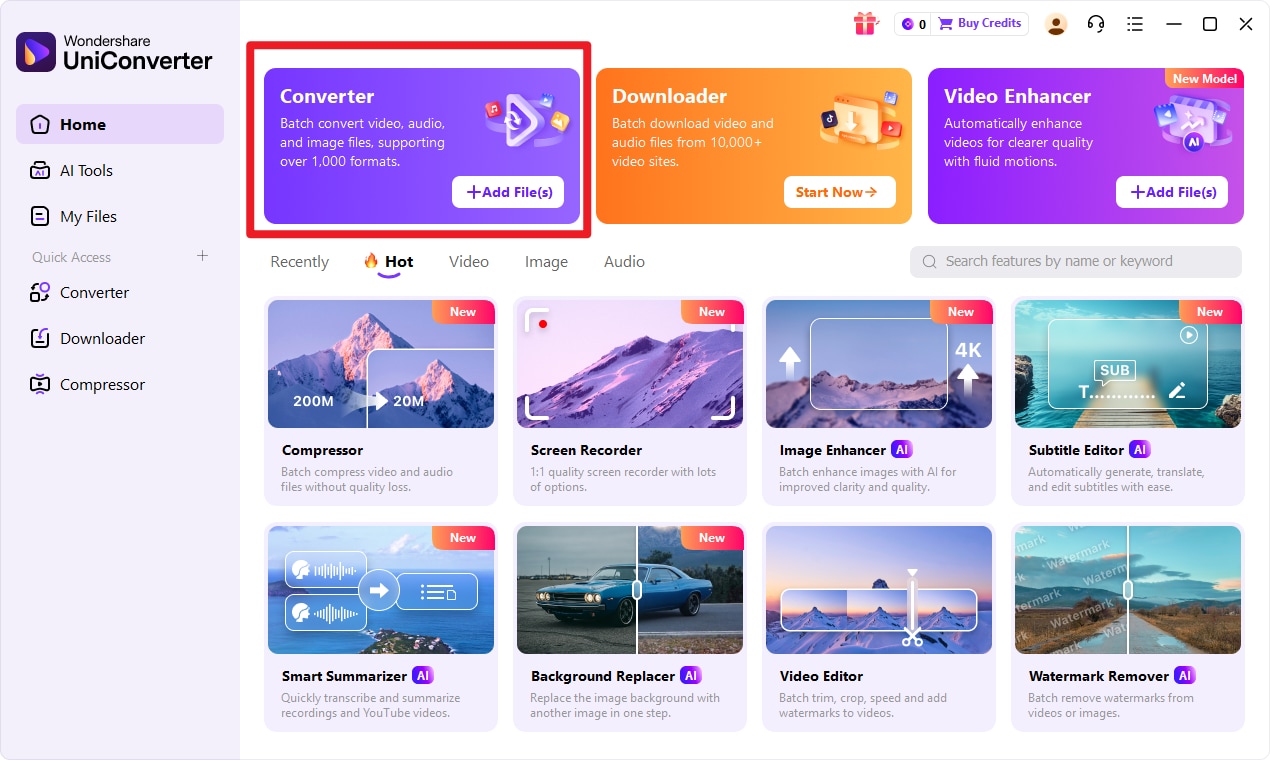
Step 1. Choose Converter in UniConverter
Launch Wondershare UniConverter on your computer. From the main screen, navigate to the left-side menu and select the Converter tool to open the conversion interface.
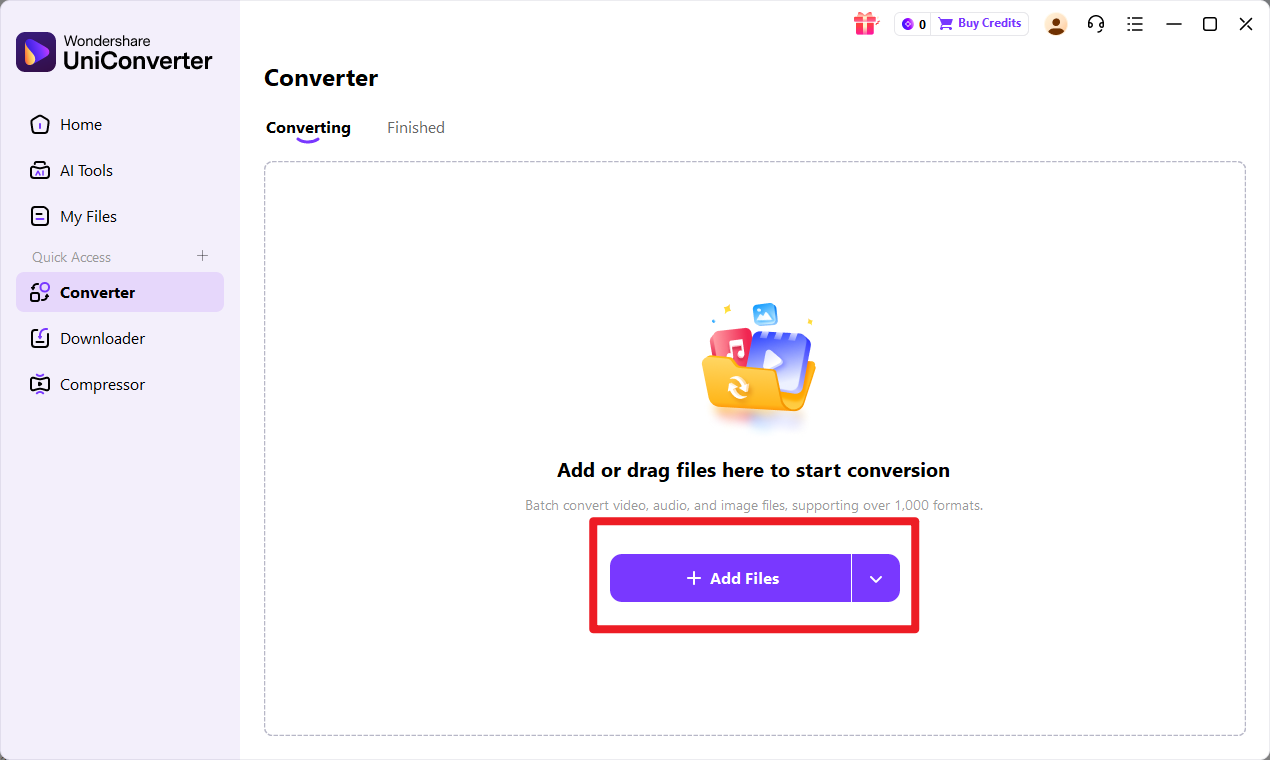
Step 2. Add Files to UniConverter
Click the Add Files button in the top-left corner or simply drag and drop your 720p video file directly into the center of the window. You can add multiple files to convert them in a batch.
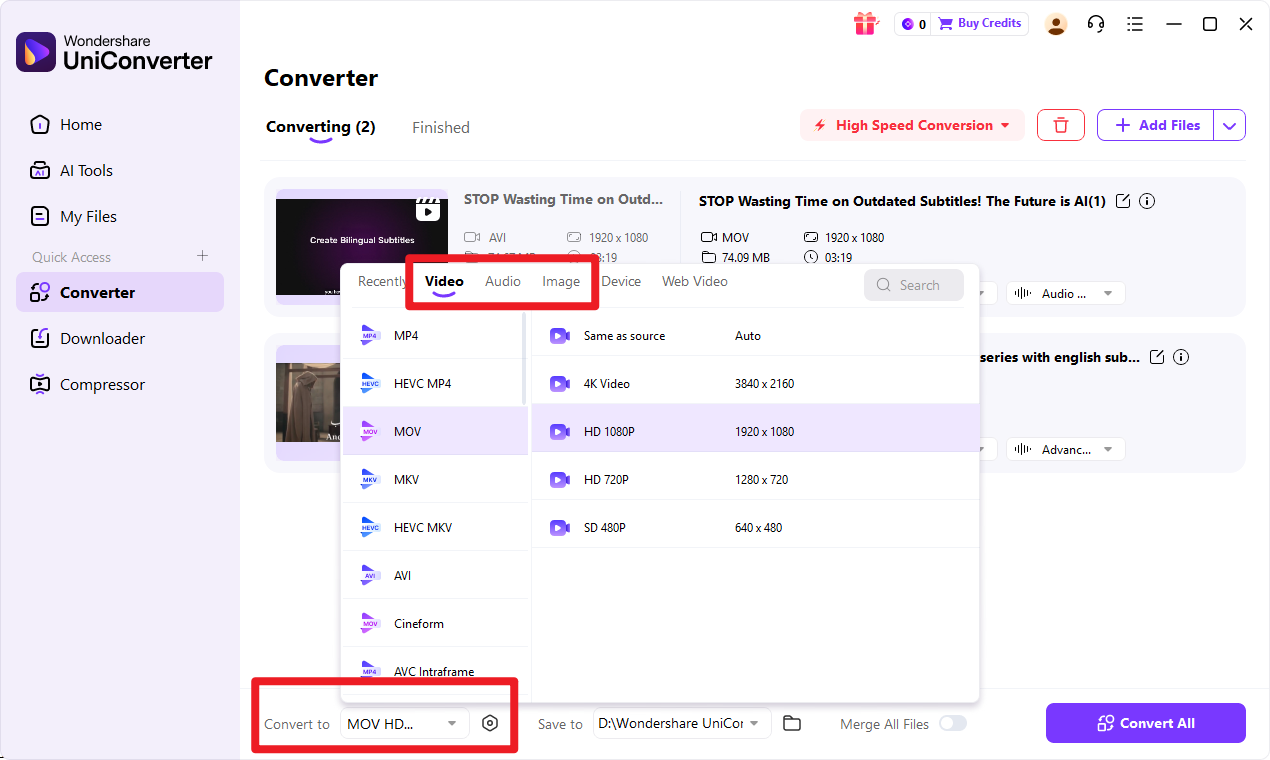
Step 3. Choose Output Format
At the bottom of the window, click on the Output Format menu. A new window will pop up. Go to the Video tab, select your desired target format (like MP4) from the list on the left, and then choose the 1080p resolution from the presets on the right.
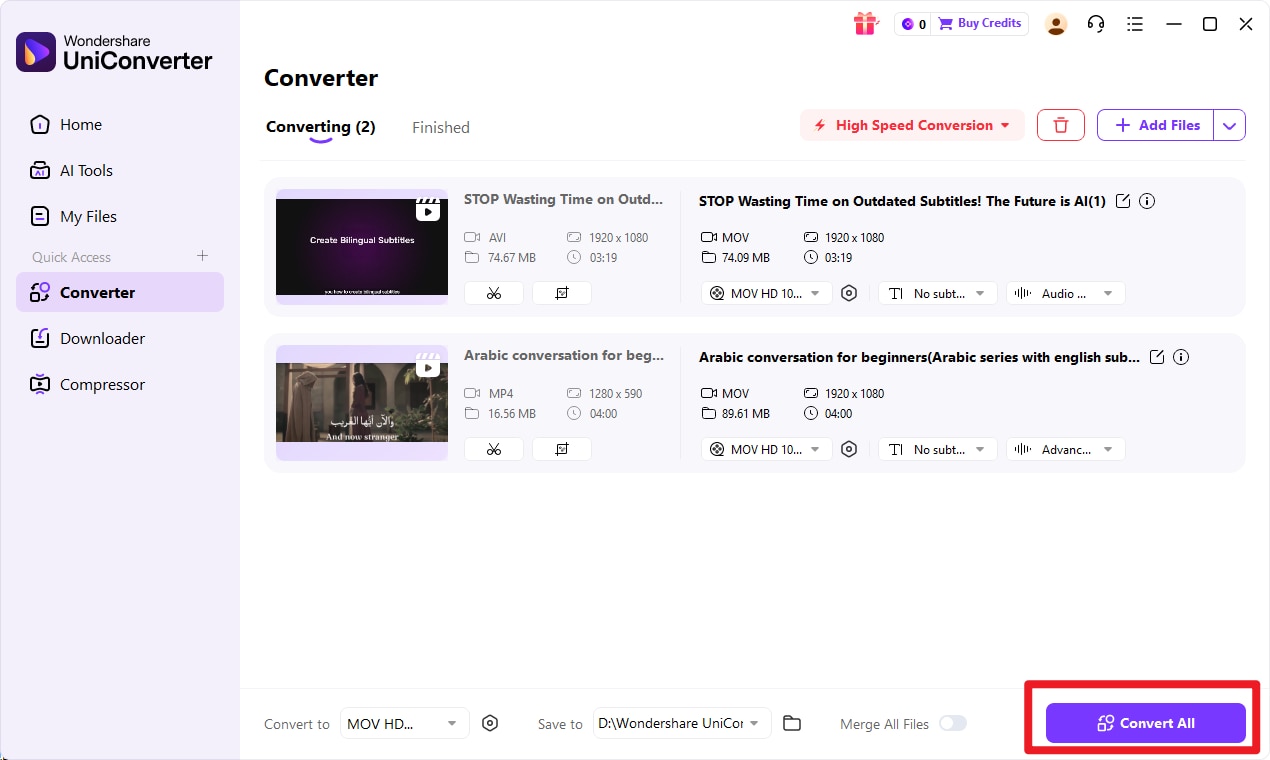
Step 4. Start the Conversion
Before converting, you can select a destination for your new file by using the File Location option at the bottom. Once you're ready, click the Convert button next to the file (or Start All if you're converting multiple videos). UniConverter will quickly process and save your upscaled 1080p video.

More Than Just a Video Upscaler
Conclusion
The choice in the 720p vs 1080p debate ultimately comes down to context. There is no single answer that fits every scenario. 1080p (Full HD) offers undeniably superior image quality, with sharper details and a more immersive picture that shines on large screens. It is the best choice when visual fidelity is your top priority and you have the bandwidth and storage to support it. On the other hand, 720p (HD) provides an excellent compromise, delivering good quality that is often indistinguishable from 1080p on smaller screens while being far more efficient with your data and storage space.
By understanding the trade-offs between quality, file size, and bandwidth, you can make an informed decision that best suits your device, your internet connection, and your viewing habits. And for those times when you need to bridge the gap between resolutions, a versatile tool like Wondershare UniConverter is invaluable. It gives you the power to effortlessly convert your videos, ensuring they are perfectly optimized for any platform or purpose.
FAQs
-
1. Is 1080p always better than 720p?
Not always. While 1080p has a higher technical quality due to more pixels, 720p is the "better" choice in many practical situations. For example, 720p is superior for streaming on a slow internet connection, saving storage space on a mobile device, or when viewing on a small smartphone screen where the quality difference is not apparent to the naked eye. -
2. Can my eyes tell the difference between 720p and 1080p?
This depends heavily on two factors: screen size and viewing distance. On a 55-inch TV viewed from a couch a few feet away, the extra sharpness and detail of 1080p are clearly visible. However, on a 6-inch smartphone screen held at a normal arm's length, the pixels are already so dense that it becomes very difficult for most people to distinguish between the two resolutions. -
3. Does converting 720p to 1080p improve quality?
No, converting a 720p video to 1080p, a process known as "upscaling," does not magically create new detail or improve the original source quality. It essentially stretches the existing 921,600 pixels to fit a frame of over 2 million pixels. This can sometimes result in a slightly softer or less sharp image. However, a high-quality conversion tool like UniConverter uses advanced algorithms to perform this upscaling process as cleanly as possible, minimizing any potential quality degradation. -
4. How much bigger is a 1080p file than a 720p file?
As a general rule of thumb, a 1080p video file is approximately twice the size of a 720p file of the same length and with the same compression settings. This is because it contains more than double the pixel data. This ratio can vary slightly based on factors like the video's content (e.g., high-action vs. static scenes) and the specific codec and compression level used during encoding.
